A resource hub dedicated to this major composer and organist of the German Baroque, this page brings together background, works and reference recordings. You will find clear guides to organ genres, analyses and listening suggestions.
Context: although he belongs to the world of Lutheran church music and the Baroque scene, the musician is often reduced to the Canon. Here, we broaden the view to chorales, fugues, toccatas and partitas to appreciate the breadth of his work for this instrument.
Focus: the emphasis is on stops, temperaments and historic instruments. Readers learn to distinguish the sounds of the organs of Gotha, Erfurt and Ottobeuren, and to choose performances suited to each acoustic setting.
There are also practical summaries: listening guides, structural pointers (bass lines, voices and repetitions) and recording recommendations that go beyond the Canon alone.
Why a resource hub on Pachelbel and the Baroque organ?
This single starting point connects sources, instruments and places to give a fuller picture of music often reduced to the Canon in D major. The popularity of that piece, reinforced by Paillard’s recording (Erato, 1969), obscures the variety of Pachelbel’s keyboard and organ works.
The aim is simple: look beyond the success of the Canon and offer an overview of the genres, liturgical practices and instruments associated with southern German cities such as Nuremberg, Erfurt and Gotha.
- Bring together biographies, catalogues and discographies so the information is easier to find.
- Explain why choosing between organ and harpsichord changes a piece’s character and articulation.
- Show the importance of acoustics and organ stops in performance.
We offer guided listening, with pointers on the bass, voices and bars that reveal the structure and musical rhetoric. This approach includes work guides, biographical background and a discography, with entries by work, instrument or recording.
| Aspect | Why it matters | Practical example |
|---|---|---|
| Works | Place genres and forms in context | Chorales, fugues, toccatas |
| Instruments | Compare sounds and registrations | Erfurt organs and an urban harpsichord |
| Guided listening | Understand musical structure | Analyses of the bass and voices |
To learn more about this famous work, read about the Canon in D major, then explore our guides to go much further.
Pachelbel, organist in cities and churches: biographical background
The composer’s career shows how strongly cities and churches shaped his art. Born in Nuremberg in 1653 and dying there in 1706, Johann Pachelbel studied at Altdorf and then at the Gymnasium Poeticum in Regensburg.
His first posts took him to St Stephen’s in Vienna (1673) and then to the court at Eisenach (1677), where he became acquainted with Ambrosius Bach. In 1678, he joined Erfurt’s Predigerkirche, before periods in Stuttgart (1690) and Gotha (1692).
His return to St Sebald’s in Nuremberg (1695–1706) marked the high point of his career. His organ output includes chorales, Musikalische Sterbengedanken (1683), Musikalische Ergötzung (1691) and Hexachordum Apollinis (1699).
Networks and influences
His connections with the Bach family and Lutheran circles encouraged the exchange of repertoire. The 95 Magnificat fugues (in eight tones) show a practical style of writing, often making limited use of the pedals, designed for liturgical services.
His private life also affected his path: the plague of 1683 took the life of his wife, Barbara Gabler; in 1685 he married Judith Drommer. These events are documented in biographical notes and the music dictionary.

Baroque organ stops in Pachelbel: forms, styles and uses
Common forms—chorales, preludes, toccatas and chaconnes—make up a repertoire intended for worship and teaching. These pieces establish the key of a hymn, replace or alternate with a chorale, and mark moments in the liturgy.
Chorales and partitas
Ornamented chorales: the cantus firmus often appears in the soprano or tenor. The imitative writing interweaves voices that support the liturgical text.
Preludes, toccatas and fugues
The stylus phantasticus remains restrained here. The preludes favour clearly perceptible bars and musical rhetoric. The fugues have a teaching character: economy of means and effective counterpoint.
Chaconnes, passacaglias and the Magnificat
Chaconnes use an ostinato bass to build successive variations. The bass line helps listeners hear the recurring cycle of bars.
The 95 Magnificat fugues, arranged across eight tones, have an apparent simplicity. They establish the tone and make it easier to alternate with singing.
| Form | Role | Character | Typical registration |
|---|---|---|---|
| Chorale / Partita | Accompaniment for singing | Imitative, measured | Flute stops, light mixtures |
| Prelude / Toccata | Introduction / freedom | Clear, measured | Principals, light reeds |
| Chaconne / Passacaglia | Variations on a bass line | Repetitive, dramatic | Foundation stops, 8-foot and 16-foot stops |
| Magnificat fugues | Liturgical function | Simple, instructive | Balanced registration |
Hexachordum Apollinis: keyboard variations for organ, harpsichord and clavichord
Hexachordum Apollinis explores the flexibility of the keyboard through pieces suited to several instruments. Published in 1699, the collection contains six Ariae with variations and two Ciacona, expressly written “for several instruments.”

Design and instruments
This work reuses thematic material whose colour changes with the instrument. On the organ, the keyboard favours resonance and legato. The harpsichord brings out attack and dance rhythms. The clavichord allows more intimate dynamic shading and inflections of pitch.
Listening pointers
To follow the Ariae, identify the opening theme, observe how the figures develop and note the cyclical pattern of the variations. The two closing Ciacona rest on an ostinato bass, often in G minor and then transformed into G major.
Notable recordings
Listen to John Butt (modern organ, mellow sound), Wolfgang Rübsam (lautenwerk), Huguette Grémy-Chauliac (Dowd harpsichord) and Wim Winters (clavichord). Compare articulation, tempos and ornaments to hear how the work changes from one performance to another.
| Instrument | Character | What to listen for |
|---|---|---|
| Modern organ | Resonant, legato | Registration, sustained sound |
| Harpsichord / lautenwerk | Crisp, dance-like | Attack, ornaments |
| Clavichord | Intimate, expressive | Shading, exploration of tempo |
For historical context and background, read the biographical entry.
Canon and Gigue in D major: continuo, two-bar entries and 12 variations
Pachelbel’s Canon combines imitation with an ostinato bass. Composed around 1680 for three violins and continuo, the piece rests on a simple harmonic ostinato. Its repetition creates tension that drives twelve successive variations.

Structure
The canon unfolds with a delay of two bars: three voices enter in succession with the same motif. The ostinato bass comprises eight quarter notes and returns 28 times.
Continuo and progression
The continuo sets out the harmonic sequence I–V, VI–III, IV–I, IV–V. This progression sustains harmonic continuity between bars and supports the variations.
Listening, tempo and gigue
Group the 12 variations by their rhythmic patterns: quarter notes, eighth notes, sixteenth notes and thirty-second notes. Their character changes with the tempo, from ceremonial to lively. The closing gigue, in 12/8, carries the dancing momentum forward.
Reception and arrangements
The Paillard effect (1969) popularised Pachelbel’s Canon and led to numerous arrangements for strings, keyboards and mixed ensembles. Canon and Gigue can now be heard in many popular settings.
| Element | Role | Note |
|---|---|---|
| Canon | Imitation between three voices | Entries every two bars |
| Continuo | Harmonic ostinato | Eight quarter notes, repeated 28 times |
| Gigue | Dance-like conclusion | 12/8 metre, rhythmic energy |
Johann Pachelbel at the organ: Baroque organ stops
This overview connects musical forms, registration practice and questions of temperament.
Overview of the organ works
The keyboard repertoire includes chorales and partitas, the collections Musikalische Sterbengedanken (1683) and Choräle zum Präambulieren (1693), and the 95 Magnificat fugues. These pieces served worship and teaching.
Writing, stops and practical approach
The writing favours clear individual voices and a distinct bass line. For performers, choosing foundation stops (flutes and principals) and adding restrained reeds helps bring out the cantus firmus.
Use precise articulation to keep the counterpoint clear in a church acoustic.
Pitch and temperaments
Practice shifted from meantone temperament towards temperaments closer to equal temperament. This development changes the character of different keys and informs registration choices.
| Element | Effect | Practical advice |
|---|---|---|
| Chorales / Partitas | Support for singing | 8-foot flute stops, light mixtures |
| Fugues (Magnificat) | Liturgical and teaching function | Moderate use of pedals, balanced registration |
| Free pieces (preludes, toccatas) | Rhythmic freedom | Principals, prominently featured reeds |
Essential recordings compared: organs, harpsichords and performances
The discography offers several routes through the music: complete recordings, cycles, solo performances and chamber interpretations. This short guide helps you choose a starting point according to the instrument, temperament and recording quality.
Complete recordings and cycles
- Centaur (Joseph Payne), Dorian (Antoine Bouchard) and CPO offer broad surveys.
- Delphian (Owens) and Oehms (Kelemen) offer modern, well-documented approaches.
Reference albums
- Olivier Vernet: restrained registration.
- Jozef Sluys: Erfurt’s historic organ and its local colour.
- Werner Jacob: structured, clear interpretations.

- Wolfgang Rübsam: lautenwerk for the Hexachordum.
- Albert Bolliger: Ottobeuren’s spacious acoustic.
- London Baroque and Space Time Continuo: transcriptions and textures for strings and theorbo.
Listening tip: compare a performance on a historic organ, one on a harpsichord and then a chamber interpretation. Listen to the Magnificat, the chaconnes and Musikalische Ergötzung to appreciate the temperament and attack.
| Type | Strength | When to listen |
|---|---|---|
| Complete cycle | Overall view | In-depth discovery |
| Solo-instrument reference | Restraint, registration choices | Comparative study |
| Transcription | New colours | Instrumental alternatives |
Also worth mentioning are recordings noted around June 2019: Erik Feller’s Toccatas on streaming platforms.
Organs, places and construction: the sounds of Pachelbel’s world
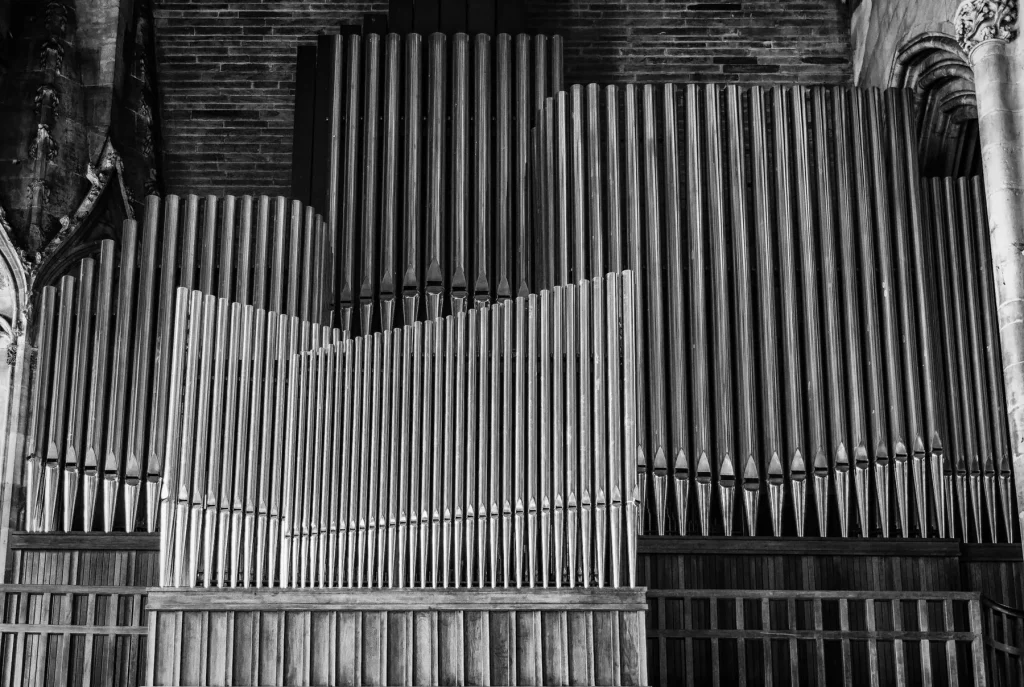
Historic organ cases and modern reconstructions offer very different sound palettes. Gotha’s Margarethenkirche illustrates this contrast with an original case by Weiss (1632) and later work by Schuke (1961) and Waltershausen Orgelbau (2015).
This instrument has four divisions: Brustwerk, Great, Swell and Pedal. The organ offers rich foundation stops (Prinzipal, Gedackt), mixtures and expressive reeds such as the Dulzian and Vox humana.
Gotha’s Margarethenkirche: specification, stops and restorations
The organ combines mechanical key action with pneumatic stop action. The I/II, III/II and I/P couplers allow distinct contrasts. Restoration work has improved the keyboard response and the stability of the stops.
Historic organs in Austria and Germany: registration choices and acoustics
The organs of Sankt-Petri (Stertzing, 1702) and Austrian monasteries provide useful points of reference. In a church, reverberation changes the clarity of attacks and the perception of each bar.
For performers, combining foundation stops with a sesquialtera suits chorales. Carefully balanced mixtures help fugues. Reeds can highlight the bass or a solo line and affect the tempo, ornaments and balance between voices.
“Comparing the same piece on two historic instruments reveals the effect of their sounds and stop layouts.”
| Place | Strength | Listening tip |
|---|---|---|
| Margarethenkirche (Gotha) | Historic case, rich reeds | Compare chorales and fugues |
| Sankt-Petri (Erfurt) | Southern German style | Listen for clarity in the pedal part |
| Austrian organs | Lyrical colours | Notice the temperament and sound |
In short, an organ’s construction guides performance choices and changes how we hear the music. For a practical reference, consult the music dictionary and listen to the same work on two historic organs.
Conclusion
His keyboard music is best explored by comparing several instruments and performances.
The composer remains an important figure in church music: his repertoire is rich, clear and poetic, with deep liturgical roots.
Beyond the famous Canon, explore a few Magnificat pieces, some chaconnes and then a suite. Compare performances on historic organs, harpsichord and clavichord to hear their different colours.
As you listen, identify the bass, count the bars, follow the voices and appreciate the phrasing. Compare a gigue, fugue and chaconne to feel the variety of moods.
This resource hub remains a starting point for further exploration of Johann Pachelbel’s recordings, historic instruments and classical music.