

The ocarina is an ancient musical instrument that is attracting more and more enthusiasts. Compact and melodic, it is ideal for beginners who want to learn to play without difficulty. Within a few weeks, you can play your first melodies.
This guide was designed to accompany every new musician step by step. Whether you are young or older, this instrument is for everyone. For example, Jean, 72, started playing and corrected his mistakes in just three weeks with the help of a tuner.
Learning the ocarina has many benefits. It can improve coordination and concentration in a short time. This guide will help you choose a suitable model, master the basics and care for your instrument.
Follow this path to discover a fascinating musical world and enjoy making progress.
What is an ocarina? An introduction to this wind instrument and why you might learn to play it
The world of musical instruments is full of treasures, and this captivating wind instrument is certainly one of them. The ocarina, whose origins date back to the Mayan and Aztec civilizations, has crossed centuries and cultures. Originally used in sacred rituals, it evolved into a modern art object and was popularized by Giuseppe Donati in 1853.
This historical development led to a variety of ocarinas. Several types exist today, including the 12-hole model. It is particularly popular with beginners because it can produce a wide range of melodies. Its range of about an octave and a half is ideal for playing different pieces.
Origins and history of the ocarina
The earliest traces of the ocarina are found in ancient civilizations, where it was used for rituals and celebrations. Its design evolved over the centuries, incorporating modern elements while retaining its traditional character. Thanks to craftspeople such as Donati, the ocarina became standardized and more accessible.
Its distinctive sound and appeal to beginners
What makes the ocarina so appealing is its ability to produce soft, ethereal sounds. Compared with other instruments, such as the flute or piano, it offers a quick introduction to playing music. Beginners appreciate its compact size and intuitive shape, which make it easy to hold.
Why choose a 12-hole ocarina from the available models?
The 12-hole model is often recommended for newcomers. It offers a good balance between ease of learning and musical range. By covering and uncovering its holes, you can explore a variety of notes and quickly produce pleasing sounds.
The ocarina is also extremely portable. Whether you are traveling or at home, you can practice almost anywhere. This turns idle moments into opportunities for musical expression. Many enthusiasts say that the instrument crosses cultural boundaries and makes music accessible to everyone.
Finally, playing the ocarina may also be relaxing. In keeping with the philosophy of healing sounds, the instrument can be used for relaxation and well-being. It is therefore an appealing choice for anyone who wants to combine musical enjoyment with personal well-being.
| Type of ocarina | Features | Benefits |
|---|---|---|
| 12-hole ocarina | Range of an octave and a half | Easy to learn |
| Transverse ocarina | Ergonomic design | Varied sounds |
| Pendant ocarina | Greater portability | Ideal for travel |
In short, the ocarina is a fascinating instrument worth discovering. Whether you are a beginner or an experienced musician, it offers many musical possibilities. To learn more about how it works, read this article.
How to choose a 12-hole ocarina: a complete guide to getting started
Choosing the right instrument can greatly influence your musical experience. Beginners should understand the different types of ocarina available. This will help you make an informed choice based on your preferences and skill level.
Types of ocarina: transverse, pendant and multichamber
There are several types of ocarina. The transverse model, with 10 to 12 holes, is well suited to adults. It offers a wide range of notes and lets you explore different melodies.
By contrast, the pendant ocarina, which has only 4 to 6 holes, is better suited to children. Its compact size makes it easy to hold. For advanced musicians, multichamber ocarinas provide more notes, but they are generally more expensive and bulkier.
Materials: the advantages and disadvantages of plastic and ceramic
The choice of material also matters. Ceramic, for example, produces a warm, rich sound, but it is fragile. Handle it carefully.
Plastic models, on the other hand, are durable and lightweight. They are ideal for beginners who worry about accidental drops. Although their sound may be less rich, they offer adequate quality for learning.
Recommended registers for beginners: soprano, alto and bass
An alto ocarina in C is often recommended for beginners. It offers an excellent balance, has a pleasant middle register and suits most available sheet music.
It is also useful to know about soprano and bass ocarinas. Each affects the sound produced and the level of difficulty. Avoid untuned Peruvian ocarinas, however, which are often more decorative than functional.
In summary, choosing the right ocarina model depends on several factors, including your level, budget and musical preferences. Read reviews and listen to examples online to get a sense of how each model sounds before making your choice.
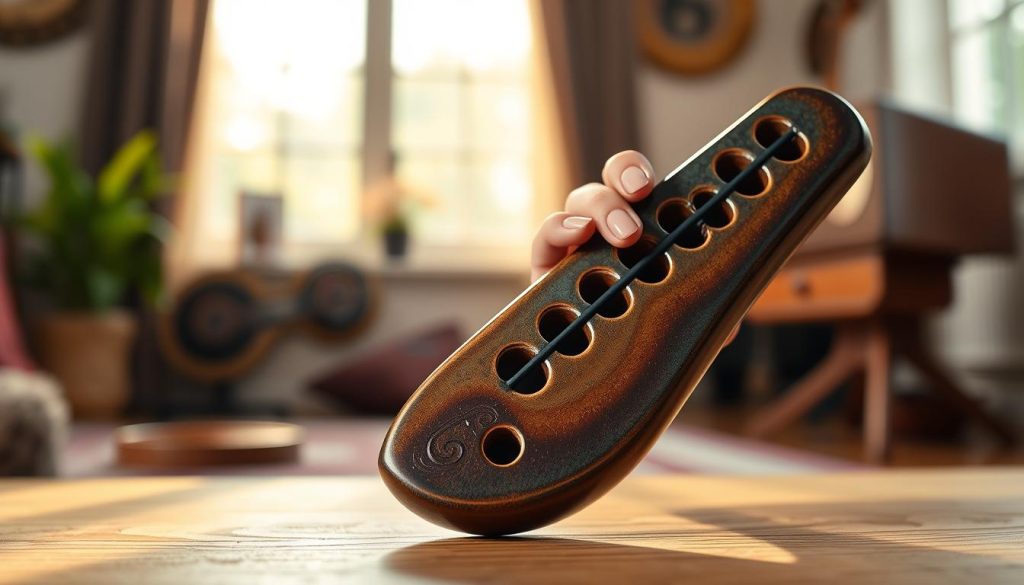
Getting started: how to hold your ocarina and blow into it
To begin playing this fascinating instrument, you need to master the fundamentals. A comfortable grip helps you play smoothly. Here are the basics of holding your ocarina and blowing into it.
Good posture for comfortable, effective playing
Stand upright with your feet firmly planted on the floor, like a tree. This position makes breathing easier and improves stability. Good posture is important for playing well. It helps you control your breath and produce a clear sound.
Hand and finger placement on a 12-hole ocarina
To position your hands correctly, follow these steps:
- Place your left index finger over hole 1
- Place your left middle finger over hole 2
- Place your left ring finger over hole 3
Make sure your fingers fully cover the holes to prevent air leaks. This is essential for producing clear notes at the correct pitch.
Mastering breathing and airflow
Place the mouthpiece against your lips firmly, without pressing too hard. Moderate lip pressure helps prevent unwanted whistling. Use diaphragmatic breathing: inhale deeply through your nose and exhale slowly through your mouth. This will help you manage the air you blow into the instrument.
To control your breath, try the candle exercise. Blow gently enough to make the flame flicker without putting it out. This will help you develop your breath control.
Check your position in a mirror to correct mistakes and make sure your fingers cover the holes without letting air escape. Poor breath control can affect both pitch and clarity. Practice these basics regularly, as they form the foundation of enjoyable playing.
Finally, avoid blowing too hard or too softly. These mistakes are common among beginners, but a few practice sessions will help you correct them.
| Aspect | Advice |
|---|---|
| Posture | Stand upright with your feet firmly planted on the floor |
| Finger placement | Index finger on hole 1, middle finger on hole 2, ring finger on hole 3 |
| Mouthpiece | Use moderate lip pressure |
| Breathing | Use diaphragmatic breathing |
| Exercise | Blow on a candle without putting it out |
To learn more, read this article about playing techniques.
Learning basic fingerings on a 12-hole ocarina
Mastering the fingerings of this instrument is an essential step for every beginner. The instrument’s holes are numbered from 1 to 6, starting at the bottom. This numbering system helps you remember finger positions and read tablature.
The hole numbering system and how it helps
Each ocarina hole has a specific function. Here are a few tips to help you remember their positions:
- Hole 1 is the lowest, and hole 6 is the highest.
- Use memory aids to remember these positions.
This approach will help you progress more quickly and play your first melodies with ease.
Essential fingerings for the main notes
To play the C major scale, begin by covering all the holes to produce middle C. Then follow these steps:
- For D, leave hole 1 open.
- For E, leave holes 1 and 2 open.
- For F, cover every hole except hole 2.
- For G, cover every hole except hole 3.
- For A, cover every hole except hole 4.
- For B, cover every hole except hole 5.
These fingerings will help you produce the main notes of the scale. Practice regularly to develop muscle memory.
How to avoid air leaks and produce clear notes
Air leaks are a common problem for beginners. Try these tips:
- Cover the holes with the pads of your fingers, not your fingertips.
- Use a mirror to check your finger placement.
- To improve your intonation, download the OcarinaTuner app, which can help you check each note.
Practice moving between neighboring notes while coordinating your breath and finger movements. This will make your playing smoother.
You can also use simple tablature, which marks the holes to cover with filled and empty circles. This will make learning easier.
To put your new skills into practice, download free sheet music from this ocarina music library. Playing simple, engaging melodies will help reinforce your fingerings.
Essential scales for making quick progress
Musical scales are essential for progressing quickly on an instrument. The C major scale is particularly important. It follows the sequence C-D-E-F-G-A-B-C. This simple pattern will help you become familiar with the notes and play your first melodies.
The C major scale: step-by-step exercises
To master the C major scale, start with a metronome set to 60 BPM. This will help you keep a steady tempo. Practice slowly at first, concentrating on playing the notes accurately. Each note should sound clear and distinct.
The Berbiguier method, which alternates legato and staccato, is recommended. It will improve your fluency and control over the notes. Spend about 15 minutes a day on these exercises to see progress.
Playing scales up and down: methods and tools
Playing scales upward and downward is essential for developing agility. Use tools such as MuseScore to transpose melodies and vary your exercises. This will make practice more interesting and stimulating.
Daily practice can produce noticeable results within a few weeks. Consistency matters when you are learning.
Adding vibrato and extending your range
After a month of practice, you can begin to add vibrato. The diaphragmatic vibrato technique developed by Claudio Colombo is particularly effective. It will make your playing more expressive.
A useful exercise is to play notes across two octaves. This will help develop finger agility and extend the range you can use on your instrument. Remember to use the OcarinaTuner app to check the pitch of each note during your exercises.
Finally, put your skills to use by learning simple melodies such as “Happy Birthday” or “Zelda’s Lullaby.” This will make learning enjoyable and motivating.
“Regular practice is the key to mastery.”
Reading sheet music and tablature for a 12-hole ocarina
Learning to read sheet music is an essential skill for any musician. It will allow you to play a variety of melodies and explore the wider world of music. In this section, we will look at simple tablature, standard musical notation and useful resources to enrich your practice.
Understanding simple tablature for beginners
Tablature is a simple visual notation system. It uses numbers to show which holes to cover or leave open. For example, the sequence 4-2-1-2-4 corresponds to the well-known melody of Zelda’s Lullaby. This system is ideal for beginners because it requires no previous musical knowledge.
An introduction to standard musical notation for ocarina
Alongside tablature, it is important to become familiar with standard musical notation. This means reading notes on a staff and recognizing accidentals such as sharps and flats. Understanding these elements will help you interpret the rhythm of pieces correctly and play more accurately.
Recommended resources for practice and sheet music downloads
Several online resources can help you expand your repertoire. OcarinaTabs.org offers more than 1,000 free tablatures for different skill levels. You can also use the MuseScore plugin to transpose sheet music automatically. This will help you adapt a piece to your instrument’s range.
Another useful resource is the book The Art of Ocarina, which helps you adapt piano scores for the ocarina. You can also download free sheet music from Feria Musica to practice a variety of pieces regularly.
To improve your music reading, begin with simple songs such as Au clair de la lune or Frère Jacques before moving on to more complex compositions. This will give you a solid foundation and help you develop your skills gradually.
Advanced techniques and tips for making quick progress
Musicians who want to improve their technique can use several methods. Mastering the instrument takes time and practice, but good techniques can help you progress more quickly.
Improving breath control and posture
Good posture is essential for playing well. Adopt the tree posture: stand upright with your feet firmly planted on the floor. This improves stability and makes breathing easier.
Also refine your diaphragmatic breathing. This technique gives you better control of your airflow, which is essential for producing clear, accurate notes. With some practice, you will notice an improvement in your playing.
Claudio Colombo’s diaphragmatic vibrato method is also worth exploring. It adds feeling and depth to your melodies, making your performance more expressive.
Learning to play more complex pieces
To tackle more difficult compositions, start with demanding pieces such as Flight of the Bumblebee. This work is useful for developing finger speed and accuracy. For example, six weeks of practice aimed at mastering “The Devil’s Trill” can strengthen your skills.
Here is a sample practice routine:
- 5 minutes warming up with scales
- 10 minutes of free improvisation
- 15 minutes working on a particular piece
Using tuning and recording tools to track progress
It is useful to work with tuning tools such as the OcarinaTuner app. It can help you check the pitch of each note and correct any inaccuracies.
Record yourself regularly, too. This will help you measure your progress over time and identify aspects of your playing to improve.
Adapt your playing style to different genres, whether classical, pop or folk music. This will enrich your repertoire and make you more versatile.
Finally, join online communities such as an ocarina community. Exchanging tips with other players and sharing your progress can be very helpful.
Regular practice is essential for reaching an advanced level. After a few months of dedicated practice, you will be able to play more complex pieces with greater ease.
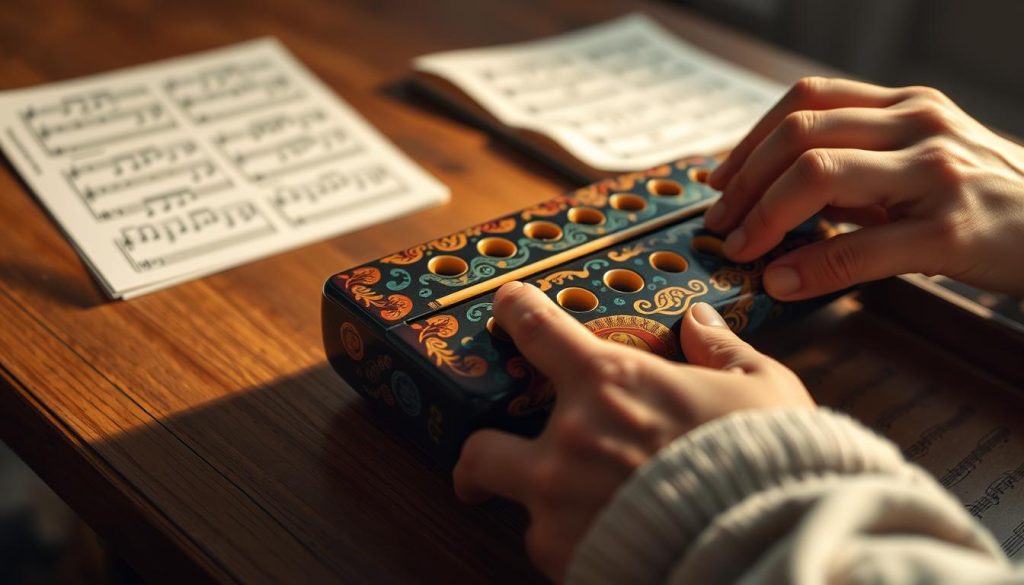
Caring for and protecting your 12-hole ocarina
Taking care of your instrument is essential to a rewarding musical experience. Regular maintenance preserves its sound and extends its life. Here are some practical tips for keeping your ocarina in good condition.
Regular cleaning and good habits
After each use, wipe the outside of the instrument with a soft cloth. This removes moisture and protects the finish. After a few minutes of playing, condensation may form inside. To remove it, use an absorbent cloth attached to a cleaning rod.
You can also let the instrument air-dry before putting it away. This prevents moisture from building up and affecting the sound.
Safe storage and transport
Always store your ocarina in a protective pouch or case. This shields it from dust, scratches and accidental knocks. Keep it somewhere with a stable temperature and humidity level. Avoid direct sunlight, which could damage the material, especially if your ocarina is ceramic.
For travel, consider cases from established brands such as Pelican or Noblex, which offer strong protection.
Tips for extending your ocarina’s life
Always handle your instrument with clean, dry hands. Avoid sudden temperature changes that could damage it. Never use harsh chemicals to clean it, as they could harm the finish and affect sound quality.
Regular care is essential if you want to enjoy playing for many years. As the saying goes, “Prevention is better than cure.” Look after your ocarina, and it will reward you with beautiful notes.

| Type of care | Frequency | Advice |
|---|---|---|
| Exterior cleaning | After every use | Use a soft cloth |
| Interior cleaning | Weekly | Use an absorbent cloth on a cleaning rod |
| Storage | At all times | Use a pouch or case |
| Handling | Whenever you use it | Keep your hands clean and dry |
Conclusion
Discovering a new instrument can be a rewarding adventure. Mastering this ancient instrument takes patience and a methodical approach. Choosing the right model and practicing regularly will help you make progress.
Join the Ocarinapolis community to exchange advice and share your enthusiasm. Resources such as Feria Musica and STL sheet music are available online. As the saying goes, “It’s never too late to learn!”
Download free sheet music and discover the pleasure of playing familiar melodies. Exploring different musical genres will enrich your experience and improve your technique.
Finally, remember to take care of your instrument. With proper maintenance, it will accompany you for a long time on your musical journey.