
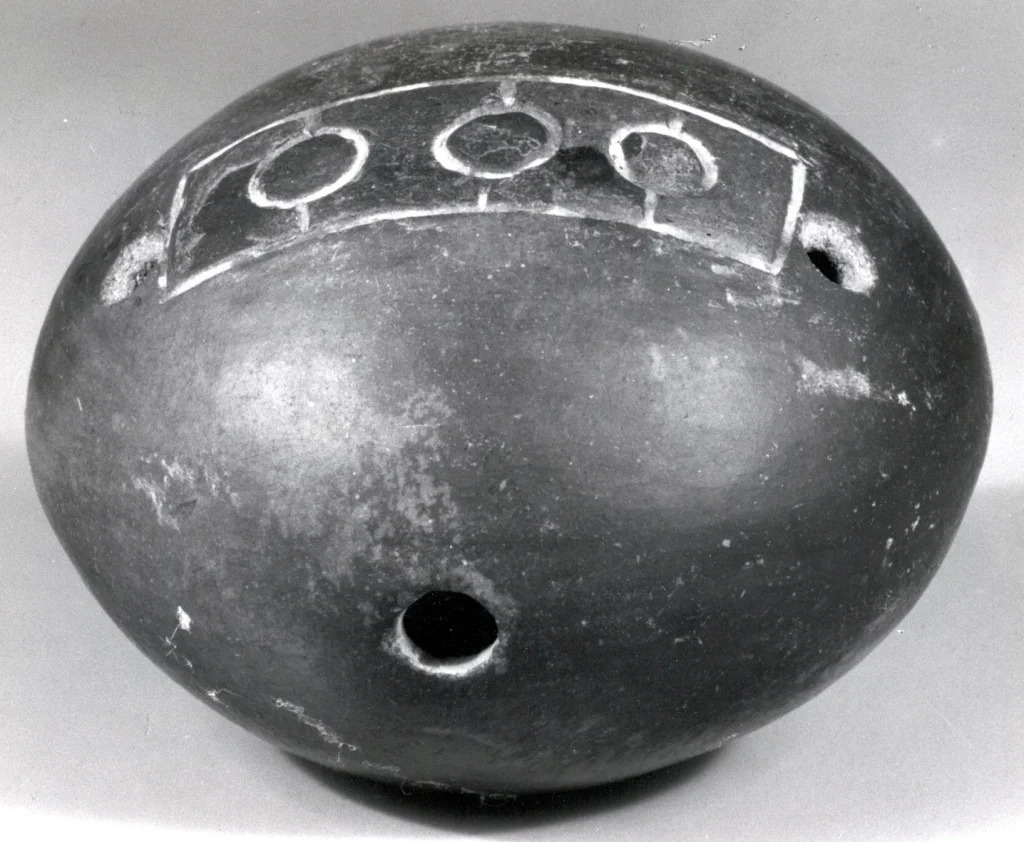
The ocarina is a fascinating wind instrument, and the 10-hole model is especially popular with beginners. Invented by Giuseppe Donati in Italy in the 1860s, it offers a rewarding musical experience. With 11 natural notes and 7 accidentals, it can play a variety of melodies.
Its popularity has grown, particularly through its appearance in iconic video games such as Zelda. This model stands out for its simplicity and comfortable grip, making it ideal for anyone who wants to explore music without too much complexity.
In this article, we will explore the instrument’s history, features and basic techniques for getting started. You will also discover online resources to help you improve quickly and make learning more accessible.
1. Discover the 10-hole ocarina: an accessible instrument and its benefits
The world of musical instruments is full of treasures, and the ocarina is undoubtedly one of the most captivating. With deep historical roots, it has evolved over time into a popular choice for musicians, especially beginners.
History and popularity of the ocarina
The instrument’s origins go back to the Maya and Aztec civilizations, where it was used in sacred rituals. In 1853, Giuseppe Donati modernized its design, creating the ocarina we know today. This transformation helped the instrument gain popularity, especially after its appearance in the 1998 video game The Legend of Zelda, which sparked worldwide enthusiasm.
Why beginners like the 10-hole ocarina
Beginners particularly appreciate this model for several reasons:
- Intuitive fingering: Unlike 6-hole or 8-hole models, the 10-hole ocarina has a simpler fingering system that makes learning easier.
- A comfortable grip: Its compact size and ergonomic shape make it easy to handle.
- A gentle learning curve: Beginners quickly enjoy playing, which encourages regular practice.
The benefits of learning music with this wind instrument
Learning to play this instrument offers many benefits:
- Better coordination: Regular practice develops hand-eye coordination.
- Improved concentration: The first few weeks of learning help strengthen concentration.
- Immediate musical enjoyment: Its gentle, melodic sounds bring immediate satisfaction.
Jean, 72, says the instrument suits all ages, showing that a passion for music has no age limit. In addition, 68% of beginners correct their intonation errors in just three weeks with the help of a tuner, suggesting that rapid progress is possible.
For those ready to begin, French-speaking communities offer useful resources, such as tablature and online tutorials, making learning even more accessible.
2. Comparing 6-, 8-, 10- and 12-hole ocarinas: choosing the right model
Every wind instrument offers a different experience depending on its design and construction. Ocarinas come in several models, each with its own features. This section explains the differences between 6-, 8-, 10- and 12-hole ocarinas to help you choose.
6- and 8-hole ocarinas: portability and complexity
Six- and eight-hole models, often worn as pendants, are compact and easy to carry. The John Taylor system, developed in the 1960s, allows them to play 17 and 18 notes respectively. However, these models require players to memorize finger combinations, which can be challenging for beginners.
Although portability is an advantage, the learning curve can be steeper. Some inexpensive models, especially those sold on general marketplaces, may also be poorly tuned.
10- and 12-hole ocarinas: easy fingering and a wider range
Ten- and twelve-hole ocarinas are often recommended for beginners. The 10-hole transverse model uses progressive fingering: lifting a finger produces a higher note, making learning more intuitive. This model can play 18 notes, while the 12-hole model can reach 22 notes, or roughly 1.5 octaves.
The latter is especially popular with musicians because of its wider range. It lets them explore a broader repertoire.
Multichamber models: for advanced musicians
For advanced musicians, multichamber models, whether double, triple or quadruple, offer interesting possibilities. These instruments combine chambers with separate mouthpieces and can cover two octaves or more. Asian fingering provides maximum continuity between chambers, while Pacchioni fingering favors overlapping ranges for a more consistent tone.
Beginners are advised to choose a 10- or 12-hole transverse alto ocarina in C, tuned to A440. This supports steady progress and provides access to a wide range of learning resources.
3. Essential basic techniques for playing the 10-hole ocarina well
To play this wind instrument well, you need to master a few basic techniques, particularly posture, breath control and fingering. Each skill plays an important part in learning and performance.
Posture and hand position: the keys to comfort
The ideal playing posture is the so-called “tree” position: keep your back straight and your shoulders relaxed. This steadies your breath and makes fingering changes easier as you play.
Check your posture in a mirror. This helps you correct mistakes and find a comfortable position, even during long practice sessions.
Breath control and an introduction to vibrato
Breath control is essential. Diaphragmatic breathing is a key method: breathe deeply through your nose so your abdomen expands, then exhale slowly and steadily into the instrument’s mouthpiece. This will help you produce clear, accurate notes.
To begin learning vibrato, start with gentle pulses from the diaphragm. Go slowly, then work toward a steady rhythm. Produce the vibrato with your diaphragm rather than your throat for a natural sound.
The candle exercise helps you control airflow: blow gently enough to make a flame flicker without putting it out. This develops precise breath control.
The 10-hole ocarina’s fingering system
This instrument’s fingering system uses numbers from 1 to 6, starting at the bottom. Lifting your fingers one at a time produces progressively higher notes, making them easier to learn.
To improve, play a short ascending and descending scale slowly. Use a tuner such as OcarinaTuner to check the pitch of each note.
A structured 20-minute session can be very useful: start with 5 minutes of breathing exercises, follow with 10 minutes of progressive tablature practice, and finish with 5 minutes of pitch checks using a tuner.
4. 10-hole ocarina: suitable songs for beginners and developing players
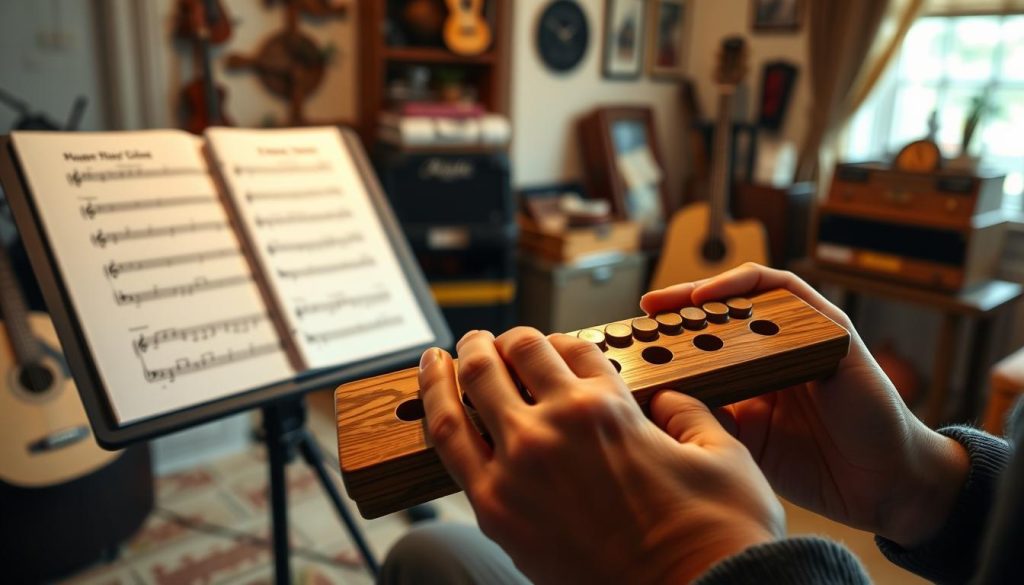
Exploring musical repertoire is essential for any aspiring musician. Choosing suitable songs makes learning more enjoyable and effective. In this section, we suggest easy melodies and traditional French songs for beginners.
Easy and classic songs to try
Themes from Zelda are excellent choices for beginners. The main theme, which uses the notes C-D-E-G-A, is ideal for your first practice sessions. Zelda’s Lullaby is a gentle melody that helps you get to know the instrument.
Song of Storms is an excellent exercise for alternating between low and high notes. It develops finger dexterity and breath control.
Traditional French songs for practicing pitch
Traditional French songs also suit beginners. Here are a few examples:
- La Faute à Voltaire, chorus
- Santiano
- La Maritza
- Et l’on n’y peut rien
- La rivière
These songs let you check your pitch phrase by phrase, which is essential for learning well.
Build a more varied repertoire with this instrument
For structured progress, start with Zelda’s Lullaby to strengthen your command of the notes. Then try Santiano to practice phrasing. Finally, La Maritza is ideal for mastering continuous playing and dynamics.
Use online tablature and sheet music to memorize the fingerings for each piece. You will gain fluency and confidence as you play.
Finally, explore additional resources, such as video tutorials and online communities. They will help you expand your repertoire and improve.
| Piece | Type | Goal |
|---|---|---|
| Main Zelda theme | Classic | Discovering the notes |
| Zelda’s Lullaby | Gentle | Getting to know the instrument |
| Song of Storms | Exercise | Alternating between low and high notes |
| La Faute à Voltaire | Traditional | Checking pitch |
| Santiano | Traditional | Practicing phrasing |
| La Maritza | Traditional | Mastering continuous playing |
5. Reading sheet music and tablature for the 10-hole ocarina
Knowing how to read sheet music enriches the musical experience. This is especially true for beginners who want to progress quickly. In this section, we will explore the basics of tablature and sheet music, along with useful resources to support your learning.
Understanding tablature: hole numbers and rhythm
Tablature is a valuable tool for musicians. It uses numbers to show which holes to cover, numbered from 1 to 6 starting at the bottom. This intuitive method lets you learn to play without prior knowledge of music theory.
For example, the sequence 4-2-1-2-4 is ideal for playing Zelda’s Lullaby. It shows how simple and effective this notation system can be for beginners.
Basic sheet music reading for beginners
It is also important to become familiar with the basics of reading sheet music: the treble clef, note pitches and duration symbols such as whole notes, quarter notes and eighth notes. These concepts deepen your understanding of music.
Digital resources and tools to help you read music
Several digital resources can support your learning. OcarinaTabs.org offers more than 1,000 free tablature entries for all levels. You can also use tools such as MuseScore to transpose sheet music for your instrument model.
Finally, consider joining online communities. You can exchange sheet music, share your progress and learn from other musicians. Start with simplified arrangements before moving on to more complex scores.
6. Choosing a 10-hole ocarina: models, materials and accessories
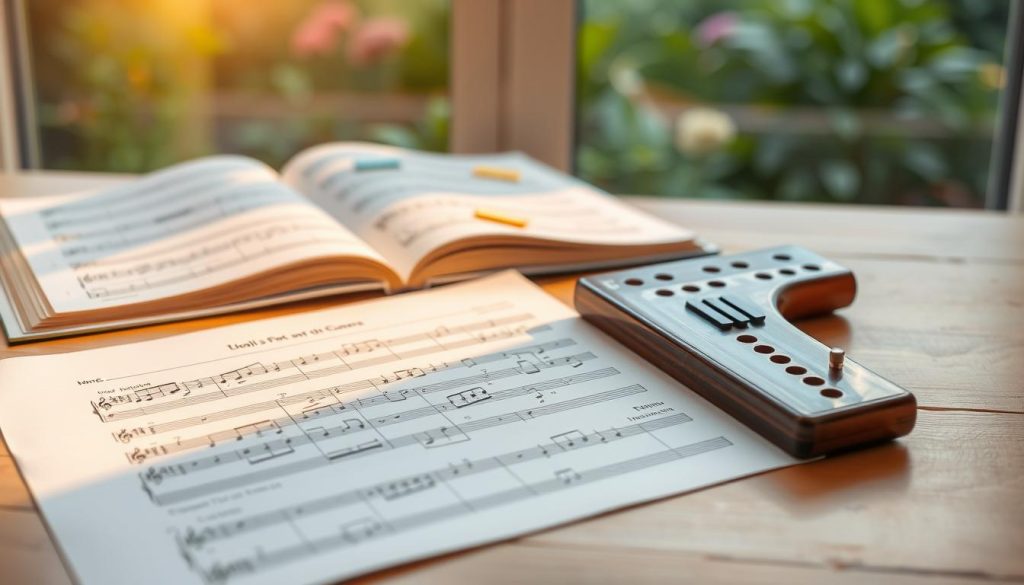
Choosing the right instrument can transform your musical experience. For an ocarina, consider the available materials, models and accessories. This will help you make an informed choice and enjoy your practice.
Comparing ceramic and plastic: advantages and disadvantages
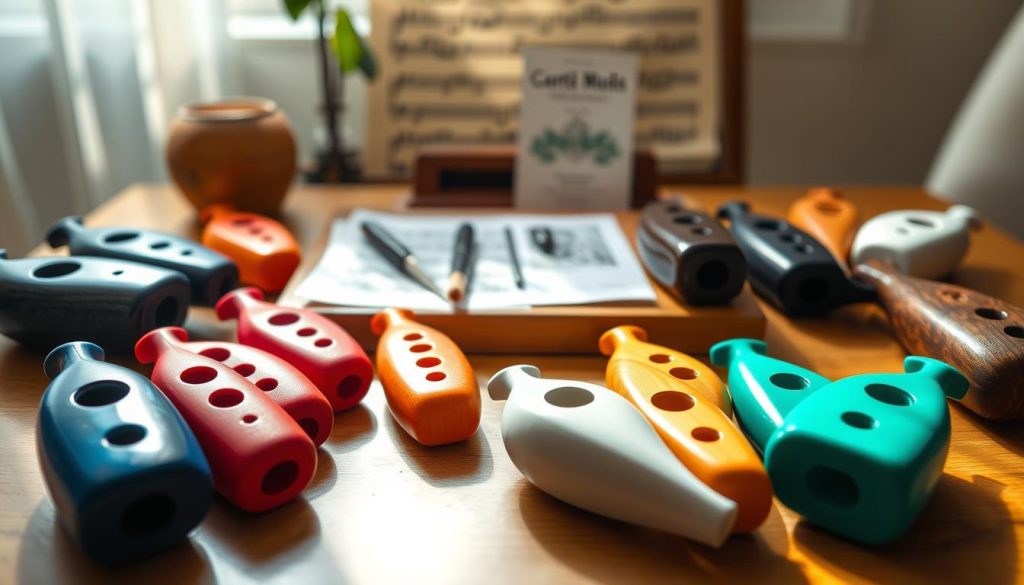
The material strongly affects the instrument’s sound. Ceramic produces a warm, rich tone, ideal for musicians seeking excellent sound quality. However, it is fragile and needs careful transport in a hard case. Its price generally ranges from €30 to €60.
By contrast, plastic is light, durable and affordable, with prices from €10 to €40. Although its tone is less deep, it is well suited to outdoor practice and frequent travel. Plastic models such as the Night by Noble are particularly recommended for beginners.
Recommended brands and quality criteria
When choosing an instrument, look for brands known for reliability. Recommended brands include STL Ocarina, Songbird, Hindocarina, Focalink/Stein and Musique de Terre. They offer well-tuned instruments with consistent pitch across their range.
Before buying, check that the instrument is tuned to A440 and test whether its tone remains stable across its range. A fingering chart included with the ocarina is also useful for beginners.
Useful accessories for protecting the instrument and making practice easier
Several accessories can help preserve your instrument. A hard case from a brand such as Pelican or Noblex protects it from knocks. Moisture-absorbing packets are useful for storage, while a soft cloth helps you care for it after each use.
It is also advisable to avoid untuned Peruvian models and inexpensive ocarinas often sold on general marketplaces. They can have pitch problems that discourage beginners.
7. Practice plan and tips for improving efficiently on the 10-hole ocarina
To master this instrument, follow a structured learning method. Organizing your sessions well can make a significant difference to your progress. Here is a detailed plan to help you improve.
How to organize a typical session and how long to practice
A 30-minute session can be organized as follows:
- 5 minutes of breathing exercises to prepare your breath.
- 10 minutes of scales and fingering exercises to warm up your fingers.
- 10 minutes working on a simple tablature.
- 5 minutes of free playing for enjoyment.
This structure lets you work on different aspects of your playing while balancing technique and enjoyment.
A one-month practice schedule for beginners
To help structure your learning, here is a one-month practice schedule:
- Week 1: Simple nursery rhymes to work on breath control.
- Week 2: Easy Zelda themes to strengthen your fingering.
- Week 3: An accessible French repertoire.
- Week 4: Consolidate what you have learned by recording yourself for self-assessment.
This schedule helps you progress gradually while giving you clear goals each week.
Using a metronome, tuner and learning materials
Using suitable tools is crucial for effective learning:
- Metronome: Set it to 60 BPM to steady your rhythm. This will help you avoid speeding up unintentionally.
- Tuner: Use a tuner such as OcarinaTuner to check the pitch of each note. This helps you correct intonation errors quickly.
- Learning materials: Include sheet music and tablature in your practice. To learn more about reading sheet music, see this article on ocarina sheet music and tablature.
Recording your sessions can also help you notice small pitch differences and adjust your breath and accuracy.
Finally, keep a practice journal to track your progress. Note the pieces you have worked on, the BPM you have reached and your observations about transitions between notes. This will help you stay motivated and see how far you have come.
| Activity | Duration | Goal |
|---|---|---|
| Breathing exercises | 5 minutes | Prepare your breath |
| Scale practice | 10 minutes | Warm up your fingers |
| Work on a tablature | 10 minutes | Learn new notes |
| Free playing | 5 minutes | Musical enjoyment |
8. How to care for and protect your 10-hole ocarina so it lasts
To make this instrument last, you need to care for it. Regular maintenance and suitable storage preserve its sound quality and condition. Here are some practical tips.
Cleaning according to the material
How you clean your instrument depends on whether it is ceramic or plastic. Let a ceramic model dry naturally in the open air, away from direct sunlight. This helps prevent warping or cracking.
For plastic models, pass a cotton swab through the holes to remove moisture. Always wipe the instrument after each session with a slightly damp soft cloth. This limits moisture buildup and preserves sound quality over time.
Storage tips and precautions
Proper storage matters just as much. Keep your instrument in a hard case in a place with a stable temperature, ideally between 15 and 25 °C. Use moisture-absorbing packets to limit changes that could damage it.
Do not immerse the instrument in water or expose it to extreme temperatures. Cover the rear hole when cleaning with compressed air to avoid unwanted whistling.
Common mistakes to avoid
To help your instrument last, do not neglect regular cleaning: poor maintenance can cause sound problems. Also avoid sudden temperature changes, such as leaving the ocarina in a car in direct sun or freezing conditions.
If you notice hairline cracks in a ceramic model, use a Loctite repair kit rather than cyanoacrylate glue, which could worsen the damage. Check your instrument’s tuning once a month with a tuner app to make sure it remains in good condition.
A regular care routine, including drying after each use and a monthly tuning check, will help you enjoy your instrument for many years.
9. 10-hole ocarina: tips to enrich your playing experience
To get the most from your instrument, add rewarding activities to your musical routine. They can make learning easier and playing even more enjoyable.
Make the instrument part of your daily musical life
Regular practice is the key to progress. Spend 15 to 20 minutes a day working on fingering and breath control. Start with simple scales and familiar themes to steady your notes before adding ornaments.
For example, begin with the C major scale. This will help you remember the hole positions and play more easily. Over time, you can try more complex melodies.
Join communities and use online resources
Online communities are ideal for exchanging ideas and advice. Ocarina-focused Discord servers and the Ocarinapolis forum give you places to talk with other musicians.
YouTube channels such as OCTalk and Gosselink offer valuable tutorials. STL Ocarina‘s video library contains plenty of educational material for all levels.
Use Part’Ocarina tablature and Musique de Terre guides to expand your repertoire and improve your learning methods.
Explore advanced techniques and different styles
To add variety to your playing, explore advanced techniques such as diaphragmatic vibrato. It will make your performances more expressive. Ornaments can enhance your melodies and make your playing more engaging.
Try different musical styles, including folk, classical and video game music. This will diversify your repertoire and help you stay motivated as you learn.
Taking part in online music challenges or sharing your performances on social media can also bring constructive feedback and encourage further progress.
Finally, remember that regular practice is essential. The ocarina rewards persistence with quick progress and an enriching everyday musical experience.
| Tip | Description |
|---|---|
| Daily practice | Work on fingering and breath control for 15 to 20 minutes a day. |
| Online communities | Join Discord servers and the Ocarinapolis forum. |
| Video resources | Use YouTube channels such as OCTalk and Gosselink. |
| Advanced techniques | Explore diaphragmatic vibrato and ornaments. |
| A varied repertoire | Play pieces from different musical genres. |
10. Conclusion
Playing this instrument can transform your relationship with music. Regular sessions of 10 to 30 minutes a day can bring significant progress. In just two months, nearly 45% of musicians manage to play three iconic Zelda melodies.
For effective learning, a 12-hole alto ocarina in C is recommended. Its simple fingering system makes it easy to get started. Using tablature, a tuner and a metronome is essential for structuring your practice.
Set a clear goal, such as mastering three melodies in eight weeks. Avoid common mistakes, including blowing too hard or neglecting to clean the instrument. Once you have developed your technique, consider switching to a ceramic model for a richer sound experience.
It is never too late to learn music. Whatever your age or starting level, this instrument is ideal for developing a lasting passion for music.