
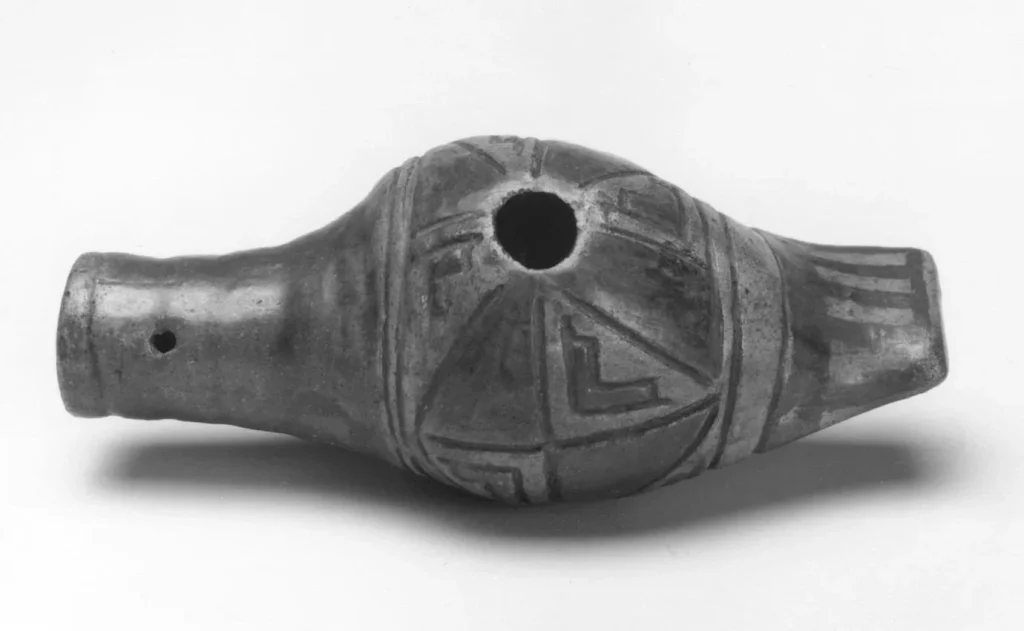
The ocarina is an ancient wind instrument valued for its gentle sound and ease of use. Its origins date back to the Mayan and Aztec civilizations, but Giuseppe Donati popularized it in 1853. The 4-hole model is particularly well suited to children and beginners, offering an accessible musical experience.
Light and small, this instrument lets you create melodies without knowing how to read music. Its appearance in popular culture, particularly in video games such as The Legend of Zelda, has also helped increase its popularity.
In this article, we offer a complete guide to learning to play it. You will explore essential topics such as choosing a model, posture, fingerings, and reading music. With a little regular practice, even beginners can soon play their first melodies.
Introduction to the 4-hole ocarina: an accessible, melodic instrument
The ocarina is a fascinating wind instrument that produces soft, captivating sounds. Its rich history begins with pre-Columbian civilizations, particularly the Maya and Aztecs. It was not until 1853 that the Italian Giuseppe Donati popularized the instrument and brought it to a wider audience.
The 4-hole model is especially popular with children and beginners. Its light, compact design makes it easy to hold and lets you play simple melodies without any prior knowledge of music theory. Weighing between 80 and 150 grams, it is much lighter than a concert flute, making it ideal for young musicians.
Brands such as STL, Hindocarina, and Songbird offer ceramic and plastic models for different needs. This variety helps beginners choose an instrument that suits their preferences in both appearance and sound.
The instrument is even more appealing because of its place in popular culture. It has appeared prominently in iconic video games such as The Legend of Zelda, adding to its worldwide recognition. Despite what some might think, the ocarina is a real instrument capable of expressive melodies, rather than merely a toy.
In short, the 4-hole ocarina is an ideal introduction to wind instruments. Its ease of use and melodic charm make it a favorite for anyone beginning a musical journey.
4-hole ocarina: how do you learn to play it?
Learning this enchanting instrument opens up a world of melodies. To start well, you need to understand the basics, especially how breath and fingering work together to produce harmonious notes.
Understanding the basics of playing
Start by mastering your breathing technique. Natural diaphragmatic breathing is enough to create pleasant sounds. By paying attention to your breath, you can produce clear, accurate notes.
One simple exercise is to blow gently toward a candle without extinguishing it. This helps you control your airflow, an essential skill for playing the instrument.
Why regular practice matters
Consistency is essential for making progress. Just 15 minutes of daily practice can produce significant results. One study reported a 37% improvement in hand-eye coordination after a month.
Regular practice strengthens your musical skills and improves your concentration. Think of each session as another step toward mastering the instrument.
Realistic first goals for beginners
Set achievable goals. Instead of aiming for complex pieces, focus on learning one simple melody. Within a few weeks, you could play a piece such as “Zelda’s Lullaby,” as one 72-year-old learner did.
It can also help to structure your practice sessions. Begin with a warm-up, continue with technical exercises, and finish by playing familiar melodies. This keeps you motivated and helps you make balanced progress.
Finally, remember that every small success counts. Learning to play is a gradual process that builds both confidence and musical skill.
Benefits of the 4-hole ocarina for beginners
Discovering a new musical instrument is an exciting adventure. For beginners, the ocarina offers gradual learning and quick results. Numbered tablature makes it possible to learn without knowing how to read music, making the process both accessible and enjoyable.
Simple and quick to learn
Beginners can achieve tangible results quickly. Numbered tablature makes melodies easy to play, which helps sustain motivation. People beginning their musical journey can enjoy playing right away.
Easy to hold and carry
This model is especially suitable for small hands, so children can begin learning from age 6. At 80 to 150 grams, it is much lighter than a concert flute. Easy to carry, it is ideal for travel or outdoor practice.
Developing basic musical skills
Playing this instrument helps develop essential skills. One study reported a 37% improvement in hand-eye coordination after a month of regular practice. It can also strengthen concentration, which is useful in other areas of life.
Here is an overview of its benefits:
| Benefit | Details |
|---|---|
| Easy to learn | Numbered tablature and quick results |
| Easy to hold | Suitable for children from age 6 |
| Portable | Light and easy to carry |
| Skill development | Improved coordination and concentration |
Practical accessories, such as a carrying case and microfiber cloth, also make it easier to use. Overall, this instrument is an excellent choice for anyone who wants to develop a positive relationship with music. For more information about learning to play, see this article here.
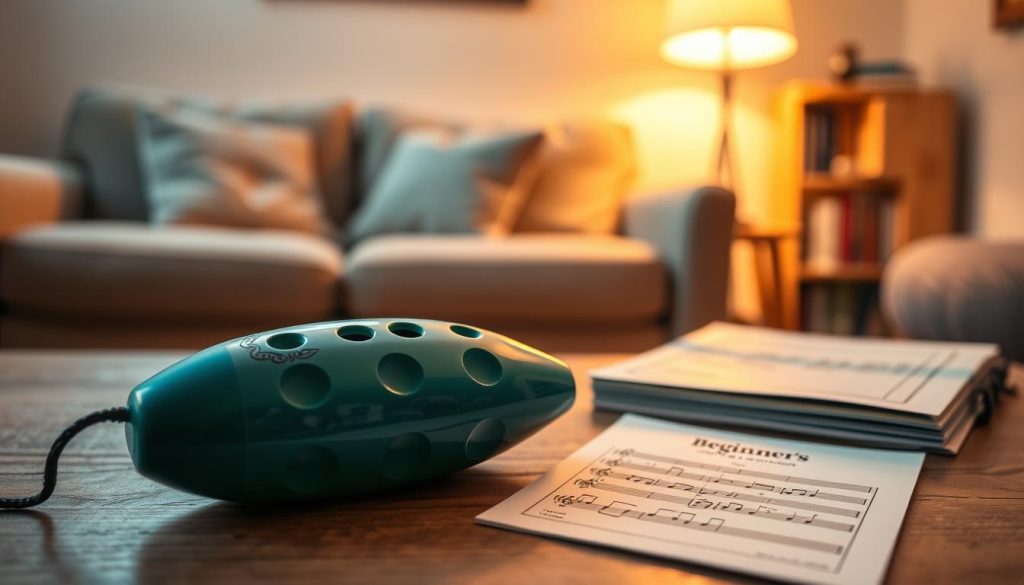
Choosing a 4-hole ocarina: suitable materials and models
When choosing an ocarina, pay attention to its material and design. Your choice can affect your musical experience. The two main materials are ceramic and plastic.
Comparing ceramic and plastic
Ceramic is often considered the traditional choice. It generally lasts five years or more and produces a rich, warm sound. However, it is more fragile and can break if dropped.
Plastic, by contrast, is lighter and less expensive. It is ideal for children, but its lifespan is limited to two or three years. It also needs daily care to prevent condensation from building up.
Ergonomics and sound quality
Beginners should choose a model that is comfortable to hold. Check the shape of the mouthpiece and the placement of the holes. A good grip makes learning more enjoyable.
Test the instrument’s sound quality, too. An airtightness test may reveal unwanted whistles that indicate a manufacturing defect. Make sure the ocarina is in tune before buying it.
Tips for choosing a durable, well-tuned model
Favor reputable brands such as Songbird, which offer reliable, well-designed instruments. Avoid Peruvian ocarinas that are more decorative than functional, as they are often made from lower-quality materials.
Finally, check that the instrument comes with a warranty of at least two years. A good beginner model can be found for around €50, offering excellent value for money.
Essential foundations for getting started with your ocarina
Before you begin playing, learn the instrument’s basic principles. Posture and hand position play a crucial role in the quality of your playing. Adopt the “tree” posture: keep your feet parallel and your spine aligned. This encourages smooth breathing and better stability.
Posture and hand position
Place your left index finger on the first hole and your right index finger on the second. Avoid pressing too hard on the mouthpiece, as this can affect the sound. As a simple exercise, hold a feather in front of the mouthpiece to check that your breath is steady.
Controlling breathing and airflow
Breath control is essential for clear, accurate notes. When you first start, aim to sustain each note for about four seconds. To develop your technique, try vibrato by varying your airflow by 5% to make your playing more expressive.
The free OcarinaTuner app is a useful tool. It helps you tune your instrument and correct intonation errors from the start.
Basic exercises for a confident start
Begin with a sequence of progressive exercises: sustain one note, play up and down a simple scale, then move slowly between two or three notes. This will help you build a solid foundation.
- Use a metronome set to 60 BPM to develop a steady rhythm from your first exercises.
- Avoid unnecessary tension in your hands, wrists, and shoulders so you can play smoothly.
- Record your practice sessions to observe and correct your posture and hand position.
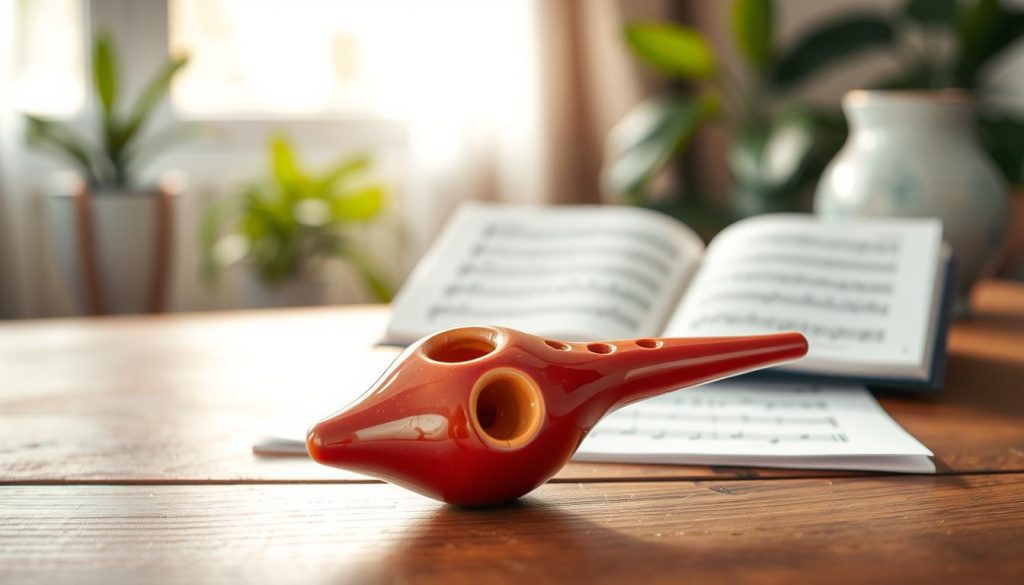
How to learn basic fingerings on a 4-hole ocarina
Mastering basic fingerings is essential for every beginner. Finger position determines the quality of the notes you produce. Here are some key steps to help you progress.
Naming and remembering the holes
Start by naming the ocarina’s holes. Imagine holding the instrument with the mouthpiece at your lips. Identify the upper-left hole as “1,” the upper-right hole as “2,” the lower-left hole as “3,” and the lower-right hole as “4.”
An “X” represents an open hole, while a number indicates a covered hole. For example, middle C is represented by 1, 2, 3, 4, meaning that all four holes should be covered.
Main fingering combinations for basic notes
Here is a table of finger positions for the notes of the C major scale:
| Note | Fingering |
|---|---|
| C | 1 2 3 4 |
| D | 1 X 3 4 |
| E | 1 2 3 X |
| F | 1 X 3 X |
| F-sharp | X 2 3 4 |
| G | X X 3 4 |
| A | X X 3 X |
| B | X 2 X X |
| High C | X X X X |
Practicing scales and progressive exercises
Practice scales both upward and downward. Start slowly so you can remember each finger position. One helpful method is to assign a color to each hole: red for hole 1, blue for hole 2, green for hole 3, and yellow for hole 4.
To play more smoothly, practice five notes each day for two weeks. Then add sharps and flats using the appropriate fingerings. Practicing in front of a mirror can also improve finger symmetry and independence.
Finally, use a metronome set to 60 BPM to work on steady, accurate fingering changes. These foundations will prepare you to play more elaborate melodies and pieces.
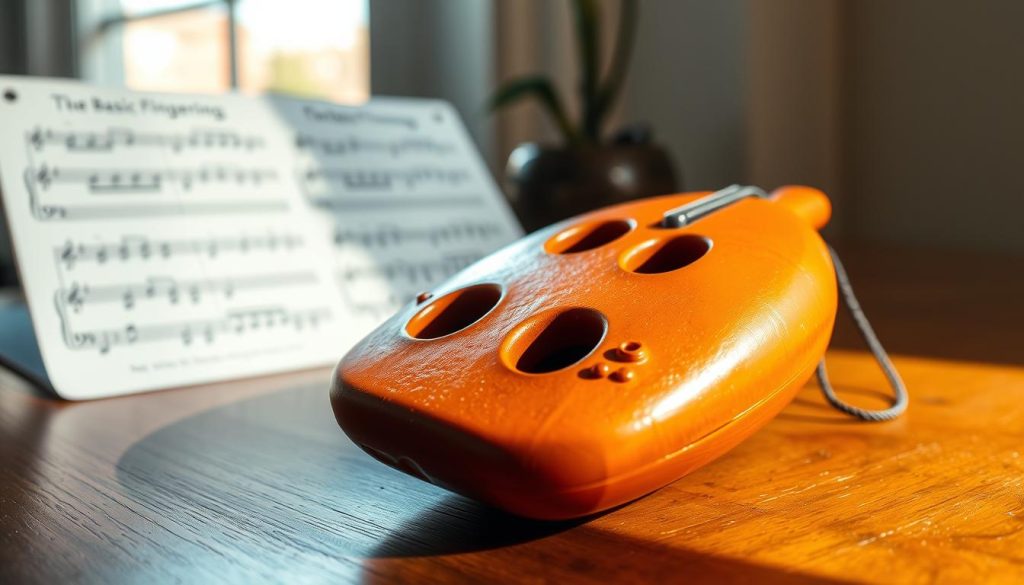
Reading sheet music and tablature for the 4-hole ocarina
Reading sheet music and tablature is an essential skill for any musician. Beginners may find these forms of notation difficult to interpret at first. With a little practice, however, reading them becomes natural.
Simple tablature: interpretation and key symbols
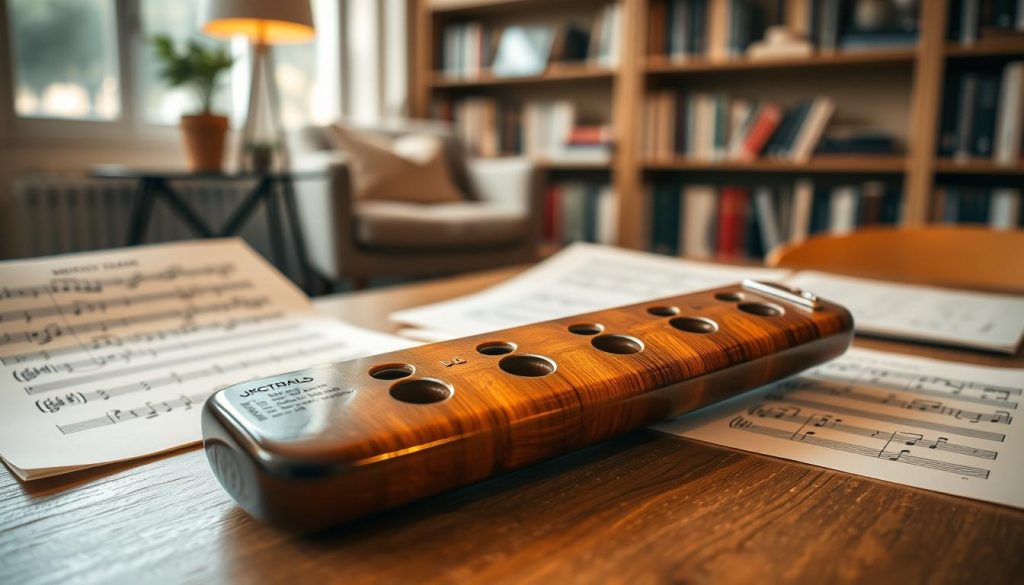
Simple tablature offers an accessible way to play melodies. Read it from top to bottom and left to right. Each diagram represents a note to play. Black holes show which holes to cover; white holes remain open.
Here are some key symbols to know:
- Horizontal dashes: these extend the length of a note. One dash means two beats; two dashes mean four beats.
- Multipliers: these show how many times to repeat a note or sequence.
- Braces: these indicate phrasing slurs, meaning the notes should be played in one breath.
Conventional sheet music adapted for the ocarina
Conventional sheet music is an excellent way to learn music. It includes essential information such as the treble clef, staff, and note values. Beginners should become familiar with these concepts.
Here is a table of note values:
| Note | Duration |
|---|---|
| Whole note | 4 beats |
| Half note | 2 beats |
| Quarter note | 1 beat |
| Eighth note | 1/2 beat |
| Sixteenth note | 1/4 beat |
Advanced tablature: combining notation and fingerings
Advanced tablature combines conventional notation with fingering diagrams. It connects written notes to the fingerings needed to play them. This approach is recommended for beginners because it makes learning music notation more gradual.
Pay attention to your instrument’s key! Fingerings vary depending on whether your ocarina is in C, F, or G. Most tablature available online is designed for ocarinas in C, helping make that model popular.
To get started, try a simple melody such as “Zelda’s Lullaby” (sequence 4-2-1-2-4). This will help you become familiar with tablature before moving on to more complex pieces.
To find more sheet music, visit OcarinaTabs.org, which offers more than 1,500 free scores for all levels.
Techniques and methods for making quick progress
To progress quickly, use techniques suited to the instrument. One effective approach is the Berbiguier method, which alternates legato and staccato. This improves pitch accuracy and intonation while strengthening breath control.
Working on pitch accuracy and intonation
To refine your playing, begin with pitch exercises. Record yourself each week to compare your progress and identify areas to improve. Try hearing the music in your head before you play to get a stronger sense of its rhythm. This can greatly improve the accuracy of your performance.
Regular practice and focused exercises
A structured practice routine is essential. For example, start with 10 minutes of technical warm-ups, followed by 15 minutes of improvisation. This develops your musical ear and creativity. Focused exercises will help you progress more quickly.
Playing simple melodies to build confidence
Playing simple melodies is an excellent way to strengthen your foundations. Join arrangement workshops to adapt pop hits for your instrument. This makes practice more playful and motivating. For a stimulating challenge, try the 30-day challenge: play a different piece each day. “In just one month, I learned to play 30 different pieces thanks to this challenge,” reports one player.
In short, regular practice, even in short sessions, is more beneficial than occasional long sessions. Explore different musical styles to become more versatile and discover the instrument’s full expressive potential.
Avoiding common mistakes while learning
To progress, learn to recognize common mistakes. Many beginners struggle with intonation, finger movement, and instrument care. Understanding these problems can improve your musical experience.
Intonation problems and solutions
A University of Montreal study reports that 68% of recurring mistakes are related to intonation. To address them, tactile visualization is an effective method. Imagine the notes before playing them to improve your accuracy. A pressure sensor can also help correct overly forceful blowing, giving you better control of the airflow and helping you avoid wrong notes.
Managing finger movement and playing smoothly
Smooth finger movement is crucial for playing harmonious melodies. The “butterfly” exercise is an excellent way to improve it. Hold your hands like wings and move your fingers slowly to develop agility. A pre-playing checklist can also help. Check that your shoulders and wrists are relaxed to avoid unnecessary tension.
Caring for the instrument and preventing wrong notes
Wrong notes caused by condensation can be avoided by using 3 mm non-slip rings. These rings steady your fingers over the holes and help prevent positioning errors. Regular instrument care is also essential, especially for plastic models, to prevent condensation from building up.
Here is a summary of the key points:
| Common mistake | Solution |
|---|---|
| Intonation problems | Tactile visualization and a pressure sensor |
| Finger movement | The “butterfly” exercise and a pre-playing checklist |
| Wrong notes | Non-slip rings and regular care |
Keep these tips in mind to prepare for the challenges of learning the instrument. Treat each mistake as a chance to learn, and analyze it methodically so you can improve.
Equipment and practice recommendations
Investing in the right accessories can greatly improve your learning experience. To get started, you need suitable tools. Here are some recommendations to help you make the most of your musical journey.
Useful accessories for beginners
Here is a list of useful accessories for effective practice:
- Digital tuner: this tool helps you check your instrument’s pitch.
- Carrying case: it protects your instrument from knocks and moisture.
- Metronome: it helps you develop rhythm and play at a steady tempo.
The free OcarinaTuner app is also a useful tool for tuning your instrument and correcting intonation errors in real time. A microfiber cloth is recommended for daily care, especially for plastic models.
Recommended learning resources and materials
To broaden your repertoire, download Feria Musica’s progressive sheet music. These resources can help you structure your learning. You can also explore OcarinaTabs.org, which offers more than 1,500 free scores for all levels.
Joining a community to share and improve
Being part of a community can enrich your experience. Join Ocarinapolis, a French-language forum with more than 20,000 enthusiastic members. There you can find advice, sheet music, and encouragement.
Jean, 72, is an inspiring example: he started two years ago and has become a volunteer teacher. His experience shows that learning is open to everyone.
Finally, the Jammr app lets you practice online with other musicians and develop your ensemble skills. Share your progress and musical discoveries with the community to stay motivated and enrich your learning.
| Accessory | Use |
|---|---|
| Digital tuner | Checking pitch |
| Carrying case | Protecting the instrument |
| Metronome | Practicing rhythm |
| OcarinaTuner | Correcting intonation |
| Microfiber cloth | Caring for the instrument |
Conclusion
Starting to make music with this instrument is a rewarding experience. For successful learning, focus on five essentials: choose a suitable model, adopt good posture, master tablature, practice regularly, and care for your instrument.
Accessible to everyone, the ocarina lets beginners from children to older adults discover music without prior knowledge. Jean, 72, is an inspiring example: he went from beginner to volunteer teacher in just two years.
To get started, download our introductory pack of 15 easy tablature pieces. After six months of practice, consider moving to more advanced models to explore new musical possibilities. Join the Ocarinapolis community, where more than 20,000 members share their passion and support one another.
Whether you want to play for pleasure or share your passion, this instrument makes an ideal companion. Music is a universal language, and the ocarina offers a simple, rewarding way into it. Begin your musical journey today!