
The ocarina is a fascinating wind instrument that is often unfamiliar to the general public. Its egg-shaped body and captivating sounds draw in those who discover it. Descended from early whistles, this small instrument has endured and evolved over the centuries. Its renewed popularity owes much to popular culture, especially the video game The Legend of Zelda: Ocarina of Time, released in 1998.
In this article, we will explore the question: “What is an ocarina and how does this instrument work?” We will cover its history, construction and acoustics. This guide is for curious beginners and musicians who want to deepen their knowledge.
Traditionally made from clay or ceramic, ocarinas are now also made from materials such as plastic and metal. You will discover how such a small object produces soft, ethereal sounds, and how its holes let players change the pitch. By the end of this article, you will understand how the instrument works.
Introduction: getting to know the ocarina
The ocarina is a captivating wind instrument and a musical treasure. Its egg-shaped or rounded body and ease of use make it popular with musicians. By blowing into a mouthpiece and covering or uncovering holes with their fingers, players can produce a variety of notes.
The instrument has a hollow body with several holes and often a sound opening. This opening lets air escape and contributes to its distinctive sound. The ocarina is considered a descendant of early prehistoric whistles. It differs from tubular flutes such as the concert flute and recorder.
In orchestral classification, this wind instrument belongs to the woodwind family. Its classification depends on how sound is produced when air flows across a sharp edge, rather than on the material used to make it. The sound-producing principle is similar to that of a recorder, although the shape of the resonating chamber differs.
The ocarina is especially accessible because it is easy to use. It is an excellent choice for beginners exploring music and wind instruments. It also comes in a wide range of sizes, shapes and materials, which directly affect its pitch range and sound quality.
The name “ocarina” means “little goose” in the dialect of Bologna, referring to the characteristic shape of this traditional Italian instrument. To play it, a musician holds it in both hands, blows into the mouthpiece and uses specific fingerings to produce different notes.
The ocarina is far more than a toy: it is a genuine musical instrument used in traditional music and contemporary compositions alike. Its charm and versatility appeal to many musicians.
Origins and history of the ocarina
The ocarina’s roots reach deep into ancient history and reveal an instrument rich in tradition. Archaeological finds on several continents suggest that rudimentary versions were made around 12,000 years ago. These instruments, often limited to two to six notes, have been found in places including ancient Kosovo, Egypt, China and various South American countries.
Among these discoveries, the Runik ocarina from Kosovo is considered the oldest prehistoric musical instrument found in that region. It shows the importance of such instruments in ancient cultures. In China, for example, the xun, a similar instrument, dates back more than 7,000 years. These wind instruments played an important role in rituals and ceremonies.
In Mesoamerican and other ancient American civilizations, including the Inca, Maya and Aztec cultures, ocarina-like instruments featured in celebrations. Often egg-shaped and fitted with eight holes, they were used to play melodies during sacred rituals. These musical traditions endured and spread across cultures.
Spanish conquests in the sixteenth century brought the instrument to Europe. It soon lost popularity, however, until its rediscovery in the nineteenth century. Giuseppe Donati, a young musician from Budrio, Italy, then transformed the ocarina. In 1853, he created a ten-hole model capable of playing up to eleven notes. The name “ocarina,” meaning “little goose” in the dialect of Bologna, was chosen because of its shape.
In 1928, Takashi Aketagawa designed the twelve-hole ocarina, which became the standard model. The instrument experienced a broader revival in the twentieth century. During both world wars, soldiers used pocket ocarinas to lift their spirits. The instrument was nevertheless overtaken by less expensive alternatives, such as the recorder.
The ocarina’s popularity surged thanks to the 1998 video game The Legend of Zelda: Ocarina of Time. The game introduced it to a broad audience, especially in Asia and the United States. Today, the ocarina continues to evolve through double, triple and even quadruple models, showing its resilience and adaptability.

How ocarinas are made and what they are made from
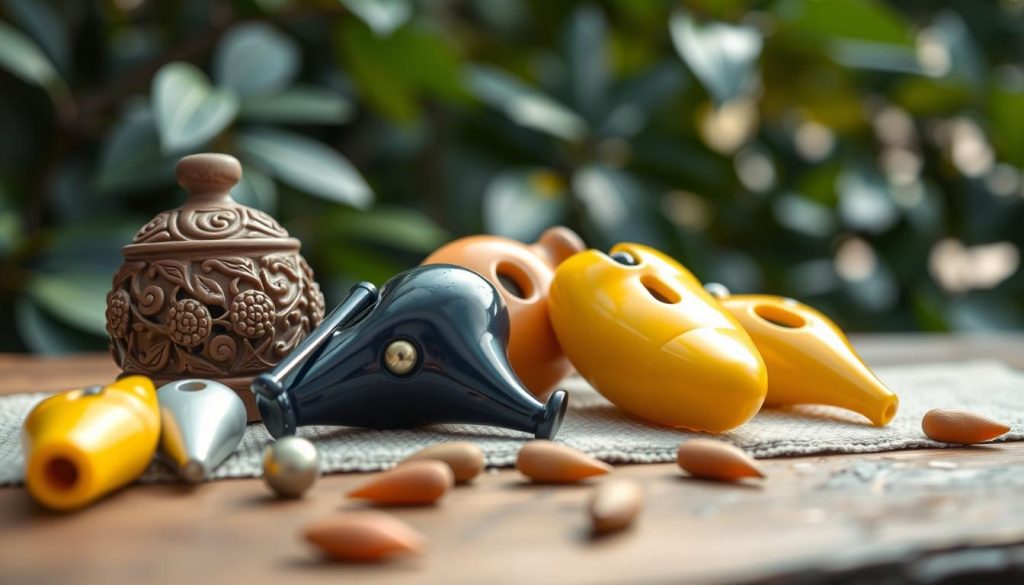
Ocarinas are made from a wide variety of materials. Traditionally, they are crafted from terracotta, ceramic or porcelain. These materials offer excellent acoustic qualities and a distinctive handmade appearance.
Traditional materials
Terracotta is the oldest and most widely used ocarina material. It allows makers to shape the sound chamber precisely and create a variety of forms.
Ceramic and porcelain can produce ocarinas with purer, brighter tones. They also allow for a smoother, more refined finish, making them popular with musicians.
Modern materials
Modern materials such as plastic are also used today. Plastic ocarinas cost less to make while retaining surprisingly effective acoustics. They are therefore an excellent choice for beginners.
Wood, metal and even bone can also be used. Each material brings different tonal nuances and a distinctive appearance.
Some ocarinas are made from plant materials such as bamboo, bark, seeds or fruit shells, continuing ancient craft traditions.
Shapes and sizes
An ocarina’s size directly affects its pitch. The smaller the ocarina, the higher the notes. Conversely, a larger ocarina produces lower sounds.
Shapes vary too: egg-shaped, rounded, animal-shaped or the classic goose-head form popularized by Giuseppe Donati. Although the shape of the sound chamber has relatively little effect on sound quality, its volume and the precision of the sharp edge are crucial.
The choice of material and shape depends on the musician’s preferences, budget and intended use. Each combination offers a different playing experience.
| Material | Advantages | Use |
|---|---|---|
| Terracotta | Excellent acoustic qualities | Traditional instruments |
| Ceramic | Pure tones and a smooth finish | Professional instruments |
| Plastic | Affordable price and effective acoustics | Beginners |
| Wood | Varied tonal nuances | Handcrafted instruments |
| Plant materials | Traditional craftsmanship | Folk instruments |
Structure and main parts of an ocarina
Every ocarina has a structure that lets it produce captivating sounds. Understanding its parts is essential to understanding how it works. Here are the main components of this fascinating instrument.
The mouthpiece and windway
The mouthpiece, often beak-shaped, is where the musician blows air into the ocarina. This point of contact is crucial because it affects the quality of the sound produced.
The air then travels through an internal windway connecting the mouthpiece to a sharp edge. At this angled edge, the airflow splits and creates sound-producing vibrations. The windway is therefore fundamental to note production.
The sound chamber
At the heart of the ocarina is its sound chamber. This rounded cavity is essential because its volume affects the instrument’s fundamental pitch. As air vibrates inside, it produces the ocarina’s characteristic sound.
The chamber’s shape and size play a part, but they are secondary to how air enters it. The sound chamber is central to the ocarina’s operation.
Finger holes and their placement
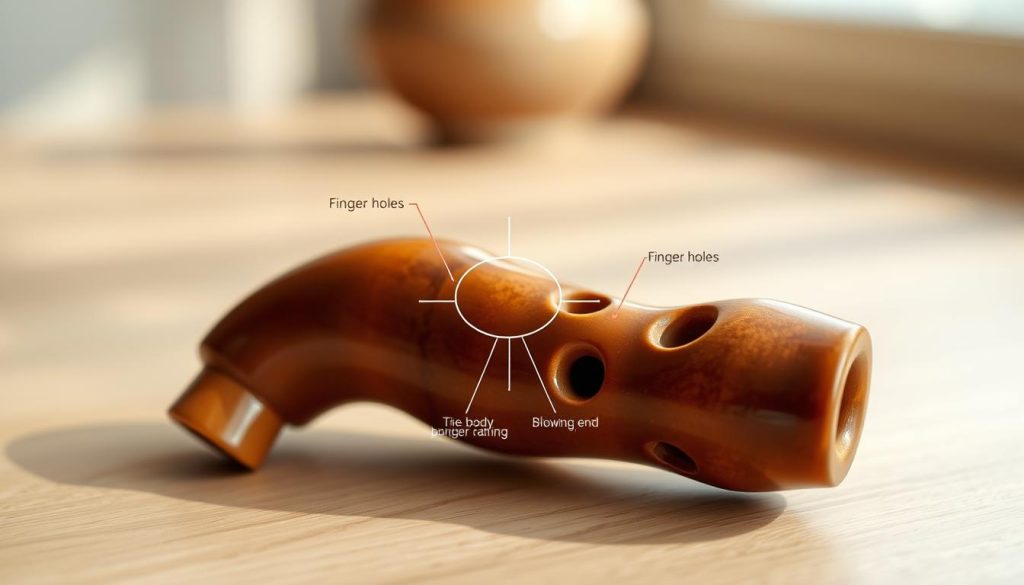
Finger holes, also called tone holes, are made in the ocarina’s body. By covering or uncovering them, the musician changes the pitch of the notes. Although their exact position matters relatively little acoustically, they are placed to make the instrument comfortable to play.
There may also be a small hole near the base of the mouthpiece. It holds a cord to help prevent the ocarina from being dropped. This detail shows the ingenuity of its makers.
Understanding the ocarina’s internal structure helps explain its acoustics. Every part, from the mouthpiece to the sound chamber, contributes to the musical experience. To learn more about this fascinating instrument, read this article.
What is an ocarina and how does it work? Acoustics and sound production
This wind instrument works through fascinating acoustic principles. The ocarina acts as a Helmholtz resonator, a principle described by Hermann von Helmholtz around 1850. It is fundamental to understanding how the instrument makes its distinctive sounds.
Understanding Helmholtz resonance
Consider a bottle as an example. When you blow across its neck, the pitch depends on the volume of the cavity. Partly filling the bottle lets you produce different notes. The same principle applies to the ocarina.
When a musician blows into the mouthpiece, air passes through an internal windway and strikes a sharp edge. The airflow then splits, creating pressure changes that cause vibrations. This mechanism resembles that of a recorder, although the ocarina’s edge is less visible.
The role of the mouthpiece and sharp edge
The mouthpiece and sharp edge are crucial to sound production. The angle of the edge directly affects sound quality. A more precisely cut edge helps produce clearer, better-tuned notes, allowing the musician to play with subtlety and expression.
Without finger holes, an ocarina would simply be a whistle. Its holes make it possible to play several notes and varied melodies. Tuning depends on the diameter and position of the holes, as well as the volume of the sound chamber.
The influence of breath and temperature
How hard a musician blows also has a significant effect on pitch. A stronger breath produces higher notes, while a gentler breath produces lower ones. Breath control is essential to expressing the ocarina’s full range of musical nuances.
Ambient temperature can also affect the sound slightly. Colder, denser air changes the speed of vibration and the tuning of the notes. The size of the sound chamber matters too: the larger it is, the lower the sound.
The ocarina combines science and art. Understanding its acoustics helps musicians explore its full potential. To learn more about how it works, read this article.
| Component | Function | Effect on sound |
|---|---|---|
| Sound chamber | Resonance | Determines the fundamental pitch |
| Mouthpiece | Air inlet | Affects sound quality |
| Sharp edge | Splits the airflow | Creates sound-producing vibrations |
| Breath strength | Controls pitch | Produces higher or lower notes depending on intensity |
| Temperature | Affects air density | Slightly changes tuning |
The role of the holes and the ocarina’s range
An ocarina’s holes are essential to producing different notes. Each opening adds another playing possibility. Covering all the finger holes gives the musician the lowest note. When none are covered, air escapes more easily and produces the highest note.
This mechanism follows a simple physical principle. Opening the holes changes the effective volume of the resonating cavity, producing higher notes. Tuning an ocarina is delicate work: the holes must have the right diameters to prevent notes from sounding out of tune.
There are several ocarina models with different numbers of holes. Four-hole models, for example, are often used as pendants. Six-hole models, typical of the English ocarina, generally cover a diatonic scale of about one octave. A twelve-hole ocarina can play a complete chromatic scale and offers a wider range.
Each ocarina model has a different range. The right number of holes depends on the player’s musical needs. To work around the limits of a single instrument’s range, ocarinas are made with differently sized chambers: soprano, alto, tenor and bass.
The choice of model also depends on the music you want to play. Many beginner ocarinas are alto models, offering a useful balance between range and ease of playing. Their holes are arranged to make finger placement as natural as possible.
Mastering fingerings and understanding what the holes do are essential to playing in tune. These skills let you use the full range of notes available on this fascinating instrument. For more information about different ocarina models, read this article.

Different types of ocarinas
The world of ocarinas includes models suited to many styles of playing. Each type offers a different experience, allowing musicians to choose one that fits their preferences.
English, Peruvian and inline ocarinas
The English ocarina is a rounded, six-hole model. It can play ten notes across a chromatic scale, plus one whole tone. Popularized by mathematician John Taylor in the mid-twentieth century, it is especially suitable for children.
The Peruvian ocarina has pre-Columbian and Inca roots. It is egg-shaped and has eight holes. It can play eleven notes and is traditionally used at celebrations and rituals in Andean cultures.
The ten-hole inline ocarina combines features of the two preceding models. Although it offers the same playing capacity as the Peruvian ocarina, its fingering is simpler and more intuitive.
Multichamber ocarinas: double, triple and quadruple
Multichamber ocarinas are a more recent development. The double ocarina, invented in Italy, offers seventeen notes and two mouthpieces. The triple ocarina, created in Japan, offers twenty-one notes and three mouthpieces.
The quadruple ocarina, developed in China between 2007 and 2009, is the most complex. It can play twenty-four notes and is held horizontally in both hands, offering greater tonal and harmonic variety.
Pendant ocarinas and other variations
Pendant ocarinas are small and easy to carry. They come in two main varieties: the English pendant, with a four- or six-hole fingering system, and the eight-hole Peruvian pendant.
Keyed ocarinas have also been made experimentally since the late nineteenth century. These models aim to expand the instrument’s technical possibilities.
Finally, animal-shaped ocarinas and ocarinas shaped like people reflect the cultural and artistic richness of instrument making around the world.
Each type of ocarina offers a different playing experience. The best choice depends on a musician’s preferences, skill level and needs. The variety available means that everyone can find a suitable instrument, from a simple pendant to a quadruple concert ocarina.
What does an ocarina sound like?
The ocarina produces soft, ethereal sounds that give it a distinctive place among wind instruments. This quality comes mainly from its rounded resonating chamber, which produces a characteristic pattern of overtones.
Sound quality: softness, timbre and variation
The ocarina’s timbre varies and may sound melancholy, nostalgic or even plaintive. It can also sound joyful, depending on how the musician plays. Each note can evoke powerful emotions, making the musical experience especially rich.
- Its sound is often described as plaintive or nostalgic, immediately capturing the listener’s attention.
- The distinctive shape of its resonating chamber produces a sound unlike that of tubular flutes.
- Its tone is especially suited to introspective melodies, ballads and world music.
Volume and what affects it
An ocarina’s volume depends on several factors, especially its size and how strongly the player blows. It generally produces about 70 decibels, placing it toward the quieter end of musical instruments. It can therefore be played indoors without disturbing others too much.
Ambient temperature and humidity can also affect sound quality. Players sometimes need to adjust their breath to the conditions. The material can affect clarity too: ceramic and porcelain models tend to produce purer sounds than plastic ones, although some plastic ocarinas have surprisingly good acoustics.
The beauty of the ocarina’s sound lies in its simplicity and purity. Played with sensitivity, it can stir deep emotions. To hear its tonal richness for yourself, listen to ocarina recordings. Listen here for an immersive experience.
The ocarina in music and culture
The ocarina, a wind instrument with undeniable charm, belongs to many musical traditions. Although French has no official term for someone who plays it, the word “ocariniste” is commonly used. Formed in the same way as the French words for guitarist and flautist, it reflects the instrument’s growing recognition in music.
Musicians and names
Since the late nineteenth century, the ocarina has found a place in classical music. Composers such as Leoš Janáček included it in their works, notably his 1927 cycle Říkadla. More recently, György Ligeti used four ocarinas in his Violin Concerto (1990–1993), demonstrating the instrument’s versatility.
Use in classical and contemporary music
In contemporary music, the ocarina is often valued for its ability to create distinctive atmospheres. Its soft, melodic tone lets musicians explore varied styles. Its presence in modern compositions shows that it can adapt to different genres.
Appearances in popular culture: video games, films and more
Iconic works have raised the ocarina’s profile in popular culture. The 1998 video game The Legend of Zelda: Ocarina of Time made a particularly strong impression. In it, Link uses the instrument to travel through time and solve puzzles.
The ocarina also appears in films such as The Good, the Bad and the Ugly, in which Ennio Morricone uses an arghilofono, a low-pitched version of the ocarina, for the theme of the character Angel Eyes. Other works, including My Neighbor Totoro and Pokémon: The Power of One, have featured the instrument and strengthened its popular appeal.
The success of Song of Ocarina in France in the 1990s also helped popularize this wind instrument. It appears in series such as Professor Layton and in a Dragon Ball Z original video animation featuring Tapion.
Finally, ocarinas are often played in traditional Italian ensembles, particularly in Emilia-Romagna, where groups of musicians perform together on instruments of different sizes. They continue the tradition begun by Giuseppe Donati and show how highly regarded the instrument has become.
Long considered a simple children’s instrument, the ocarina has established a place in classical music, film, video games and popular culture worldwide.
Conclusion
This small, often overlooked instrument can produce captivating melodies. The ocarina, a wind instrument, works on the principle of Helmholtz resonance. Its history, stretching back more than 12,000 years, runs from early prehistoric whistles to modern models.
Making a quality ocarina requires precise craftsmanship. Materials such as ceramic offer excellent acoustic qualities. Understanding how the instrument works helps you appreciate it and make an informed choice when buying one.
We encourage you to get an ocarina and begin learning. The instrument is accessible to beginners and comes in models suited to every level. Stores such as Instruments du Monde offer more than 50 models, including plastic ocarinas that are ideal for newcomers.
Finally, the ocarina is easy to carry and can be played almost anywhere. We hope this article has introduced you to its beauty and encouraged you to explore this fascinating instrument further.
Share this article with other music lovers and keep learning about the ocarina, an instrument that deserves to be known and appreciated.