A central figure in German Baroque music, this Nuremberg composer and organist left a body of work far larger than the famous Canon.
His music for organ and harpsichord includes toccatas, preludes, fugues, chorales, chaconnes and suites. Hexachordum Apollinis (1699) shows his contrapuntal clarity and gift for gentle expression.
In this article, we offer English-speaking readers a guided selection: listening pointers, liturgical contexts and performance suggestions. Our aim is to show how his restrained, lyrical style influenced the next generation, particularly Bach’s musical language.
To explore sources and editions further, read this recent account of the new complete recording project for organ music.
A guided introduction to Pachelbel’s keyboard works
Understanding the different genres makes his organ and harpsichord pieces easier to approach. His keyboard music includes chorales, versets, fugues, toccatas, preludes, fantasias, chaconnes and suites.
The chorale holds a central place: embellished chorales, variations and fugal settings serve the liturgy. A notable example is Musikalische Sterbensgedanken (1683), with its mournful, contemplative character.
His liturgical music includes 94 to 95 fugal Magnificat versets. These short pieces, with their alternating motifs, serve as preludes or establish the liturgical tone.
The organ remains the principal instrument for liturgical use, but many compositions also suit the harpsichord because of their spare, flexible writing. The toccatas and preludes favor intimacy and brevity over grand gestures.
The chaconnes provide fertile ground for variation, reaching a high point in the work in F minor. Hexachordum Apollinis (1699) brings together six sets of variations on arias, much admired on the harpsichord.
Suggested listening sequence: begin with the versets and shorter chorales, then hear the fugues and preludes before moving to the more ambitious chaconnes and suites. Keep each composition’s date and context in mind.
Biographical and musical context: from Nuremberg to Gotha, an organist and composer in the service of the Church
His musical journey combined formal study with parish responsibilities in several German cities. After studying at Altdorf in 1669 and then at the Gymnasium Poeticum in Regensburg, he learned from Kaspar Prentz and absorbed the Italian influence conveyed by Kerll.
Training and Italian influence
Altdorf and Regensburg gave him a firm academic foundation and a taste for melodic clarity. Kerll and Prentz helped shape his restrained style, with its emphasis on songlike lines and transparent counterpoint.
Church appointments and responsibilities
He held successive organist posts in Vienna (1673), at the court of Eisenach (1677) and at Erfurt’s Predigerkirche (1678).
In Erfurt, he was responsible for composing annually for church services and maintaining the organ, duties that encouraged a steady output of liturgical music. Appointments in Stuttgart (1690), Gotha (1692) and at St. Sebald’s in Nuremberg (1695–1706) followed.
Style, connections and legacy
His style favors gentleness, natural melody and lucid counterpoint. He formed a friendship with the Bach family, taught Johann Christoph (his pupil) and became godfather to Johanna Juditha, Ambrosius Bach’s daughter.
The tragedy of 1683 inspired Musikalische Sterbensgedanken, reflecting a life shaped by faith. His career made him an important link to later composers such as Johann Sebastian Bach.
For an introduction to the sources and editions, see this overview of Pachelbel’s musical sources.
Johann Pachelbel: Keyboard Works to Discover
His keyboard music is concise and often intended for liturgical use. The chorale has a central place, both in embellished settings and in variations.
Organ chorales
The embellished chorale combines a cantus firmus in the pedal with clear counterpoint in the upper voices. Musikalische Sterbensgedanken (1683) brings together four chorales marked by grief, including Christ lag in Todesbanden and Ein’ feste Burg.
Fugues and ricercars
The Magnificat versets form a group of 94 to 95 short fugues. These organ pieces, often playable without pedals, establish the liturgical tone and abound in melodic ideas.
Toccatas, preludes and fantasias
There are around 16 toccatas and 7 preludes: brief, intimate works of measured virtuosity. The six fantasias, including the celebrated Fantasia in G minor, explore suspensions and chromaticism.
Chaconnes, Hexachordum Apollinis and suites
Six chaconnes demonstrate his art of variation; the one in F minor is its high point. Hexachordum Apollinis (1699) presents six sets of variations on arias, including the Aria sexta, known as the Sebaldina.
| Genre | Approximate number | Character |
|---|---|---|
| Chorales | Many, including partitas | Embellished chorales with a liturgical purpose |
| Magnificat fugues | 94 to 95 | Short versets establishing the liturgical tone |
| Toccatas and preludes | About 16 and 7 | Short pieces of measured virtuosity |
| Chaconnes and Hexachordum | 6 and 6 | Rich variations; Aria sexta, known as the Sebaldina |
| Harpsichord suites | 21, including 17 from 1683 | French form: allemande, courante, sarabande, gigue |
For a guide to his works and editions, consult this detailed resource.
Beyond the “famous Canon”: why the keyboard reveals the fuller Pachelbel
The Canon’s fame obscures the richness of his organ and harpsichord music. The Canon and Gigue in D major, for three violins and basso continuo, rests on a repeated eight-note bass line. This structure appealed to modern listeners and became popular in the twentieth century.
The Canon and Gigue in D major alongside the organ and harpsichord works
The Canon and Gigue shows imitative writing built on exchanges among the violin parts and an ostinato in the basso continuo.
Yet the composer’s art is also heard at the keyboard. The chaconnes, the chorales of 1683, the Magnificat fugues and Hexachordum Apollinis (1699) display songlike counterpoint. These pieces use measured variation and a sparing range of effects to achieve deep expressive inwardness.
- The Canon and Gigue, for three violins and basso continuo, rests on an ostinato bass that has won a wide audience.
- The chaconnes and embellished chorales transform their thematic material and develop musical form.
- The brief, liturgical Magnificat fugues reveal surprising rhythmic freedom.
- Hexachordum Apollinis draws on harmonic variation and rhythmic subtlety ideally suited to the keyboard.
| Aspect | Canon and Gigue | Keyboard works: chaconne, chorale, fugue |
|---|---|---|
| Strengths | Clarity of canon, memorable character | Variation, songlike counterpoint, liturgical nuance |
| Forces | Three violins and basso continuo | Solo keyboard, organ or harpsichord, or transcription |
| Listening experience | Repetition and progression | Thematic transformation and harmonic depth |
Listening and performance advice for audiences and organists
To approach these compositions, listen to how they breathe on the chosen instrument.
Organ and harpsichord: adaptable writing and a Lutheran spirit
Many pieces work equally well on harpsichord and organ, reflecting a Lutheran practice connected with domestic music making and liturgical use. Hear the same piece on both instruments to appreciate the differences in tone and articulation.
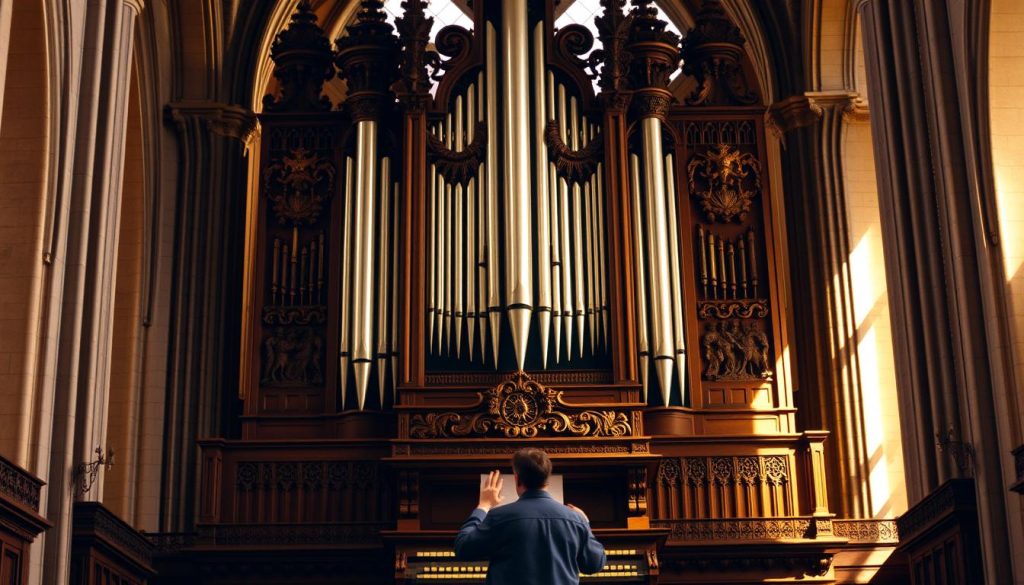
Simple pieces to start with
Begin with short chorales, Magnificat versets—often playable without pedals—and brief toccatas or preludes. These pieces introduce his forms and style without excessive technical demands.
Practical advice and listening suggestions
Organists should favor restrained registrations with 8- and 4-foot foundation stops, avoiding heavy mixtures to preserve contrapuntal clarity. Harpsichordists should attend to articulation and use ornaments sparingly.
Recording suggestions: Antoine Bouchard’s complete organ recordings, toccatas performed by Erik Feller, Hexachordum on harpsichord by Huguette Grémy-Chauliac, and ensemble recordings by London Baroque.
To appreciate the resonance, listen to these works in an acoustic resembling a church; think of Gotha and its historic organ as a model of sound. Explore recordings devoted to Pachelbel’s sons and the Bach family to follow the transmission of their music and place the compositions in the context of their date and parish.
Conclusion
Ultimately, his music for liturgical use combines restraint, grace and contrapuntal invention.
A church organist and composer, Johann Pachelbel united Lutheran tradition with Italian elegance. His music for organ and other keyboards—chorales, preludes, Magnificat fugues and variations, including the chaconnes and Hexachordum Apollinis—speaks in a clear, songlike language.
The cities and courts where he worked shaped a life devoted to music. His ties to the Bach family, especially Ambrosius Bach and his pupil Johann Christoph, anticipated the synthesis that later composers would develop further.
To understand the Canon’s modern reception, read this article on the reasons for its fame. Then continue exploring less frequently performed works on organ and harpsichord, with attention to the acoustics of each setting and the context of the period.