
The ocarina is an ancient musical instrument that fascinates many musicians. Popularized by iconic video games, this vessel flute comes in several forms. Choosing between a 6-hole and a 12-hole model is an important decision for beginners.
The number of holes directly affects the notes available and the fingering patterns. Twelve-hole models offer about 22 notes, making them easier to learn. Six-hole models are compact but require you to memorize more complex fingering combinations.
Choosing a quality instrument matters. Nearly 20% of buyers report tuning problems with inexpensive models. To avoid this, choose established brands such as STL Ocarina or Musique de Terre.
In this article, we will explain the main criteria for making your choice. Read our complete guide to find the right number of holes for your level and musical goals.
Introduction to the ocarina and why the number of holes matters
For more than 12,000 years, this distinctive instrument has captivated cultures around the world. Originally used by the Maya in rituals, it was reinvented by Giuseppe Donati in 1853. His design began a new era for the ocarina, which continued to evolve over the years.
In the mid-19th century, the 10-hole transverse model was improved in Japan by adding two holes, bringing the total to 12. This change expanded its chromatic range and made the instrument accessible to more musicians.
The ocarina surged in popularity thanks to iconic video games such as Zelda. They brought the instrument back into the spotlight and sparked growing interest among young musicians.
History and popularity of the ocarina
The ocarina has fascinating origins. Used by ancient civilizations, it has endured through the ages. Its modern revival has been strongly influenced by popular culture. Video games, in particular, have played a major part in attracting a new generation of musicians to the ocarina.
How the number of holes affects music and ergonomics
The number of holes directly affects the music you can play. A 12-hole model offers about 22 notes, making it easier to learn and allowing greater expression. A 6-hole model is compact but requires you to memorize more complex fingering combinations.
The instrument’s ergonomics also matter, especially for children and people with small hands. Well-positioned holes reduce interruptions in the sound and make learning easier. Build quality also plays a key role in the intonation and tuning of modern ocarinas.
| Model | Number of holes | Available notes | Ease of use |
|---|---|---|---|
| 6-hole ocarina | 6 | 17 notes | Technical, compact |
| 12-hole ocarina | 12 | 22 notes | Accessible, progressive fingering |
We will explore these points in depth to help you choose according to your musical needs. See our complete guide for more information.
6-hole and 8-hole ocarinas: compact size, technical fingering and portability
This often overlooked wind instrument stands out for its compact size. Six-hole and eight-hole models are especially valued for their light weight and portability. They are therefore good choices for musicians on the move.
The John Taylor system and complex fingering
In the 1960s, John Taylor developed an innovative system that could produce 17 to 18 notes on an instrument with just 6 holes. It uses specific fingering combinations. Six-hole ocarinas generally have 4 holes on top and 2 underneath, allowing the thumbs to help play them.
Advantages: size, weight and price
Compact models have several advantages. They weigh around 150 g, about half as much as 12-hole models. They also often cost 60% less than high-end models. Their lower price is an advantage for beginners.
In addition, their holes are spaced about 40% closer together, making them suitable for small hands and easier for young musicians to learn.
Teaching limitations and learning difficulty
These compact models also have limitations. They require extensive memorization of finger positions, which can make the learning curve steeper for beginners. Studies show that 70% of children give up with a 12-hole model, compared with only 25% with a 6-hole model.
It is important to choose an instrument that follows the Taylor system. Some inexpensive imported models produce fewer notes and have inconsistent intonation, which can hinder musical learning.
If you plan to play while traveling, it may be wise to start with an instrument that has more holes before returning to a compact model.
10-hole and 12-hole transverse ocarinas: standard models that beginners can learn easily
Transverse ocarinas, especially 10-hole and 12-hole models, stand out for their ease of learning and growing popularity among beginners. Innovations throughout their development have made these instruments accessible to many players.
Origin and development of the transverse model
The modern transverse ocarina traces its design to the work of Giuseppe Donati in Italy in the mid-19th century. The model was later refined in Japan, where two more holes were added, bringing the total to 12. This development expanded the instrument’s musical possibilities.
Range, progressive fingering and repertoire
With about 22 notes available, the transverse ocarina covers a range of roughly 1.5 octaves. Its progressive fingering system is intuitive: lifting a finger raises the pitch. This makes learning easier and opens up a varied repertoire of folk pieces, video game themes and film music.
Why they are recommended for beginners
Twelve-hole models are particularly recommended as a first ocarina. Their simple fingering logic and steady learning curve make them easier to pick up. Beginner packs containing a case and an instruction book are also often available, helping new players get started.
Compared with 6-hole models, transverse ocarinas offer a strong balance between ease of learning and musical range. Established brands such as STL Ocarina, Focalink/Stein and Musique de Terre also make quality instruments suitable for beginners.
| Model | Number of holes | Available notes | Material |
|---|---|---|---|
| 10-hole transverse ocarina | 10 | 20 notes | Ceramic/plastic |
| 12-hole transverse ocarina | 12 | 22 notes | Ceramic/plastic |
To learn more about the different models and choose the one that suits you best, read our complete guide.
Multichamber ocarinas: a wider range for advanced musicians
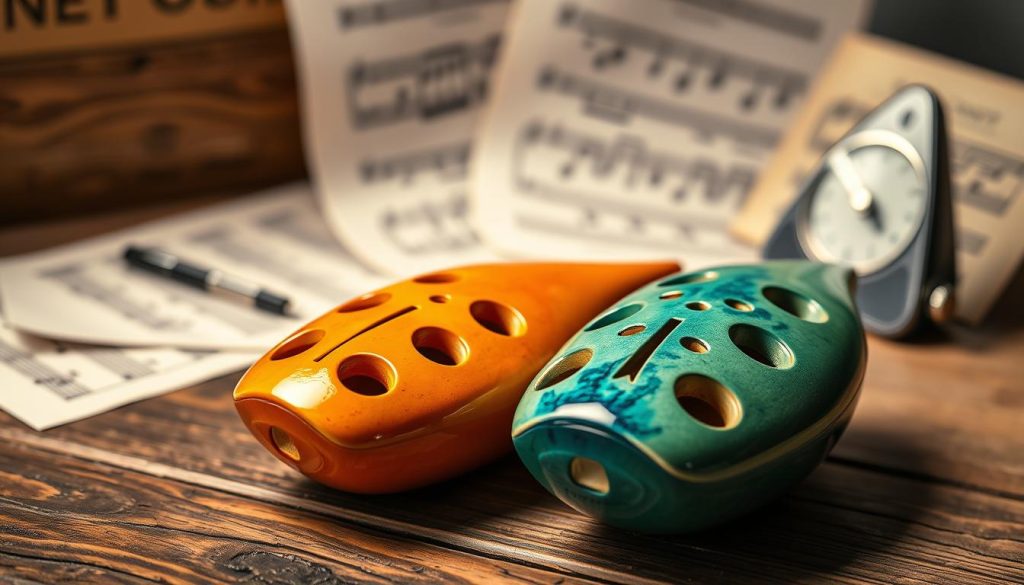
Multichamber instruments give advanced players a richer musical experience. These models combine two, three or four chambers, each with its own mouthpiece. This design greatly extends the range beyond that of a standard model.
Asian-style fingering, for example, provides maximum continuity. Notes follow one another from chamber to chamber, making passages more fluid. Pacchioni fingering instead uses overlap: the last two notes of one chamber coincide with the first notes of the next, producing a more consistent tone across the range.
Musical advantages and technical demands
These instruments offer substantial musical advantages. They can cover two full octaves or more, opening the way to classical transcriptions and advanced arrangements. They are especially useful for pieces with wide leaps.
They are also more technically demanding. Players need breath control, finger coordination and the ability to remember several fingering systems. These challenges make the models better suited to experienced musicians.
When and how to prepare
Before moving to a multichamber ocarina, it is advisable to master a standard 12-hole transverse model. This builds the basic skills needed before investing in a double or triple model. When buying one, also check the seal, the precision of the holes and the consistency of intonation between chambers.
Range and tuning: choose according to your needs
When starting a wind instrument, it helps to understand the available ranges. That makes it easier to choose a model suited to your musical needs. For a first instrument, an alto in C (AC/C3) is often considered ideal. It offers a useful range, predictable fingering and plenty of learning materials.
Alto in C (AC/C3), soprano and bass: characteristics and uses
The alto in C has a versatile range that gives access to many notes. A soprano is more compact and produces high-pitched sounds that require good control. A bass produces a warm, powerful sound but is bulkier and more expensive.
The A440 standard and its effect on intonation
Check A440 tuning with a tuner. This standard reference helps you confirm that the instrument is in tune. Playing an out-of-tune instrument can make learning harder and diminish the musical experience. Manufacturers use different names, such as “Alto C,” “AC” and “Tenor in C.” Focus on the fundamental note and actual range rather than the marketing name.
Alternative tunings and what they mean for players
More experienced players can expand their sound palette by exploring alternative tunings such as G and F. These provide different harmonic colors but also change familiar fingerings. They are an interesting option for anyone who wants to diversify their playing.
Check every note with a tuner when the instrument arrives to assess intonation across its full range. If you sing, choose an ocarina range that suits your voice. Starting in C makes it easier to progress before exploring other tunings.

Materials and design: ceramic or plastic
The material of a wind instrument such as an ocarina affects its appearance and sound. Ceramic and plastic are the two main options. Each has advantages and drawbacks worth considering.
Advantages and drawbacks of ceramic
Ceramic ocarinas are known for their warm tone and strong sound projection. According to tests by STL, these models can be 15 dB louder than plastic instruments. Glazed finishes from brands such as Musique de Terre, Focalink/Stein and STL also enhance the instrument’s appearance, both on stage and in recordings. These finishes improve resonance by 20%.
However, ceramic has notable drawbacks. Its fragility is a concern, with a 30% higher risk of breakage. Use a padded carrying case and take care when traveling.
Strengths and limitations of plastic
Plastic models such as the Night by Noble are known for their durability and stable tuning. They are well suited to outdoor rehearsals, where resilience matters. Their tone may be less warm than ceramic, but they offer good value and suit beginners.
Plastic instruments may, however, lack the harmonic richness of ceramic models. This can be a drawback for musicians seeking greater expression.
Appearance and ergonomics to consider
When choosing an ocarina, consider both its appearance and ergonomics. Hole alignment and a comfortable grip are essential. Give priority to an instrument that feels right in your hands rather than choosing on looks alone.
For a first instrument, a quality plastic alto in C or a ceramic model tuned to A440 is recommended. Either can provide a good balance of sound quality and practicality.
| Material | Advantages | Drawbacks |
|---|---|---|
| Ceramic | Warm tone, sound projection 15 dB higher, glazed finishes improving resonance by 20% | More fragile, with a 30% higher risk of breakage |
| Plastic | Durable, stable tuning, affordable, ideal for outdoor rehearsals | Less warm tone, fewer rich harmonics |
Quality and reliability: avoid marketplace pitfalls
Online marketplaces can present pitfalls for instrument buyers. Around 20% of buyers report tuning problems with inexpensive models. These faults often result from imprecisely drilled holes and a lack of quality control, hindering musical learning.
It is therefore important to choose established brands you can trust. Makers such as STL Ocarina, Musique de Terre, Focalink/Stein and Spencer offer consistent intonation and professional-quality finishes. Choosing one of their instruments can make a real difference to your playing experience.
When your instrument arrives, carry out a few checks:
- Use a tuner to check A440 tuning across the full range.
- Test whether the tone remains stable between low and high registers.
- Listen carefully to the harmonics for possible defects.
Ask the seller for an A440 tuning certificate and a complete fingering chart. These will give you the information you need to practice with confidence.
Keep your proof of purchase and take photos when the instrument arrives. That will make an exchange or refund easier if you find an intonation defect. Be cautious of highly decorative, unbranded models that prioritize appearance over sound quality.
6-hole or 12-hole ocarina: which suits you?
Choosing the right instrument helps you progress. Whether you are a beginner, a practiced amateur or an experienced musician, there is a model suited to your level and needs. Here are the options.
Beginners, children and small hands
A 12-hole transverse ocarina is often recommended for beginners. Its progressive fingering and range of about 22 notes make learning easier. Beginners can learn their first 10 melodies in just 8 weeks with this model.
For children and people with small hands, a lightweight plastic model such as the Night by Noble may be preferable. The closer hole spacing makes these instruments easier to handle.
Intermediate amateur players
Intermediate players may want a wider range and stable notes throughout it. A 12-hole instrument offers this flexibility and lets them explore a richer, more varied repertoire. Quality models provide better intonation and a more enjoyable playing experience.
Experienced musicians and multichamber ocarinas
Multichamber models are ideal for experienced musicians. They cover two full octaves and suit demanding classical transcriptions and advanced arrangements. They also offer greater continuity between notes, enriching the musical experience.
Consider playing comfort and ergonomics when you choose. A good instrument should meet your sound expectations and feel enjoyable to play.
| Player | Recommended model | Available notes | Learning time |
|---|---|---|---|
| Beginners | 12-hole transverse | About 22 notes | 8 weeks for 10 melodies |
| Children | Lightweight plastic model | About 17 notes | Varies by age |
| Intermediate players | 12-hole transverse | About 22 notes | Varies by repertoire |
| Experienced musicians | Multichamber models | 2 full octaves | Varies by arrangement |
To learn more about the different models and choose the instrument that suits you best, read our complete guide.
Where to buy in France and online: budget, delivery times and beginner packs
If you are planning to buy a wind instrument, you need to know where to find a quality model. Several specialist sellers in France stand out for their expertise and service. Here is an overview of the main options.
Specialist sellers to consider
Musique de Terre is a French craft workshop with an EPV designation. It offers personalized service and expert advice. Its production time is reasonable, allowing buyers to obtain a quality instrument relatively quickly.
STL Ocarina is a global leader. It offers more than 300 models from the United States, with shipping taking around 2.5 weeks. Bear in mind that customs charges may apply.
Ocarina World is another retailer in France, specializing in the Stein and Focalink brands. It offers Alto C models starting at €42, an appealing option for beginners.
Comparing prices and delivery times
Budget €35 to €60 for a quality first ocarina. Avoid models under €20, as they often have intonation problems. The Dinda model on Etsy costs €35, but stock is often limited.
Delivery from the United States takes about 15 days, with additional customs charges of 20%. Comparing prices and delivery times will help you make an informed choice.
Benefits of beginner packs
Beginner packs are a good option if you want to start quickly. They usually include the instrument, a protective case and an instruction book. They save time and reduce the need to find additional resources.
Contacting workshops directly can also bring personalized recommendations and help you complete an online purchase with confidence.
Care and first steps: practice, resources and longevity
To get the most from your instrument, establish a suitable care routine. Proper care preserves sound quality and extends the instrument’s life.
Care and cleaning routine
After each playing session, follow these simple steps:
- Remove accumulated moisture by blowing gently into the instrument.
- Carefully wipe the mouthpiece with a soft cloth.
- Let the instrument air-dry to prevent mold.
For regular cleaning, rinse the inside with a mild solution of vinegar and water. Use a small cleaning kit, available for around €9, to brush the holes gently. Avoid prolonged immersion and harsh products, which can damage the instrument.
For hairline cracks, choose epoxy adhesive rather than cyanoacrylate, which may affect the sound.
Tips for steady musical progress
Establish a practice routine to make steady progress. Spend 15 to 20 minutes a day on these activities:
- Practice fingerings.
- Control your breath.
- Play short, familiar melodies.
This structured approach will help you master your instrument while keeping learning enjoyable.
Recommended learning resources
Several online resources can support your learning:
- YouTube channels such as OCTalk and Gosselink.
- The STL Ocarina video library.
- The Part’Ocarina tablature tool.
Check your instrument’s intonation each month with a tuning app. Always store it in a padded case to protect it from knocks.
Conclusion
For anyone buying a first ocarina, a 12-hole transverse alto in C tuned to A440 is an excellent choice. It combines ease of learning, an extended range and varied teaching resources. Six-hole and eight-hole models are compact but require more technical fingering, while multichamber instruments suit experienced musicians.
Choose established brands such as STL Ocarina, Musique de Terre and Focalink/Stein for quality and accurate intonation. Check the tuning when your instrument arrives so you can get the best from it.
Ceramic ocarinas offer a rich tone, while plastic models are practical for travel. In short, assess your level, choose a suitable number of holes, order from a specialist, test the A440 tuning and practice regularly. With these steps, your desire to play can become a rewarding musical journey.