
Purpose of this guide: to offer an annotated selection of organ hymns, place each piece in the context of Baroque church music, and provide accessible listening pointers for English-speaking readers.
This major composer from southern Germany shaped a chorale style in which liturgy and poetry meet. We introduce the main forms: prelude, partita, ornamented chorale, and Magnificat fugue, along with their functions and musical rhetoric.
The sources vary: the P, T, PC, and POP catalogues help identify pieces, while the Tenbury manuscripts shed light on the authenticity of certain works. This guide follows a simple path: biographical background, guided listening to key pieces, an introduction to the cycles, and instructions for using the catalogues.
Approach: what to listen for (cantus firmus, counterpoint, pedal), how to compare versions, and which interpretations to favor in light of historical practice.
Why English-speaking listeners need a complete guide to Pachelbel’s chorales
This guide aims to make the subtleties of Lutheran chorale writing accessible to English-speaking listeners.
Aim and benefits: to listen more closely to Baroque church music. Readers learn to identify the cantus firmus, the pattern of entries, and the role of each voice. Understanding thus deepens enjoyment.
Historical context
According to Michel Rusquet, Pachelbel’s output is distinguished by its gentleness and modesty. This restrained style later influenced J. S. Bach.
In practice: the organ served worship, while the harpsichord extended meditation into the home. Comparing the organ, harpsichord, and piano helps reveal the polyphonic structure.
- The organist establishes the key and accompanies the singing of the psalms.
- Guided listening reveals imitative techniques and thematic shapes.
- This guide offers simple pointers for making progress step by step.
| Aspect | Benefit for the listener | Recommended listening |
|---|---|---|
| Cantus firmus | Identify the main melody | Organ / harpsichord |
| Role of the organist | Structure of the service | Recording of a liturgical performance |
| Variations | Understand the form | Piano arrangements |
Biographical background for understanding the church music
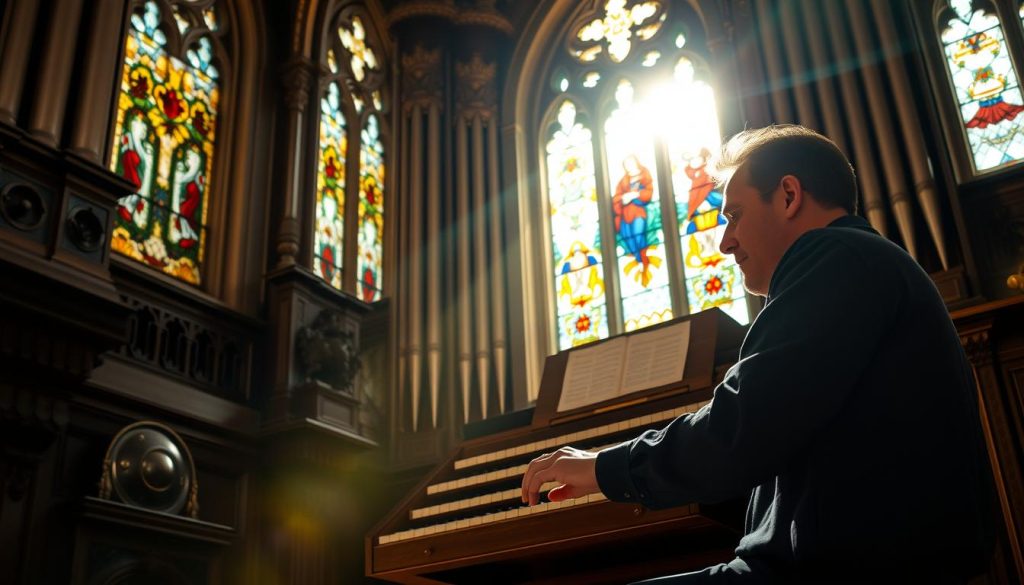
His travels largely explain the variety of timbres and forms in his writing for the organ. Born in Nuremberg in 1653 and deceased in 1706, this composer worked in Vienna, Eisenach, Erfurt, Stuttgart, and Gotha before returning to St. Sebald’s.
From Nuremberg to Gotha and back: an organist serving the Church
Each position enriched his liturgical language. At St. Stephen’s in Vienna and then at Erfurt’s Predigerkirche, the acoustics and instrument shaped his use of the pedal and choice of stops.
This path forged a practice centered on worship and teaching. His role as an organist thus became the source of clear, devout forms.
Connections and influences: the Bach family, Georg Böhm, pupils, and sons
In Eisenach, he associated with the Bach family and was influenced by a local school of music. He taught a notable pupil, Johann Christoph, who provided a direct link to Johann Sebastian Bach.
Among related figures, Georg Böhm stands out for his sense of ornamentation.
“The passing of knowledge from teachers to their successors explains the poetic and liturgical strength of these pieces.”
| City | Position | Effect on his writing |
|---|---|---|
| Vienna | St. Stephen’s | Preludes and liturgical accompaniment |
| Eisenach | Court | Encounters with the Bach family and stylistic exchanges |
| Nuremberg | St. Sebald’s | Teaching, succession by his sons, and pastoral maturity |
This background helps listeners place the music in context and understand choices of tempo, stops, and devotional expression.
Johann Pachelbel’s chorale works: an annotated selection
A starting point for understanding his church music: these pieces balance liturgical function with melodic invention. They remain close to worship while offering genuine expressive freedom.
Ornamented and fugal chorales: the signature of a poetic organist
The ornamented chorale here consists of a cantus firmus sustained in long notes and supported by imitative writing. This form combines long notes with contrapuntal entries. It is a true hallmark of the composer.
Chorale preludes, “Choräle zum praeambuliren” (Nuremberg, 1693)
These short preludes establish the key and prepare the congregation. Their themes include Ich ruf zu dir and Wie schön leuchtet. They appear in the P, T, PC, and POP catalogues and suit both the organ and a keyboard instrument at home.
Chorale variations, “Musicalische Sterbens-Gedancken” (1683)
This collection contains four sets of variations, including Christus, der ist mein Leben (12 variations). It reflects a year of mourning and expresses an intimate, restrained, and intense devotion.
- Listening pointers: identify the cantus firmus and follow the imitative entries.
- Starting points: begin with Herzlich tut mich verlangen, then try a lively prelude on Wie schön leuchtet in G minor.
- Organ and keyboard: these pieces move easily between instruments, revealing a continuity of devotional expression.
Together, these pieces form a major liturgical core within his work. They illuminate the composer’s writing and his relationship with sacred music.
Organ chorale preludes: key pieces and what to listen for
Chorale preludes for the organ provide a dramatic setting in which faith and contrapuntal structure meet.
Christ lag in Todesbanden: tension between mourning and Alleluia
Christ lag in Todesbanden works like a diptych. First, listen to the austere fugato: restrained voices, close imitation, and a clear bass line.
Then identify the cantus firmus in long notes on the pedals and the Alleluia that brightens the ending. This dramatic contrast is the key to the form.
An Wasserflüssen Babylon, Ein feste Burg, Warum betrübst du dich, mein Herz
In An Wasserflüssen Babylon, follow the contemplative line and the gentle entries. Pay attention to the long notes in the pedal part.
In Ein feste Burg and Warum betrübst du dich, mein Herz, notice the contrast between rhythmic energy and intimate lament. Compare the treatment of the cantus firmus with that of the fugue.
Organ and harpsichord: writing that sometimes suits either instrument
Several preludes can also be played on the harpsichord because the writing remains clear and polyphonic. The Lutheran practice of Hausmusik explains this versatility.
Advice on choosing stops: use a gentle principal for the cantus, flutes for the upper voices, and a clearly audible pedal bass.
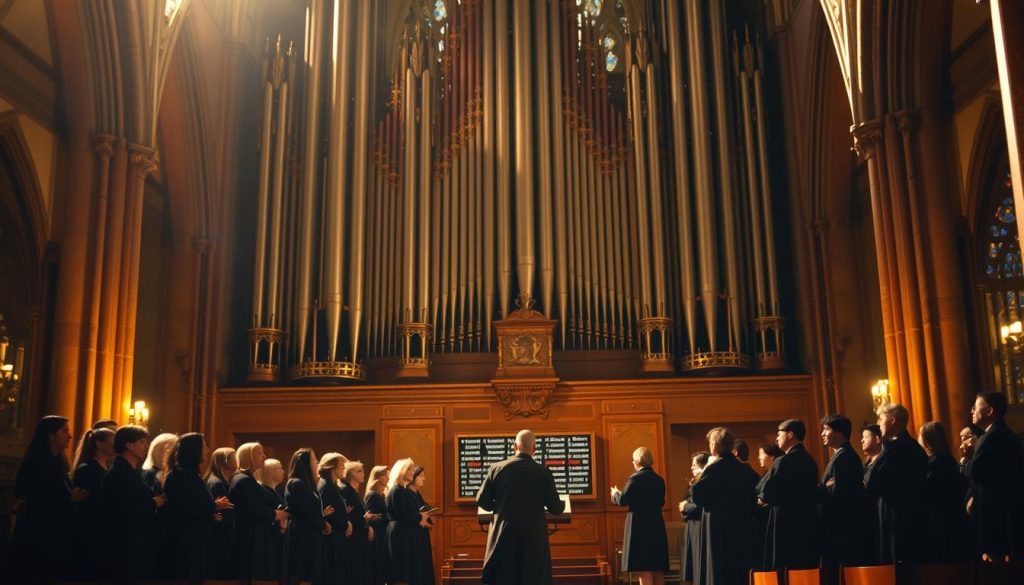
“Identifying the fugato, cantus firmus, and Alleluia reveals the inner drama of these pieces.”
- Suggested listening order: Warum betrübst du dich…, An Wasserflüssen Babylon, Christ lag in Todesbanden.
- Compare performances in G minor and G major to hear how the key affects the inner voices.
- Keep differences of attribution among the catalogues in mind: focus your listening on form and liturgical purpose.
Chorale variations and the art of variation
These variation cycles reveal an intimate practice in which prayer takes musical form.
Musicalische Sterbens-Gedancken (1683) brings together sets including Christus, der ist mein Leben (12 variations), Alle Menschen müssen sterben, Herzlich tut mich verlangen, and Was Gott tut, das ist wohlgetan.
Written in years marked by plague, these pieces turn the theme into a meditation. Each variation keeps the theme recognizable while changing its rhythm, counterpoint, and ornamentation.
Listening and performance tips
In Christus, der ist mein Leben, listen to the clear statement of the theme, followed by variations that alternate full textures with light ornamentation.
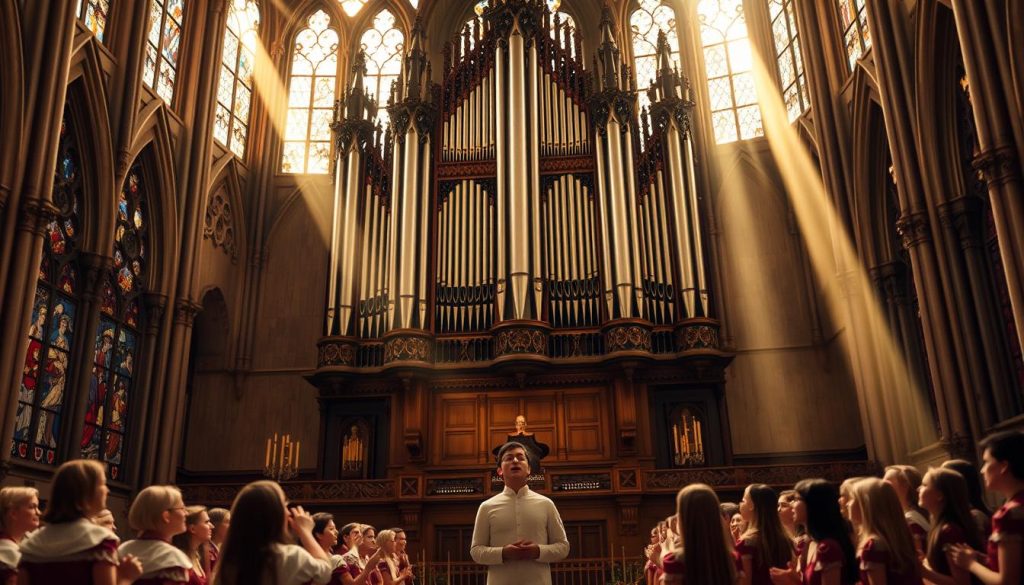
In Werde munter, mein Gemüte and Freu dich sehr, o meine Seele, follow how the theme remains at the heart of each variation.
“Variation is no empty display of virtuosity: it becomes spiritual discourse and consolation.”
- Listening exercise: identify the meter, the figuration, and what remains constant.
- Performance: choose restrained stops on the organ or a crisp touch on the keyboard.
- Compare the moods in G major to hear the play of light and shade.
| Cycle | Role | Listening tip |
|---|---|---|
| Musicalische Sterbens-Gedancken | Prayer and consolation | Follow the theme’s development |
| Werde munter, mein Gemüte | Expressive partitas | Notice the expressive arc |
| Freu dich sehr, o meine Seele | Calm and gentle movement | Notice the embellishments |
Magnificat fugues: a “garden” of 94 miniatures
Ninety-four miniatures make up this cycle. Each is brief yet expressive. Specialists describe them as a true musical garden, with every piece having its own character.
Organization by mode and key
The works are classified by church mode: primi toni (D minor, more than 20 pieces), secundi toni (G minor, about 10), tertii toni (C/G major, 12 incipits), and quarti, quinti, and sexti toni (A/E minor, F/B-flat major, F major).
Guided listening: subjects, answers, and restrained pedal use
As you listen, identify the subject and its answer. These short fugues favor economy of means and clear writing.
The pedal is rarely used; the bass supports the polyphony without dominating it. Listen for clear counterpoint and the distinct shape of each piece.
Influence on Bach and liturgical role
These pieces served as interludes during the sung Magnificat. They established the key and focused the congregation’s attention.
Listening tip: begin with a secundi toni fugue in G minor for its restraint, then continue with a tertii toni fugue in G major for its clarity. Compare the choice of stops and use of the pedal according to the organ and the acoustics.
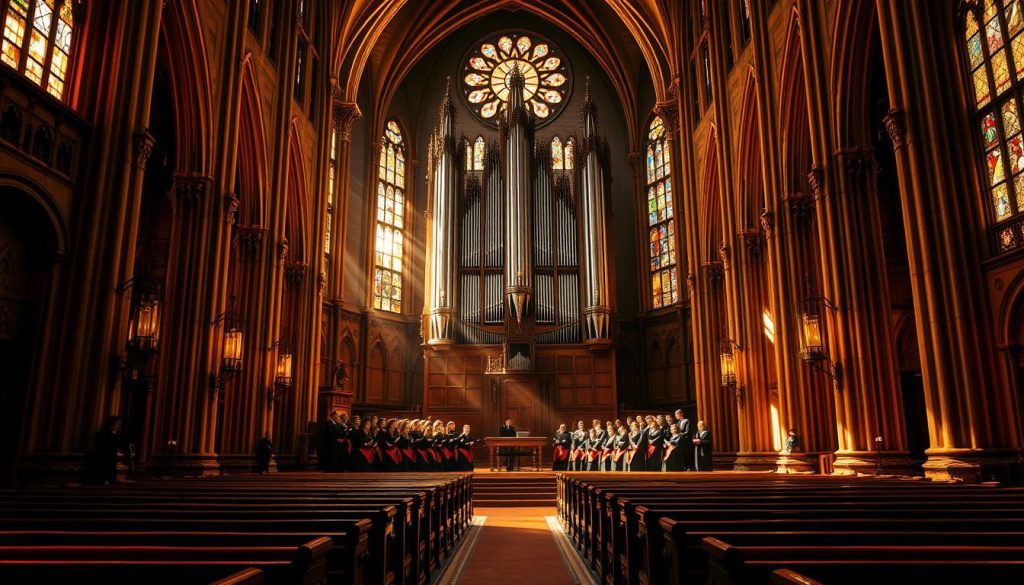
“A model of concision that would influence Bach’s art of fugue.”
Hexachordum Apollinis and the famous Canon: bass lines and variations
Hexachordum Apollinis (1699) brings together six sets of aria variations much admired by harpsichordists. The collection shows a decorative yet measured style conceived for the harpsichord, though it also suits the organ or piano.
Aria sexta “sebaldina”: melancholy and eight variations
The Aria sexta, in F minor, presents an understated theme followed by eight variations. Each explores different rhythms, textures, and ornaments.
The method remains simple: the theme stays recognizable while the musical surface changes through figuration and embellishment. Compare the harpsichord and organ to hear differences in color and attack.
Canon and Gigue in D major: from continuo bass to popular culture
The famous Canon and Gigue in D major was written for three violins and basso continuo. The canon rests on a repeating bass line heard 54 times, above which the imitative parts unfold.
Its strength lies in the simplicity of its structure and the natural flow of its melody. The piece can be adapted for many instruments and has inspired numerous arrangements, especially for piano, before becoming widely popular in the twentieth century.
- Listening tip: follow the continuo bass and identify the strict imitation between the violins.
- Enjoy the closing gigue for its rhythmic freedom and energy in G major.
- Compare the Baroque ensemble with modern versions to hear the effects of timbre and phrasing.
“Formal simplicity allows a wealth of instrumental adaptations and lasting popularity.”
Cataloguing and finding the pieces: P, T, PC, POP, and manuscripts
Consulting the catalogues helps locate missing pieces and clarify doubtful attributions. The principal catalogues complement one another: P (Perreault, 2001), T (Tsukamoto, 2002, online), PC (Welter, 1998), and POP (Bouchard, for organ music).
Understanding the abbreviations and their uses
P often serves as a thematic starting point, with lists organized by chorale, prelude, and suite.
T provides convenient online access and makes it easier to check opening musical phrases quickly.
PC (Welter) offers a separate numbering system when opening phrases are unavailable. POP adds references for organ editions.
Tenbury manuscripts, doubtful attributions, and lost works
The Tenbury manuscripts (Bodleian Library) are among the few sources close to an autograph. They are essential for distinguishing variants and tracing their transmission.
The symbols help readers navigate the catalogues: * marks an uncertain attribution; ! indicates an apparently lost composition. Watch for similar titles and opening phrases.
“Start with the chorale title, note its P/T/PC numbers, then check those references against POP to verify the attribution and instrumentation.”
- Begin with the title or opening phrase, then note the P/T/PC numbers.
- Check for a matching POP entry if you are looking for an organ version.
- Compare publication years to trace variants and attributions that appeared in later editions.
| Catalogue | Key year | Main use |
|---|---|---|
| P (Perreault) | 2001 | Thematic lists and identification by chorale |
| T (Tsukamoto) | 2002 | Online access, opening musical phrases, and quick checks |
| PC (Welter) | 1998 | Supplementary numbering when opening phrases are missing |
| POP (Bouchard) | — | References for organ editions and recordings |
A practical example: find a prelude listed in P, check its opening phrase in T, consult POP for an organ edition, and read the notes, which sometimes mention Georg Böhm as a possible composer. To plan a listening program, use the classification of Magnificat fugues by mode (for example, secundi toni in G minor and tertii toni in G major).
Conclusion
Pachelbel’s music has a pastoral clarity that invites meditative listening.
This composer and organist gave the organ and keyboard preludes, Magnificat fugues, and variation cycles that remain models of restraint and grace.
His influence, passed through a pupil to Johann Sebastian Bach, can be heard in the form and mastery of counterpoint.
Explore the pieces by alternating between G minor and G major, comparing organ, harpsichord, and piano, and going beyond the famous canon for violins and basso continuo: the richness of the suites and variations reveals the full extent of the composer’s art.
Hearing these works in a church or concert hall brings out their meditative power and living legacy.