Short answer: he played the organ above all. A Baroque organist and composer, he also wrote for the harpsichord and for ensembles with basso continuo, as in the famous Canon in D major.
Born in Nuremberg (1653–1706), Johann Pachelbel held organist posts in several German cities. His daily work in church explains the central place of the organ in his music.
His output combines liturgical music and pieces for private performance. It includes chorales, preludes, fugues, toccatas and suites. These forms reflect precise writing typical of the Baroque period.
We will first trace his career as an organist, then look at the roles of the organ and harpsichord in his compositions. Finally, an overview of his works will show how his preferred instruments shaped his musical language.
The career of a Baroque organist: from Nuremberg to Gotha and back
His career as an organist took him to courts, cathedrals and churches, marking a steady rise from Regensburg to Nuremberg.
Training and mentors. At the Gymnasium Poeticum in Regensburg, he met Kaspar Prentz, who introduced him to a southern German approach attentive to rigor and composition. In Vienna, his studies with Johann Kaspar Kerll rounded out this training.
Posts and chronology. After an initial post as a parish organist in Altdorf, he became an organist in Vienna (1673), then served at the court in Eisenach (1677), the Predigerkirche in Erfurt (1678), and the courts of Stuttgart (1690) and Gotha (1692–1695).
In 1695, he returned to his native city to take a post at Nuremberg’s Sebalduskirche, which he held until 1706.
Connections and influences. A friend of Ambrosius Bach and close to the Bach family, he belonged to a wider musical network across regions that foreshadowed his links with Johann Sebastian Bach. Churches and court chapels became places where the organ demanded technical skill and inspired his compositions, sometimes complemented by the harpsichord.
This career shows how cities, mentors and religious institutions shaped a solid command of the organ during the period, marked by the clarity of southern German music.
To learn more about his life and influence, read the entry on Johann Pachelbel.
What instrument did Johann Pachelbel play? A closer look at the organ, harpsichord and basso continuo
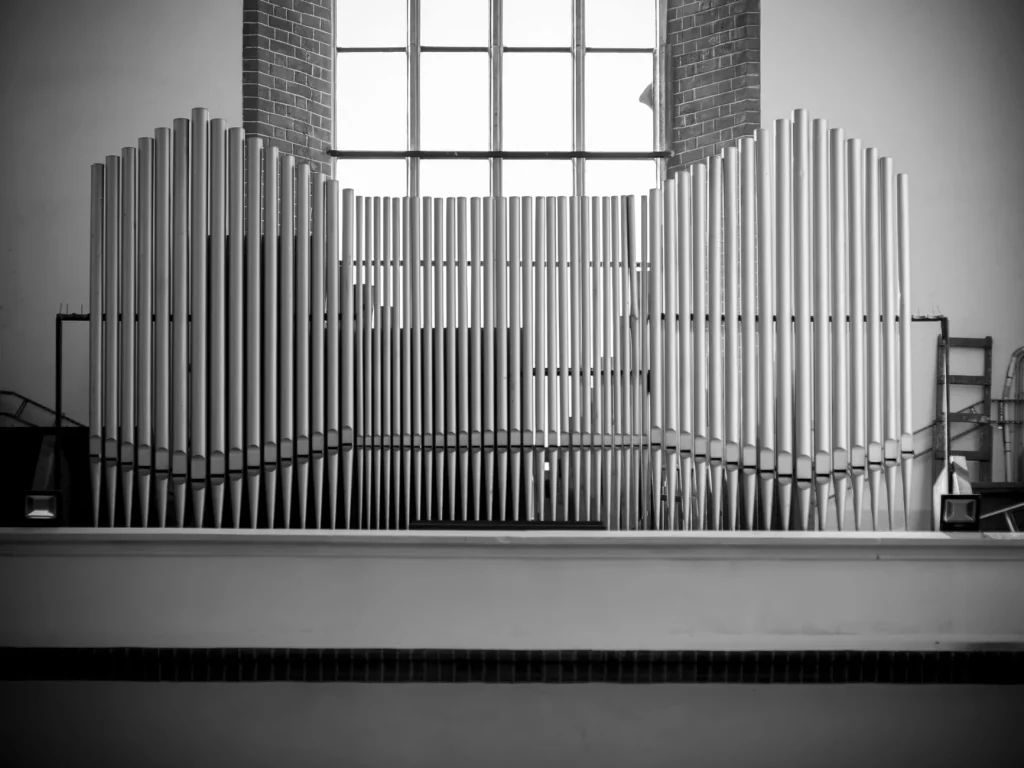
The organ occupies a central place in his music. It accompanies singing, opens worship with chorale preludes and sets the tone for the congregation. The preludes and short fugues serve the liturgy while illustrating the clarity of his counterpoint.

The organ, his instrument of choice
In the churches of Eisenach, Erfurt and Gotha, as well as at the Sebalduskirche, the organ shaped his work. Its range of stops and tone colors—flutes, mixtures and reeds—could support both chorales and solo singing.
Keyboards and harpsichord
The harpsichord and other keyboard instruments were used to play suites, ricercars and fantasias. His writing for them remained dense and controlled, suited to domestic use and teaching.
The Canon in D major
Pachelbel’s Canon sets three violins over an ostinato basso continuo repeated 54 times. This cumulative structure adapts readily from private performance to the orchestra without losing the original idea.
Gotha’s Margarethenkirche
The historic organ, rebuilt by Karl Schuke in 1961, has three manuals, a pedalboard and a range of stops (Prinzipal, Mixtur, Dulzian and Trompete). Its design allows varied registrations suited to worship.
- Use of preludes: functional and expressive.
- Toccatas and fugues: clarity over virtuosity.
- Registration: reeds for color, mixtures for brilliance.
Works, genres and style: chorales, Magnificat fugues, variations and motets
His instrumental and vocal output reveals a range of music shaped by liturgical needs and contrapuntal clarity.
Chorales and cantus firmus. Chorales occupy a central place in his organ repertoire. The lines remain clear, while imitative accompaniment supports the sung melody. The form favors stability in the service of prayer and understanding the text.
Preludes and music for worship. The chorale preludes are brief and functional. They establish the key and balance of the voices before the singing begins.
Magnificat fugues
The collection of Magnificat fugues contains about 94 to 95 short works. They cover the eight liturgical tones and were used to alternate with singing. Most are concise, often without pedals, and meet the practical needs of worship.
Variations and collections
The collections Musikalische Sterbensgedanken (1683) and Hexachordum Apollinis (1699) show a restrained art of variation. Their variations favor harmonic clarity and contrapuntal invention and were often conceived for keyboard.
Other genres and writing
His works also include toccatas, ricercars, fantasias, suites and motets. This variety confirms a style shaped by religious use and daily practice.
| Genre | Function | Characteristics | Examples |
|---|---|---|---|
| Chorales | Liturgy | Clear lines, cantus firmus | Chorale preludes |
| Magnificat fugues | Alternation of singing and organ | Short, covering all eight tones | 94 to 95 fugues |
| Variations | Keyboard performance | Restraint, inventive combinations | Musikalische Sterbensgedanken, Hexachordum Apollinis |
This writing favors clear forms and brevity. It enriched the German classical music tradition and prepared the way for developments Bach would pursue later.
To explore a collection of his organ works, see the organ works collection.
Conclusion
His career shows a lasting commitment to church instruments, with the organ at the center of his artistic practice.
In short, Johann Pachelbel was above all a church organist and composer, while also playing keyboard instruments for pieces intended for private performance and study. This dual practice contributed to the formal clarity of his works.
His legacy rests both on keyboard collections and Magnificat fugues, which left their mark on the classical music tradition, and on Pachelbel’s Canon for three violins and bass, widely heard in arrangements for orchestra.
Understanding his preferred instruments sheds light on how he composed and how his works have been received, from the church organ to concert arrangements.