
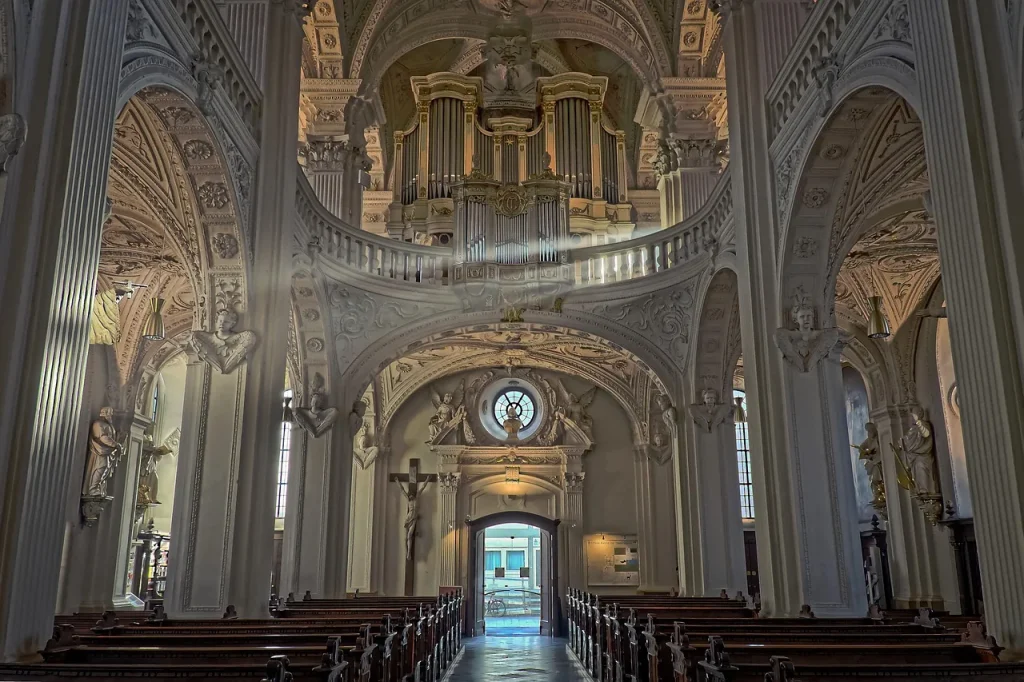
This guide offers a clear introduction to the music of a great Baroque composer who is too often reduced to a single piece.
Aim: to provide historical and practical pointers for listening more closely to a composer whose work belongs both to the church and to the home.
You will discover how the organ and harpsichord shape his art, and how quiet grace and lucid polyphony characterize his writing.
The guide follows the genres—chorales, fugues, toccatas, chaconnes and suites—with examples and advice on interpretation.
Context: born and buried in Nuremberg, he was a leading figure of the South German organ school and directly influenced the Bach family. To understand the fame of his Canon, read this detailed article on why it became so well known.
Why listen to Johann Pachelbel’s essential works today?
His repertoire bridges worship and domestic life. Its clear musical language appeals to audiences and helps music lovers develop their ear.
Know what you want from listening: discovery, immediate enjoyment and lasting musical understanding are different aims. The Canon’s rediscovery in the twentieth century brought his music into popular culture, while his organ and harpsichord pieces remain part of the classical repertoire.
What you gain: a feel for counterpoint, an understanding of musical forms and a sense of harmonic direction. Figured and fugal chorales show how faith and polyphony speak to each other.
“A simple melody can become the starting point for unshowy invention.”
| Form | Example | Context | Duration |
|---|---|---|---|
| Canon | Canon in D | Drawing rooms and ceremonies | 4 to 6 min |
| Chorale | Figured chorale | Worship | 3 to 8 min |
| Fugue / ricercar | Magnificat Fugues | Study and devotion | 5 to 10 min |
Listening in different places—through headphones, in a living room or in a church—helps reveal the music’s structure and the character of the instrument. After a few hearings, you can follow the themes and harmonic progressions running through the works.
Johann Pachelbel, Baroque composer and organist from Nuremberg
His career shows how rigorous training in Nuremberg combined with influences from Vienna and Eisenach. Baptized on 1 September 1653 and deceased on 3 March 1706, he remained closely tied to his home city.
Life and education
Taught by Heinrich Schwemmer and probably associated with Georg Caspar Wecker, he attended the St. Lorenz Hauptschule. He continued his studies at the University of Altdorf (1669), then at the Gymnasium Poeticum in Regensburg.
A musician between church and home
In 1673, he became an organist at St. Stephen’s Cathedral in Vienna. After posts in Eisenach (1677) and Erfurt (at the Predigerkirche from 1678), his contract required him to compose chorales regularly and a major piece each year.
A friend of the Bach family and godfather to one of its members, he passed on his art to students and to his children, who were also musicians. His practice of Hausmusik connected the church organ with the harpsichord at home.
| Period | Place | Role |
|---|---|---|
| 1669 | Altdorf / Regensburg | Studies and training |
| 1673 | Vienna | Cathedral organist |
| 1678– | Erfurt | Organist, teacher, annual compositions |
For more on his life and local context, read a detailed biography covering his career and family connections.
Pachelbel’s style: gentleness, grace, modesty and unobtrusive mastery
His style is defined by carefully crafted simplicity. The polyphony unfolds naturally, with every voice remaining clear and songlike within a harmonious texture.
The Lutheran tradition plays a central role. It calls for the chorale to be intelligible, the words to be clearly expressed and the sense of prayer to continue even in instrumental pieces.
The basso continuo provides a foundation. It supports the rhythm and harmony without weighing the music down, allowing the melodic lines to shine with restraint.
“An art without excess or showmanship: natural melodies, compositional skill and expressive modesty.”
Form, instruments and purpose
Form is never an excuse for display: fugues, toccatas and chaconnes serve structural needs and a language of restrained emotion.
| Element | Function | Effect on the listener |
|---|---|---|
| Polyphony | Clarity of the voices | Attentive listening |
| Basso continuo | Harmonic foundation | Stability without heaviness |
| Use of both organ and harpsichord | Church and home | Daily music-making and devotion |
This economy of expression heightens the emotion. Restraint rewards attentive listening, as each inflection gains meaning within the music’s flow.
Canon and Gigue in D major: a popular classic and more
The Canon and Gigue in D major form an instantly recognizable pair in the chamber repertoire. The work brings together three violins and basso continuo in music that combines song and dance.
This is an accompanied canon: the voices overlap as they take up the theme, while a repeated bass supports an eight-bar harmonic progression. This simple structure has inspired many modern composers and arrangers.
The main theme returns again and again, creating a gradual rise. Even in a solo piano performance, repetition and the clarity of the bass preserve its sense of serenity.
The Gigue, often overlooked, extends the work through lively rhythmic counterpoint. It brings lightness to a chamber concert setting and shows the balance between reflection and dance.
- Chamber version: the original elegance and richness of instrumental color.
- Harpsichord transcription: crisp attacks and transparency.
- Piano arrangement: broad resonance and a modern adaptation.
“The eight-bar harmonic progression gave the Canon a second life in the twentieth century.”
| Element | Effect | Why listen |
|---|---|---|
| Accompanied canon | Clear outlines | Appreciate the counterpoint |
| Repeated bass | Harmonic stability | A guide for the ear |
| Gigue | Dance rhythm | Counterpoint and movement |
Organ chorales: the art of figured, varied and fugal settings
In his catalogue, the chorale becomes both a field for contrapuntal invention and a space for focused prayer.
Chorales hold a major place: variation, figuration and fugato serve the cantus firmus without obscuring it. Their liturgical function comes first, while musical creativity deepens the expression of sacred words.
Christ lag in Todesbanden: austerity and joy together
This piece presents an austere fugato in dialogue with a firm cantus firmus in the pedals.
The manuals often respond with joyful flourishes. The contrast creates drama while keeping the music in the service of worship.
Musikalische Sterbensgedanken (1683): meditation and acceptance
This cycle of four chorales bears the mark of personal bereavement. Sorrow is joined by measured acceptance.
Each chorale takes a different approach, whether ornamentation, close imitation or sensitive expression.
Other pieces to discover
To begin, choose Ein’ feste Burg and An Wasserflüssen Babylon. They reveal a range of moods and techniques.
Remember that this is an art closely bound to worship, yet still able to move a modern listener.
“In Pachelbel’s hands, the chorale joins liturgical discipline with contrapuntal refinement.”
| Type | Feature | Effect |
|---|---|---|
| Figured chorale | Ornaments and details | Expression and depth |
| Varied chorale | Melodic variations | Richness of color |
| Fugal chorale | Close imitation | Contrapuntal clarity |
Listening tip: choose a South German organ. Its registration and acoustic setting reveal the balance between musical layers and the movement of the voices.
For practical advice on performance, read this guide to interpretation.
Fugues and ricercari: freedom of movement and a playful spirit
These contrapuntal works show lively invention, sometimes meditative and sometimes playful. They combine discipline with lightness, displaying a varied range of characters.

Magnificat Fugues: a garden of varied colors
There are 94 Magnificat Fugues and 26 free fugues. They explore contrasting forms, with clear statements of the subject, answers and episodes that hold surprises.
Critics such as Guillard and Alain note his resourceful imagination and quiet humor.
Ricercar in C minor: craft, restraint and inward song
By contrast, the Ricercar in C minor is more austere. It favors contrapuntal density and the inward movement of the voices.
Alternate short fugues with an excerpt from a ricercar to hear the expressive range. A brief example makes the connection with Johann Sebastian clearer while revealing what is distinctive about Pachelbel.
“Freedom of movement and economy of effect: the music speaks without affectation.”
| Type | Number | Character |
|---|---|---|
| Free fugues | 26 | Flexible, sometimes vivid |
| Magnificat Fugues | 94 | Varied, a tonal “garden” |
| Ricercar (C minor) | 1 notable work | Dense, restrained, meditative |
Toccatas and preludes: restrained virtuosity, moonlit poetry
The toccatas and preludes in this repertoire avoid excess. They favor clarity and proportion. The 16 toccatas and seven preludes stand apart from the North German stylus phantasticus.
The toccatas are studies in texture and momentum. Their virtuosity lies within regular structures and flowing figures. The Toccata in E minor impresses through its breadth and vitality.
Toccatas in E minor and G major: energy and intimacy
The Toccata in G major offers greater intimacy and brightness. Clarity takes precedence over rhetorical excess. Its sure touch reveals an ear attentive to musical structure.
Preludes: regular structures, fertile invention and tonic pedal notes
The preludes share the same economy. Inventive short motifs connect through harmonic logic, often built around sustained tonic notes in the pedals.
“Brilliance remains restrained: the musical line comes first and reveals the structure within.”
| Type | Characteristic | Listening effect |
|---|---|---|
| Toccata (E minor) | Breadth, energy | Dramatic impact |
| Toccata (G major) | Intimacy, clarity | Expressive closeness |
| Prelude | Tonic pedal notes, short motifs | Concentration and finesse |
Tip: choose an organ recording to hear how the acoustic gives the music room to breathe. Listen through headphones, too, to catch the inflections and phrasing. This reveals how strongly the musical line guides the work.
Keyboard fantasias: gems of understated emotion
The fantasias for keyboard give imagination room to shape the musical argument. They offer an intimate eloquence that favors expressive freedom over strict form.
Fantasia in G minor: suspensions, modulations and chromaticism
The Fantasia in G minor is often called a “gem of understated emotion” (Guillard, Sacre). Its suspensions shape the phrasing, while modulations arrive as small surprises.
Its chromaticism remains measured, creating gentle but persistent tension without disturbing the melodic clarity.
Listen slowly and let the harmonies resolve. Notice how each harmonic turn changes the phrase’s sense of breath.
Performance advice: use a soft touch on the harpsichord and the pedal sparingly on the piano to keep the lines clear. Compare the brighter Fantasia in C major to hear the range of expression.
The fantasia is more than a virtuoso piece; it tells a small, intimate story. It shows how music can be both simple and deeply crafted.
Chaconnes: variation, contemplation and melodic ingenuity
Over an unwavering bass, the chaconne develops variations that invite contemplation. The form rests on a repeated line that supports gradual development and flexible invention.
The repertoire includes six chaconnes. The composition in F minor is regarded as a high point: dense and rhythmic, it builds toward seemingly inevitable peaks. Its contrapuntal richness has sometimes earned it the nickname “Pachelbel’s Goldberg Variations.”
The Chaconne in D major recalls the Canon through its harmonic foundation. The resemblance gives listeners an immediate point of reference and renews interest in the repeated theme.
Another marvel, the Chaconne in F major, presents forty variations on a four-note motif. It is a striking example of how a constraint can inspire invention.
Listening tip: compare harpsichord, organ and piano versions. Attack and resonance change how you hear the same music.
“Listen to three chaconnes in succession: their diversity grows from the same formal pattern.”
| Chaconne | Characteristic | Why listen |
|---|---|---|
| F minor | Rhythmic density, expressive peaks | A contrapuntal masterpiece |
| D major | A harmonic foundation akin to the Canon’s | An echo of the Canon’s harmony |
| F major | 40 variations on four notes | An exercise in invention |
Hexachordum Apollinis: varied arias and a measured art
Published in 1699, this collection brings together six arias with variations. It is a high point of short-form variation, with each theme serving as the basis for coherent, refined transformations.

Aria sexta (Sebaldina): gentle melancholy and eight variations
The Aria sexta, in F minor, presents a restrained theme followed by eight melancholy variations. Its transformations explore nuance and texture without exaggeration.
The contrasts depend on articulation and color, giving harpsichordists an exercise in subtlety and measured expression.
Aria prima: decorative ease and artful craft without artifice
The Aria prima combines decorative elegance with firm structure, showing Pachelbel’s command of the genre. It is learned music, clear and free of grand gestures.
The collection also has a teaching purpose: it offers a lesson in the style and ornamentation of its era.
“A compact study of variation in which precise musical gestures matter more than showy virtuosity.”
Listening tip: choose the harpsichord to hear the precision of each attack and the delicacy of the shading. Notice how tempo and articulation transform the same theme.
Harpsichord suites: a map of keys before its time
Twenty-one keyboard suites, seventeen of them dated 1683, range across seventeen keys. They form a kind of sonic “map” that anticipates ideas about temperament while serving everyday music-making.
Each suite follows the German pattern—allemande, courante, sarabande, gigue—often enriched with an aria, ballet or gavotte. These stylized dances have distinct tempos, meters and characters.
The French style appears here in measured ornamentation and an inward sense of dance. Balanced lines favor clarity and grace over emphasis.
Listening to a complete suite reveals an understated dramatic arc: the pieces speak to one another and leave room to breathe. Compare the added movements, such as an aria or gavotte, to hear how they provide contrast and repose.
Value for learners: these suites train the hand and ear. They develop articulation, phrasing and the subtle rhythmic feel of dance music.
“A suite is a short journey through a key, joining musical gesture with form.”
Chamber works: Musicalische Ergötzung and scordatura
The pieces for two violins and bass form a small stage for shared invention. Musicalische Ergötzung contains six suites for two violins and basso continuo. They capture the spirit of music-making at home while taking real harmonic risks.

Scordatura varies the instrumental colors: retuning the strings changes their sound and makes certain passages easier to play. The practice recalls Biber’s without being identical to it.
The basso continuo holds the harmony and rhythm together. It supports the dialogue between the violins and anchors the three-part conversation that characterizes these pieces.
These works show how South German composers could explore harmonic innovations while remaining approachable. To hear the similarities and differences, compare the suites with works by Biber.
“Entertainment and experiment coexist here, revealing pieces that are both sociable and sophisticated.”
- Recommended listening: mix excerpts of chamber music with organ pieces to hear the composer’s two instrumental worlds.
Pachelbel and the Bach family: artistic influence and teaching
The ties between this master organist and the Bach family reveal the passing on of practical skills as well as musical ideas. In Eisenach and then Erfurt, their relationships involved friendship, godparenthood and teaching.
From Johann Christoph to Johann Sebastian: influence and transmission
He gave lessons to Johann Christoph Bach (1671–1721). That teaching later influenced Johann Christoph’s brother, Johann Sebastian, who benefited from the groundwork already laid.
Documents attest to ties of godparenthood and illuminate a formative period in Erfurt, where Pachelbel strengthened his standing.
In musical terms, contrapuntal clarity and devotion to the chorale shaped the family’s practice. The organ became the focus of this transmission.
“Chorales, preludes and fugues served as models of structure and expression.”
| Element | Role | Impact |
|---|---|---|
| Lessons for Johann Christoph | Practical teaching | Development of the family style |
| Godparenthood | Social connection | Sharing of liturgical practices |
| Years in Erfurt | Consolidation | Regional influence |
To hear this artistic connection, listen first to a Pachelbel chorale and then to a chorale prelude by Johann Sebastian. You will hear both continuity and change.
Listening guide: organ, harpsichord, piano and modern versions
Choosing an organ, harpsichord or piano profoundly changes how you hear nuance and musical structure. This short guide helps you select recordings by instrument, setting and approach to performance.

Choosing recordings: churches, acoustics and period instruments
Favor historic organs or faithful copies, especially in a reverberant church.
The space sustains the instrumental colors and clarifies the musical layers. Listen for the temperament and the balance between voices.
Compare live performances with studio recordings to hear the effect of the setting.
Piano versions today: faithful transcriptions and arrangements
Solo piano transcriptions have popularized some pieces. Choose between faithful performances and neo-Romantic rearrangements.
Faithfulness to the score favors clarity of line; rearrangements change the phrasing and use of the pedal.
Listen, too, to performance lessons and recordings in which contemporary composer-performers revisit the Canon, from Baroque approaches to pop reinterpretations.
What to listen for: temperament, the balance between musical layers, a tempo that lets the music breathe, clear lines and natural resonance. These qualities guide listening and deepen understanding.
Listen to Johann Pachelbel: essential works
Begin your journey with a short, gradual selection designed to hold your attention from the first piece.
Recommended playlist: from the Canon to the chaconnes, from chorale to fugue
Canon and Gigue in D — begin here. Its immediate appeal makes it easy to hear the difference in color between a chamber performance and a piano transcription.
Chaconne in F minor — listen to this next. It calls for closer attention and reveals its structure, especially on harpsichord or organ.
Fantasia in G minor — a moment of restrained lyricism. Listen on a keyboard instrument for the intimate phrasing and sense of breath.
Magnificat Fugues — alternate a few short fugues to introduce the variety of the counterpoint and keep the sequence moving.
“Christ lag in Todesbanden” — a powerful chorale where austerity meets joy. Choose a pipe organ recording to feel its liturgical impact.
Aria sexta (Hexachordum Apollinis) — a melancholy harpsichord piece that brings elegance and finesse.
A suite from 1683 — listen to a complete suite to enjoy its dances and range of keys.
Musicalische Ergötzung — finish with an excerpt for two violins and bass: the chamber music presents the composer at once sociable and learned.
“A balanced playlist can lead from immediate pleasure to attentive listening.”
Conclusion
In short, Johann Pachelbel brought different musical traditions together. His music connects Lutheran practice with the flourishing of the organ and the domestic keyboard.
The Canon later became an emblematic work, but the chorales, chaconnes and fugues are at the heart of his lasting legacy. The Nuremberg school and his studies in Vienna help explain the meeting of styles and the flexibility of his musical language.
Preludes, chorales and other forms sustain a tradition in which a theme carries both memory and invention. Over the years, the organist and composer forged connections among church, family, the teaching of his children and the composers who followed.
The Canon’s fame has sometimes overshadowed his other work. Classical music listeners can do it justice: return to the piano or organ, then hear the Canon again with a better-informed ear.