
Aim: to present a clear framework for studying how a Baroque composer served as a link to Johann Sebastian Bach.
The Canon and Gigue in D major, composed around 1680 for three violins and basso continuo, illustrates the gap between composition and reception. This piece, originally composed for a particular occasion, has become one of the most famous in the world.
We place the work in the context of classical music and explain its modern fame, particularly after the landmark 1969 recording. The discussion combines a concise biography, family ties, formal analysis and modern reception.
A biographical and historical account supports this historical approach.
What to expect: this article offers a source-based guide to the techniques—ground bass, imitation and harmonic sequence—that explain the music’s lasting appeal.
Case study: framework, aims and scope of “Johann Pachelbel and Bach: influences and lines of transmission”
Composition and context: this study examines a short but richly constructed piece conceived as a paired canon and gigue for three violins and basso continuo.
Research aims: to analyze how compositional techniques circulated between musical circles, assess their aesthetic and social impact, and connect teaching practices with stylistic change.
Sources: the original score, Baroque accounts and materials concerning the work’s reception. We trace the work from its creation to contemporary adaptations.
Method: a reading of both form and function, including ground bass and imitation, supported by specific examples. The scope also includes influential recordings of the 1960s and uses of the music in the media.
Significance: this article offers both a musicological and a cultural framework. The piece serves as an example for examining why certain pieces lend themselves so well to new versions and how lessons and networks encourage transmission.
Baroque context and the career of Johann Pachelbel, German composer and organist
His career took him between princely courts and parish churches, offering a useful picture of the Baroque era.
From his birth in Nuremberg in 1653 to his death in 1706: biographical milestones and key cities
Baptized on September 1, 1653, in Nuremberg, he studied locally with Schwemmer and Wecker, then continued his education in Altdorf and Regensburg, where he studied with Kaspar Prentz.
In Vienna from 1673, he moved among patrons and noble circles. In 1677, he became an organist at the court of Saxe-Eisenach, establishing an important connection with the Bach family.
Later, in Erfurt, he composed for the church and for teaching. He returned to Nuremberg around 1695 and died on March 3, 1706.
Organist, teacher and liturgical music
As an organist, he wrote numerous pieces for organ, chorale preludes and sacred works. His substantial but partly lost catalogue reflects sustained activity.
At several institutions, he was expected to provide new works almost every year, which helps explain his steady output and his role as a teacher within a broad musical community.
Connections with the Bach family: direct and indirect lines of transmission
Pachelbel’s ties to the Bach family took concrete forms: hospitality, godparenthood and the exchange of knowledge.
In Eisenach and Erfurt: personal ties and godparenthood
In Eisenach, Pachelbel became friends with Johann Ambrosius. Their relationship continued in Erfurt, where he stayed with the family and became godfather to Johann Sebastian Bach’s older sister.
Teaching Johann Christoph: transmission before Johann Sebastian Bach
He taught Johann Christoph organ and composition. Johann Christoph would become Johann Sebastian Bach’s guardian in 1695.
“His role was not that of Johann Sebastian Bach’s direct teacher, but that of a link in the teaching network of a musical family.”
- Social trust: hospitality and godparenthood strengthened transmission.
- Chain of teaching: the lessons given to Johann Christoph shaped the musical line of transmission.
- Local practice: Eisenach and Erfurt were centers of exchange.
| Place | Action | Consequence |
|---|---|---|
| Eisenach | Friendship with Ambrosius | Stronger family network |
| Erfurt | Hospitality and godparenthood | Transmission of practices |
| 1690s | Lessons given to Johann Christoph | Impact on Johann Sebastian Bach’s education |
The Canon and Gigue in D major: three violins and basso continuo in the service of one idea
This piece shows how strict imitation combines with an ostinato to create a coherent listening experience.
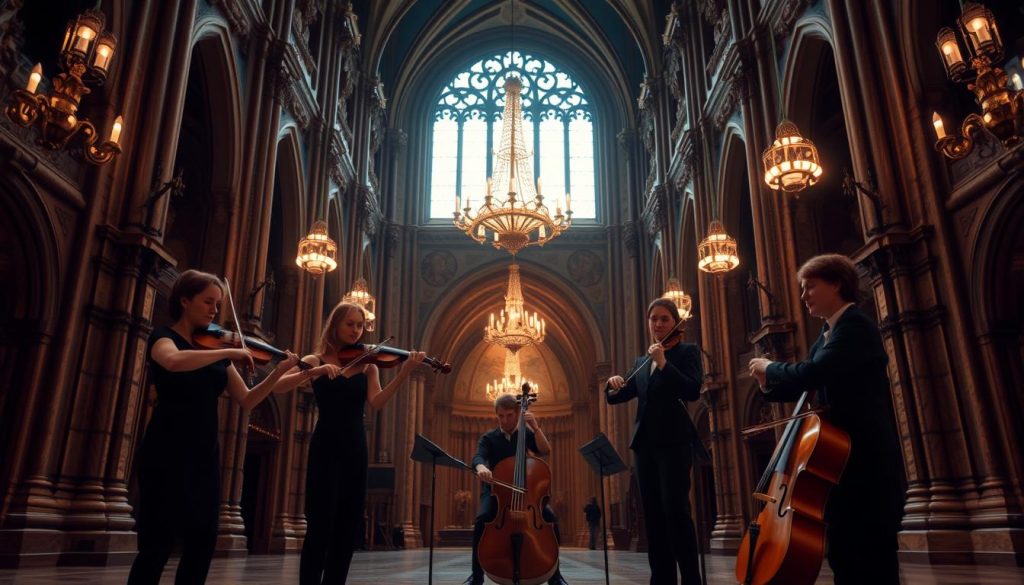
Polyphonic canon: imitation, overlapping voices and three violins
In the canon, the violins enter one after another. The same motifs overlap at a delay, creating a continuous flow.
The texture remains clear despite its density. Three violins allow the entries to overlap closely, with each one extending the previous one.
Chaconne and passacaglia: ground bass, harmonic sequence and the role of the basso continuo
The bass repeats every two measures and forms the piece’s framework. As a basso continuo, it is enriched on the keyboard with chords and inversions.
This repetition of notes provides stable reference points that support the counterpoint.
From the Romanesca to the “famous” progression: why it appeals to modern ears
The eight-chord harmonic sequence recalls the Romanesca: three descending fourths followed by a half cadence. This simple pattern creates an almost litany-like effect.
The balance between the steady bass and the variety of the violin parts explains why Johann Pachelbel’s canon remains so familiar to listeners and appears in various pieces.
Johann Pachelbel and Bach: influences and lines of transmission in composition and style
The composer of the late seventeenth century developed a formal model that informed sacred and secular writing.
Model and framework: organ techniques, chorales and the practice of counterpoint
The use of the organ and chorales established straightforward principles: clear counterpoint, stable progressions and preparation for cadences.
These choices made teaching easier. They supported compositions intended for worship and instruction.
Examples of stylistic echoes: ostinatos, cadences and harmonic structure
Pachelbel’s canon illustrates the effectiveness of a ground bass and a simple harmonic sequence.
These techniques recur in several later works: repeated ostinatos, prepared cadences and measured modulations.
- Clarity of the voices and bass
- Economy of means and strong expression
- Use in teaching and worship
| Technique | Effect | Example |
|---|---|---|
| Ostinato | Rhythmic foundation | Pachelbel’s canon |
| Prepared cadence | Musical breathing space | Organ chorale |
| Simple progression | Easier learning | Teaching pieces |
“A shared musical grammar extends beyond personal lines of transmission.”
For an example of analysis, studying an ostinato reveals how the voices are distributed and how the harmony is sustained.
Ultimately, this approach to composition characteristic of the era ensured lasting continuity and had a measurable influence on later practices.
Reception, rediscovery and circulation: from the 1960s to the present
The rediscovery of this work in the twentieth century brought it from a specialist repertoire into everyday life.

A recording that became a phenomenon
In 1969, an album by the Jean-François Paillard Chamber Orchestra modernized the piece’s sound. Its release at the end of the 1960s sparked a wave of interest.
Social uses and popular adaptations
The piece soon accompanied wedding processions and appeared in various songs. From rock to hip-hop, its harmonic framework became fashionable.
- Worldwide circulation: radio, television and records carried the melody around the world.
- On screen: its appearance in Neon Genesis Evangelion shows its narrative power.
- Adaptations: jazz, dance, pop and instrumental arrangements multiplied the versions.
From harpsichord to piano: teaching and performance
There are many piano transcriptions. They are used in conservatories and piano teaching methods.
For beginners, the repeated harmony makes the piece easier to memorize. It now appears alongside teaching staples such as Für Elise in beginner piano repertoire.
“From the 1960s to today, the media, teaching and the music industry have sustained the vitality of a work that has become a standard.”
Conclusion
This conclusion brings together the elements that make this article a useful introduction to the career of a composer and organist and to his most famous canon.
From his birth in Nuremberg in 1653 to his death in 1706, his biography sheds light on the origins of a composition for three violins and basso continuo. Its technique—a canon over a ground bass—explains the balance between simplicity and density.
Modern rediscovery turned this work into a famous canon heard around the world. Its harmonic framework has inspired numerous pieces and arrangements, from harpsichord to piano.
This short article also shows the line of musical teaching through Johann Christoph and the piece’s value for learning piano. Listen to the bass and the successive entries of the canon to hear how it works.