The Canon and Gigue in D major is a Baroque work for three violins and basso continuo, composed around 1680. The work rests on a two-measure ground bass repeated over 28 cycles.
This introduction sets the scene for a full exploration of the music and its structure. We will begin with the form and function of the bass, then see how the listener’s attention shifts among the layers of sound as the cycles unfold.
The discussion will cover the historical context, formal structure, harmonic analysis, counterpoint, and successive variations. This article is intended as a guide for music lovers, performers, and analysts.
The central idea is to show how a minimal yet rigorous structure can generate great musical richness. For more historical and musical context, see this detailed account of the piece.
Johann Pachelbel, the Canon in D major, and its era
Johann Pachelbel belonged to the rich tradition of late Baroque Germany. He shaped a piece that is both sophisticated and immediately memorable.
Dating from around the 1680s, the work for three violins and basso continuo combines three violins in a canon at the unison with a bass part (cello, viol, harpsichord, or organ). These instruments provide melodic clarity and a harmonic foundation.
The work has two parts: a strict canon and a less frequently performed gigue in 12/8. The Canon in D major is often associated with weddings; it may have been played at Johann Christoph Bach’s wedding in 1694.
Its duration varies with the tempo: recordings run from about 4 to 7 minutes. Paillard’s 1969 recording played a major role in its modern popularity, favoring a slow tempo and a fuller texture.
| Element | Description | Example |
|---|---|---|
| Instrumentation | Three violins and basso continuo | Violins in canon, harpsichord, and cello |
| Era | Around 1680 | Baroque Germany |
| Use | Ceremonies and recordings | Paillard (1969) |
| Duration | About 4 to 7 minutes, depending on tempo | Historical and modern interpretations |
The canon’s form and flow: cycles, textures, and structure
The canon’s formal design rests on a regular alternation between density and breathing space. This alternation shapes its progress and guides the listener.
The triple canon has three staggered entries: violin I begins in measure 3, violin II in measure 5, and violin III in measure 7. The three violins share the same line and take turns moving between the foreground and background.

The structure is built around eight-measure cycles. The first four measures form the main part (two two-measure motifs), while the next four provide accompaniment. This pattern creates an alternation of tension and release that can be heard throughout the piece.
Instead of clear cadences, changes in texture mark the divisions: the texture thickens to emphasize a passage and thins to create a sense of release. The piece moves forward through controlled renewal of its motifs, avoiding an overloaded sound.
- Triple canon: the voices alternate between leading and supporting roles.
- Eight-measure cycles: formal landmarks and breathing spaces.
- Texture as a formal tool: punctuation without harmonic breaks.
Harmonic analysis of Pachelbel’s Canon
A two-measure ostinato runs through the work and establishes its tonal logic. This bass repeats 28 times, providing a stable foundation.
The ground bass and fundamental line
The bass acts as a pillar: the root almost always remains in the bass, even as the upper voices vary. Modern performances often include an arpeggiated figure resembling an Alberti bass.
Progression and Roman numeral analysis
The main progression follows I-V | VI-III | IV-I | IV-V. This economical set of chords creates a clear, repeating harmony that supports the polyphony.
Alternative readings and neighboring harmonies
The analysis can change locally: up to measure 16, the fourth chord is sometimes read as F-sharp minor (III). In measure 17, the D in violin I allows a reading of D major over F-sharp (I6), showing the flexibility of harmonic analysis.
Intervals, ending, and continuity
Passing notes and neighbor notes often fill the intervals. A few “hidden” parallels remain, but the counterpoint masks them. The ending works like a crossfade: the three violins finish together, extending the sense of continuity rather than creating an abrupt cadential break.
Overall, the piece favors a denser texture over modulation, while the unchanging bass holds the work together.
Complete analysis and detailed Roman numeral notation
Counterpoint, voices, and techniques: the Canon’s musical engine
The interweaving voices drive the music, connecting each motif with its harmonic role.
The octave leap and the neighbor note are two elements that unify the melodies. The octave leap adds shape and surprise. The neighbor note creates continuity and subtle variation.
In the main-part passages, the beginning of the phrase contains more controlled dissonance: appoggiaturas and passing notes give rhythm to the entry.
The accompaniment provides breathing space. It uses longer note values and simple contours. The background thus steadies the flow without overcrowding the texture.
Hidden parallels and intervals
Forbidden parallels sometimes occur, but the activity of the other voices conceals them. These include isolated parallel fifths and octaves.
“The polyphonic density allows a degree of stylistic freedom that makes certain movements imperceptible to the listener.”
- Three-voice counterpoint draws on recurring elements to strengthen coherence.
- The main melody carries the dissonance; the accompaniment reduces it.
- Hidden intervals blend into the polyphonic weave.
| Technique | Role | Audible effect |
|---|---|---|
| Octave leap | Melodic marker | Accent and lift |
| Neighbor note | Motivic link | Flow and continuity |
| Controlled dissonances | Embellishment of the main part | Brief tension followed by resolution |
| Accompaniment and background | Stabilization | Clarity and relief from an overly dense texture |
Variations and motivic development: from the first cycle to the coda
Five successive cycles trace a path of motivic development in which the same bass guides distinct transformations. From the introduction (measures 1 to 10), a D–C-sharp appoggiatura establishes an expressive gesture. This note prepares the three violins to unfold their melodies and capture the listener’s attention.
Cycle 1
Measures 11 to 18: the rhythm quickens into sixteenth notes, with an opening octave leap and neighbor note. The gesture takes hold, then gives way to an accompaniment in longer note values, preserving the clarity of the line.
Cycle 2
Measures 19 to 26: a finer rhythm (thirty-second notes), shifts in register, and parallel thirds. These small rhythmic changes add interest without obscuring the piece.
Cycle 3
Measures 27 to 34: oblique polyphony on two melodic levels. An added figure in measures 29 and 30 briefly reverses the balance of the sound; the accompaniment sometimes adopts the rhythm of the main part.
Cycle 4
Measures 35 to 42: earlier rhythms combine with new octave leaps. The accompaniment becomes more spacious again; an appoggiatura closes the first half of the cycle.
Cycle 5 and coda
Measures 43 to 50: a dotted motif, suspensions, and descending stepwise motion prepare the ending. In the coda (measures 51 to 57), prominent octave leaps and descending contours “release” the melodic tension before the final cadence.

- Variation in density and rhythm: each cycle reshapes the texture.
- Appoggiatura notes and neighbor notes shape the expression.
- The unchanging bass allows these variations while preserving the cohesion of the piece throughout.
From the Baroque to reinterpretations: recordings, arrangements, and cultural impact
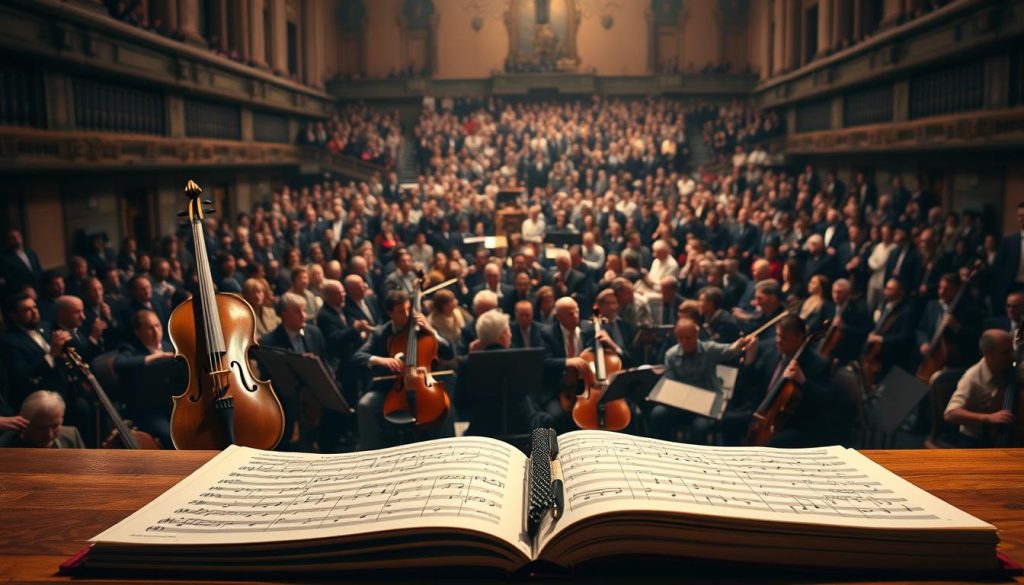
Recordings and arrangements transformed a chamber work into a worldwide cultural phenomenon. Paillard’s slow recording (Erato, 1969) played a key role. Its measured tempos and pizzicato textures made the piece instantly recognizable to a broad audience.
From Paillard to historically informed performances
Historically informed performance practices offer another perspective: period instruments, a brisker tempo, and crisper articulation. These choices reveal rhythmic details and accents that can disappear in large modern arrangements.
Arrangements and popular culture
The harmonic progression has inspired many popular works. Examples include rock arrangements (JerryC’s “Canon Rock”), jazz adaptations, and orchestrations for film.
- Pop connections: the Beatles and Maroon 5 draw on the harmonic sequence in contemporary hits.
- Range of arrangements: from solo piano to large ensembles, each arrangement changes the rhythmic and emotional effect.
Listening and piano practice tips
When listening to or playing the piece on piano, distinguish the roles of the hands: the left hand supports the bass, while the right carries the upper lines. Control repeated notes and balance the sound to keep the piece clear.
| Element | Effect | Tip |
|---|---|---|
| Paillard recording | Expansive emotion, slow tempo | Listen for its tone color |
| Historically informed approach | Rhythmic clarity, brisk tempos | Compare performances to sharpen your ear |
| Pop and jazz arrangements | Harmonic reinvention | Study how the chords are adapted |
Conclusion
Johann Pachelbel shows remarkable mastery here: a bass repeated 28 times and an I-V | VI-III | IV-I | IV-V progression support twelve canonic variations. The austere structure becomes a source of invention for the three violins, combining counterpoint with clarity.
Each variation explores a measured contrast between background and foreground, a balance between accompaniment and melody, and motivic unity through neighbor notes, octave leaps, and voice leading.
The modern success of Pachelbel’s Canon stems from this simple yet fertile design. From piano versions to contemporary arrangements, the piece remains a lesson in composition for listeners and musicians alike.
To learn more about contrapuntal techniques and their role in the music’s development, see the basics of counterpoint.