
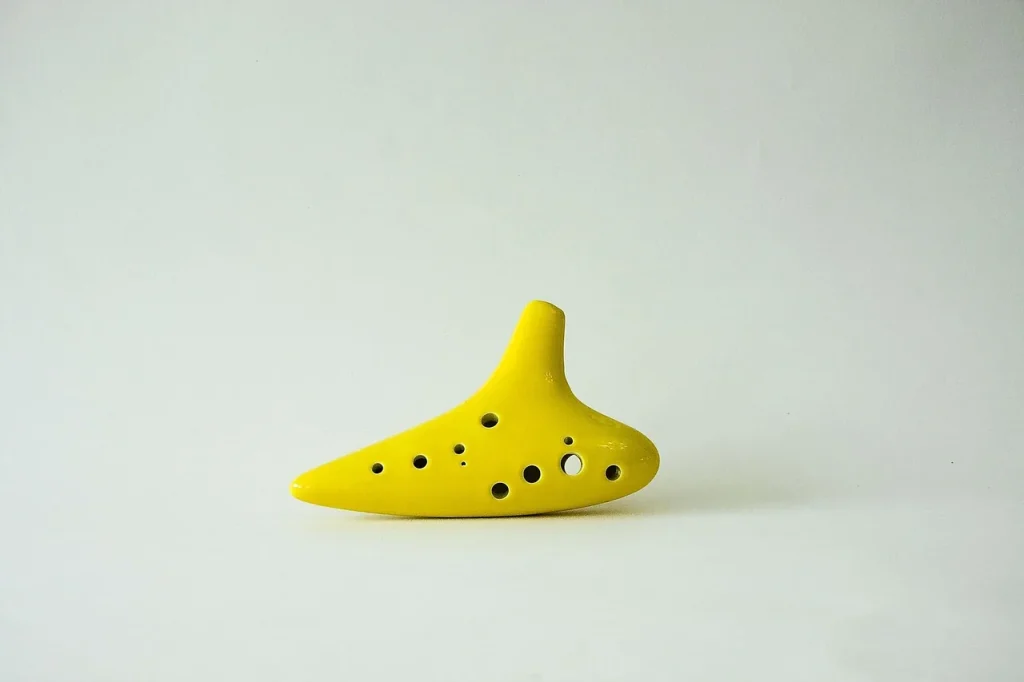
The ocarina is a fascinating wind instrument, known for its unique, melodic sound. This instrument has endured through the centuries, captivating musicians and audiences alike.
The roots of this instrument lie in ancient traditions, particularly in Africa, Asia and Mesoamerica. Although Giuseppe Donati invented its modern form in Italy in 1853, he drew inspiration from much older musical instruments.
The word ocarina comes from the Bolognese dialect and means “little goose.” The name evokes the instrument’s egg-like shape. In this article, we’ll trace its journey from prehistoric vessel flutes to contemporary models.
We’ll also explore its cultural importance in different civilizations, from the Chibcha to the Aztecs. Discover the ocarina’s rich sound and the melancholy tone that has won over music lovers.
The ancient origins of the ocarina
Vessel flutes, ancestors of modern instruments, have left fascinating traces throughout history. Archaeological discoveries point to clay whistles dating back 30,000 years in Central Africa. These objects attest to musical practices that existed long before more elaborate flutes appeared.
African archaeological evidence: the first vessel flutes
The earliest vessel flutes capable of playing several notes were found in Egypt and date back around 12,000 years. Made from stone, bone or bark, these instruments show the ingenuity of ancient cultures. They paved the way for other wind instruments, including the ocarina.
Mesoamerican and South American remains: the legacy of the Chibcha and pre-Columbian civilizations
In the Andes, the Chibcha, a people who lived in what is now Colombia between 500 BC and 1536, developed a rudimentary four-hole ocarina. It could produce five notes, and its influence spread among the Maya, Inca and Aztecs. According to ethnomusicologist Curt Sachs, these instruments originated with the Chibcha rather than the Maya or Inca, as is often believed.
The ocarina in Neolithic Europe: discoveries in Kosovo and Romania
The discovery in 1966 of the Runik ocarina in Kosovo is remarkable. This 8 cm terracotta instrument is more than 8,000 years old and is considered the oldest prehistoric musical instrument found in the region. Excavations at Liubcova Orniţa in Romania also uncovered an ocarina more than 5,000 years old, confirming that such instruments existed in Europe long before the modern era.
Asian influences: the Chinese xun and similar instruments
The Chinese xun, played for more than 7,000 years, has similarities to the ocarina. Unlike the ocarina, however, it has no mouthpiece: the musician blows directly across an opening. Other Asian instruments, such as the niwawu of the Hui ethnic group, inscribed as intangible cultural heritage in 2005, show the diversity of vessel flutes across cultures.
In short, the origins of this wind instrument are deeply rooted in human history. They reflect how musical practices have evolved over time and across cultures.
| Instrument | Region | Age (years) | Characteristics |
|---|---|---|---|
| Clay whistles | Central Africa | 30,000 | Simple vessel flutes |
| Egyptian flutes | Egypt | 12,000 | Made from stone, bone or bark |
| Runik ocarina | Kosovo | 8,000 | 8 cm, terracotta, four holes |
| Liubcova ocarina | Romania | 5,000 | Ancient terracotta instrument |
| Xun | China | 7,000 | Instrument without a mouthpiece |
The birth of the modern ocarina and its spread across Europe
The 16th century marked a turning point in the instrument’s history. In 1527, Hernán Cortés conquered Mexico and brought Aztec and Maya musicians back with him. They played eight-hole ocarinas for Charles V and captured his attention. This encounter marked Europe’s first contact with these Mesoamerican instruments.
Impressed by the new sounds, Charles V encouraged the musicians to perform across Europe, beginning the ocarina’s spread throughout the continent. Later, an anonymous baker in Rome, taken with the flute’s sound, began making terracotta versions in his oven. The practice spread quickly. For more than 300 years, these small flutes were regarded as children’s toys rather than musical instruments in their own right.
Giuseppe Donati and the creation of the classic ten-hole ocarina
In 1853, Giuseppe Donati, a 17-year-old brickmaker, transformed the instrument by creating the first classic ten-hole model. His ingenious design used every finger, improving intonation and making ensemble playing possible. Its distinctive shape suggested a goose’s head, departing from the traditional egg-like shape inherited from South America.
The name “ocarina” comes from the Bolognese words “ucarèina” or “ucarènna,” meaning “little goose.” The name highlights the importance of shape to the instrument’s identity. In 1864, Donati founded the “Gruppo Ocarinistico Budriese,” the first musical ensemble dedicated to the ocarina. It still exists today, more than 150 years later.
Its spread through Italy and beyond: from toy to musical instrument
The ten-hole model quickly spread beyond Italy and laid the foundations for the ocarina’s international recognition as a musical instrument. This change in perception was crucial: once considered a simple toy, the ocarina became an instrument capable of playing a full range of notes.
The ocarina’s growing popularity in Europe reflected changing musical practices. Once seen as little more than a souvenir, it gained an important place in music. The modern ocarina thus reflects human ingenuity and a cultural richness that spans the ages.
The ocarina’s technical and musical evolution in the 20th century
In the 20th century, this wind instrument underwent major changes that enriched its musical repertoire. They resulted from technical innovations and growing interest in music around the world.
Japanese innovations: Takashi Aketagawa and the twelve-hole model
In 1928, Japanese sculptor and musicologist Takashi Aketagawa made a major innovation by adding two holes to Donati’s design. This twelve-hole model extended the instrument’s range and gave musicians greater expressive freedom.
The model did not become widely known until 1986, when Japanese virtuoso Nomura Sojiro composed music for the documentary The Great Yellow River. That work brought the twelve-hole ocarina to international attention.
Multichamber models: double, triple and quadruple ocarinas
Innovation continued with multichamber models, which expanded the instrument’s musical possibilities. The double ocarina, created by Italians, offers 17 notes, while the triple, invented by Japanese makers, offers 21. The quadruple ocarina, developed in China between 2007 and 2009, can produce up to 24 notes.
These modern designs significantly expanded the ocarina’s range of forms and sounds, making its playing possibilities even more varied.
Its social and cultural role during the world wars and in education
During both world wars, the ocarina played an important social role. American soldiers carried pocket ocarinas to lift their spirits in the trenches. Moments of music brought them comfort and hope in difficult times.
In the 1950s, the instrument entered the American education system. Children learned to play it in public schools, where it was affectionately nicknamed the “sweet potato” because of its shape and gentle sound.
Although the ocarina gradually lost ground to the recorder after the Second World War, it enjoyed a cultural revival toward the end of the century, showing its resilience and lasting appeal.
The ocarina’s technical features and manufacture
The design of this instrument rests on fascinating acoustic principles. As a Helmholtz resonator, it belongs to the family of duct vessel flutes. Sound is produced when air vibrates inside an enclosed cavity, creating captivating melodies.
Traditional materials: terracotta, ceramic and more
Artisans have long shaped the instrument from traditional materials. Terracotta and ceramic are especially valued for their warm, characteristic tones. Porcelain, bone, stone and copper also give it distinctive sounds.
Modern materials: plastic, wood, metal and their advantages
As manufacturing techniques have evolved, modern materials such as plastic have become popular. Plastic instruments are ideal for beginners because they are durable and affordable. Wood offers tonal richness, while metal stands out for its durability and sound projection.
Plant materials such as bark and bamboo are also used in some cultures. Seeds can be used too: the kiokioca, for example, is made from a giant bean seed.
Shapes, fingerings and hole counts: effects on sound and playability
Ocarinas come in several forms. Transverse models, usually with ten or twelve holes, are the most common. Pendants with four to eight holes are also popular, as are inline, multichamber and keyed ocarinas.
The number of holes directly affects playability and range. A four-hole model, for example, can play five notes, while a twelve-hole model has a range of 2.5 octaves. The mouthpiece, located near the middle of the instrument, lets players produce different sounds by blowing into its internal duct.
The most common keys are C major, F major and G major. Depending on the music played, its tone is often described as melancholy, nostalgic or wistful.
Finally, different fingering systems, whether linear or based on combinations, affect musical expression and ease of playing.
The ocarina in music and popular culture
For centuries, this instrument has found a place in musical traditions and cultures around the world. Its use in traditional music is especially striking. At Andean festivals such as the one in Cuzco, it accompanies ancestral dances and rituals, adding a distinctive sound to the celebrations.
Use in traditional and classical music
Renowned composers have also used the ocarina in concert music. Leoš Janáček included it in his 1927 chamber choir cycle Říkadla. György Ligeti featured it in his Violin Concerto (1990–1993) and Sippal, dobbal, nadihegedűvel (2000). These works show how the instrument found a place in contemporary compositions.
Popularization through video games: The Legend of Zelda and beyond
The release of The Legend of Zelda: Ocarina of Time for Nintendo 64 in 1998 marked a major turning point in the ocarina’s recognition. The game introduced the instrument to a wide audience and led to a 300% increase in sales in 1999. In the game, the hero Link learns to play several melodies, forging a strong emotional connection between players and the instrument.
The ocarina also appears in other video games, including Wonder Boy V on the Mega Drive and Professor Layton, in which the heroine Arianna plays one. These appearances strengthened its place in popular culture.
Appearances in film, television and other media
Film has also brought attention to the instrument. In The Good, the Bad and the Ugly (1966), Ennio Morricone used an arghilofono, a low-pitched version of the ocarina, for the character Angel Eyes. Other films, including Stanley Kubrick’s The Shining, feature the ocarina in their soundtracks, adding a distinctive touch.
Animated works feature it too. In Captain Harlock, the character Stellie is nicknamed “the little girl with the ocarina.” The instrument also appears in My Neighbor Totoro and Princess Sarah, underscoring its appeal across generations.
Finally, Song of Ocarina became a major hit in France in the 1990s, while bands such as The Troggs and Duran Duran incorporated the instrument into their music, showing its continuing influence.
| Event | Type | Year | Impact |
|---|---|---|---|
| Use by Janáček | Classical music | 1927 | Inclusion in concert music |
| Release of Zelda | Video game | 1998 | Worldwide popularization |
| Film appearance | Film | 1966 | Use by Morricone |
| Success of Song of Ocarina | Music | 1990 | Popularity in France |
| Appearances in animated series | Television | 1980s–1990s | Appeal across generations |
The ocarina today: accessibility and future prospects
Today, this wind instrument is enjoying growing popularity, with sales rising by 15% a year since 2015. People of all ages, from children to adults, are taking an interest in it, reflecting enthusiasm for music around the world.
Although the ocarina is less widespread in France than in English-speaking or Asian countries, it has a growing community of enthusiasts there. Musicians are embracing the instrument as part of a diverse musical culture.
Choosing a model: prices and specialist shops
Ocarinas are available for every level of player. Prices vary according to the materials used:
- Plastic models: ideal for beginners, they cost between €20 and €50.
- Ceramic ocarinas: intended for intermediate players, these models cost between €80 and €120.
- Wooden instruments: intended for professionals, these ocarinas often start at €150.
Well-known brands such as Focalink, STL Ocarina and Songbird offer a wide choice of models. In France, Instruments du Monde offers more than 80 different models to suit musicians’ needs.
Learning resources and future technological innovations
There are many resources for anyone who wants to learn to play. OcarinaForest.com offers tutorials, as do videos by Japanese master Nomura Sojiro on YouTube. Interactive mobile apps also support learning.
Beginner methods are available in French too, including two guides written by an enthusiastic musician. These resources make learning easier and bring the ocarina within reach of a wider audience.
Technological innovations, such as MIDI ocarinas and connected models, offer new possibilities. They can link the instrument to music software and expand its creative potential.
Despite growing interest, the ocarina remains uncommon in European conservatories. New initiatives are emerging, however, suggesting a promising future for this wind instrument.

Conclusion
The ocarina’s journey reveals a rich and varied heritage. From its ancient roots in Africa and South America, the instrument evolved into its modern form, thanks in particular to Giuseppe Donati and Takashi Aketagawa. Aketagawa refined the twelve-hole model, extending its range.
Over the centuries, the ocarina has crossed cultures, from pre-Columbian rituals to contemporary concerts. Its revival in popular culture, especially through The Legend of Zelda, introduced new generations to its distinctive melancholy sound.
Today, the instrument is accessible to everyone, with models to suit every budget. As Nomura Sojiro said, “music is a universal language,” a thought that captures the ocarina’s ability to cross cultural boundaries. Explore this fascinating instrument and let its music carry you away.