
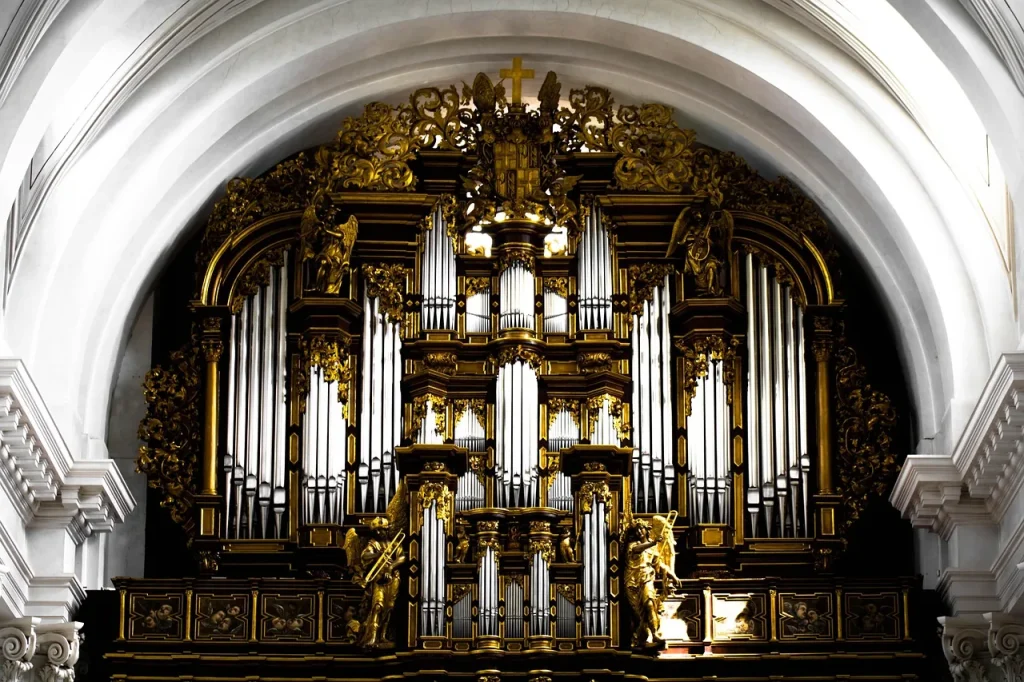
Johann Pachelbel remains a major composer of southern Germany. Born on September 1, 1653, in Nuremberg and deceased in March 1706, he wrote for organ, harpsichord, and domestic ensembles.
His music favors clear polyphony and precise counterpoint. Its melodic lines are songlike, and its formal structure is easy to follow. This approach favors restraint over showy virtuosity.
He is best known for the Canon in D major, but his catalog also includes fugues, toccatas, chaconnes, chorales, and suites. These compositions served worship, teaching, and music-making at home.
This guide explores his era, the features of his style, his major works, and his legacy. It shows why his music still holds an important place in concert programs and the rediscovery of musical heritage.
An overview of German Baroque music and Johann Pachelbel’s place in it
The musical centers of northern and southern Germany developed very different responses to the same models. In the South, tradition favored restraint, clarity, and inward expression.
Baroque music took shape in free cities, churches, and courts. These centers of learning helped Italian influences spread.
The southern German repertoire favors formal discipline. Here, the composer masters melodic line and balance rather than spectacular display.
Pachelbel occupies a pivotal place between church and home. His compositions for organ, harpsichord, and voice, as well as his chamber music, enriched both church practice and domestic classical music.
“His art sets gentleness and restraint against the vehemence of the North while incorporating an essential basso continuo.”
- A blend of Italian and German traditions enriched harmony and counterpoint.
- Urban networks and centers of learning encouraged teaching and the spread of music.
- Basso continuo played a central role in accompaniment and an economical use of musical resources.
| Characteristic | North | South |
|---|---|---|
| Expression | Vehemence, virtuosity | Modesty, formal discipline |
| Functions | Dramatic worship, improvisation | Liturgy, teaching, domestic music |
| Influences | Local traditions, stylus phantasticus | Italian and Lutheran traditions |
| Accompaniment | Solo organ | Basso continuo and voices |
To learn more about the region’s instruments and repertoire, consult this resource on the organ and its repertoire.
Pachelbel’s life, career, and musical networks in Germany and Europe
Pachelbel’s career took him through cities and courts, revealing a network of influential teachers and employers.

From Nuremberg to academic study
Born in Nuremberg on September 1, 1653, he studied with Heinrich Schwemmer and Georg Caspar Wecker. He continued his education in Altdorf and Regensburg, where he studied with Kaspar Prentz.
Appointments and travels of an organist
In 1673, he became an organist at St. Stephen’s Cathedral in Vienna. He moved to Eisenach in 1677 and then to Erfurt’s Predigerkirche in 1678.
He later held posts in Stuttgart (1690) and Gotha (1692). He returned to St. Sebald’s Church in Nuremberg in 1695 and remained there until his death in March 1706.
In Erfurt, his contract required him to create a work each year that surpassed the previous one.
Teaching and family connections
In Eisenach, he formed ties with the Bach family and taught Johann Christoph. Christoph would later influence Johann Sebastian Bach’s education, passing on an artistic tradition.
For detailed information on his appointments and repertoire, consult this biographical and musical resource.
Johann Pachelbel’s Musical Style: German Baroque
His writing is recognizable for its clarity and its focus on melodic line and counterpoint. His melodies are simple and songlike. They fit within a clear polyphonic texture.
The toccatas avoid the vehemence of the northern style and rely on controlled intensity. His free-form pieces show a measured imagination rooted in the flexibility of musical expression rather than display.
Many works can be played on either organ or harpsichord. The practice of Hausmusik helps explain this frequent passage from church to the intimacy of the home. The harpsichord thus carries forward music first heard on the organ in worship.
“Gentleness, grace, and modesty: contrapuntal rigor in the service of inward expression.”
- Clear polyphony that makes the music easy to follow.
- Carefully measured ornamentation that preserves the balance of the voices.
- Subtle variations and poetic transformations rather than spectacular displays.
| Characteristics | Effect | Examples |
|---|---|---|
| Songlike melody | Clarity for the listener | Chorales, cantus firmus |
| Rigorous counterpoint | Formal strength | Fugues, ricercars |
| Pieces for organ or harpsichord | Use in worship and at home | Toccatas, preludes, variations |
Major works: organ, keyboard, and chamber music
Among his most notable compositions are organ pieces, harpsichord cycles, and chamber works that have become part of the repertoire. The Canon in D major and its Gigue, written for three violins and basso continuo, embody the interplay between a repeating harmonic pattern and melodic line.

Canon and Gigue for three violins
The Canon in D major uses staggered violin entries supported by a persistent basso continuo. The Gigue in D major extends its dance-like momentum and accompanies this famous work.
Chorales and organ pieces
His organ chorales range from ornamented settings to sets of variations. They include Musikalische Sterbensgedanken (1683) and arrangements of hymns such as Christ lag in Todesbanden, in which austere fugal writing alternates with joyful passages.
Fugues, ricercars, and fantasias
The 94 Magnificat fugues and the ricercars reveal freedom of expression and a Mediterranean smile. The toccatas and preludes offer controlled intensity, while the six fantasias, including the one in G minor, remain especially popular.
Variations, chaconnes, Hexachordum Apollinis, and suites
The chaconnes in F minor and D major demonstrate his art of variation; the F minor work is often considered a masterpiece. Hexachordum Apollinis (1699) brings together six sets of variations on arias, including the particularly well-known Aria sexta for harpsichord.
Finally, 21 French-style harpsichord suites complete this overview. These organ and keyboard compositions define the composer’s language through firm counterpoint and simple melodies, and enrich his chamber music.
Influence, reception, and modern legacy
Pachelbel’s influence spans generations and still shapes instrumental practice and concert programming. His music connects teaching with church concerts.

From master organist to a model for Bach
By teaching Johann Christoph in Eisenach, Pachelbel passed on clear musical principles. Those principles helped shape the young Johann Sebastian Bach.
The technical inheritance concerns counterpoint, the treatment of the bass, and the construction of fugues. Members of the Bach family thus served as vital intermediaries.
Twentieth-century rediscovery and interest in France
The twentieth century brought critical editions and notable recordings. Performers including Gustav Leonhardt, Wolfgang Rübsam, Joseph Payne, Julian Gembalski, Fernando De Luca, and Tibor Pinter have shaped the way we hear this music.
In France, city churches regularly program the Canon in D major. This famous canon also appears in organ recitals and classical music series.
| Aspect | Transmission | Twentieth century |
|---|---|---|
| Technique | Counterpoint, basso continuo | Studies and critical editions |
| Repertoire | Magnificat fugues, organ works | Harpsichord and organ recordings |
| Circulation | Families and teaching circles (the Bach family) | Concert halls, churches, and festivals |
| Tribute | Liturgical and educational use | Asteroid (4972) Pachelbel |
“A legacy spanning the centuries, from March 1706 to today’s stages.”
Conclusion
His work combines contrapuntal clarity with a gentleness that has endured for centuries. Born in September 1653 and deceased in March 1706, Johann Pachelbel remains a master of the organ and harpsichord. His works — chorales, Magnificat fugues, toccatas, chaconnes, suites, and variations — have a clear, songlike musical structure.
The Canon in D major and Gigue in D major illustrate the dialogue between violins and basso continuo. His organ pieces serve worship and enrich domestic music-making at the harpsichord.
To explore more of the instruments and repertoire discussed here, consult this resource on Baroque music. Listen to the violins, bass, harpsichord, and organ to rediscover the richness of a composer and organist whose influence endures.