
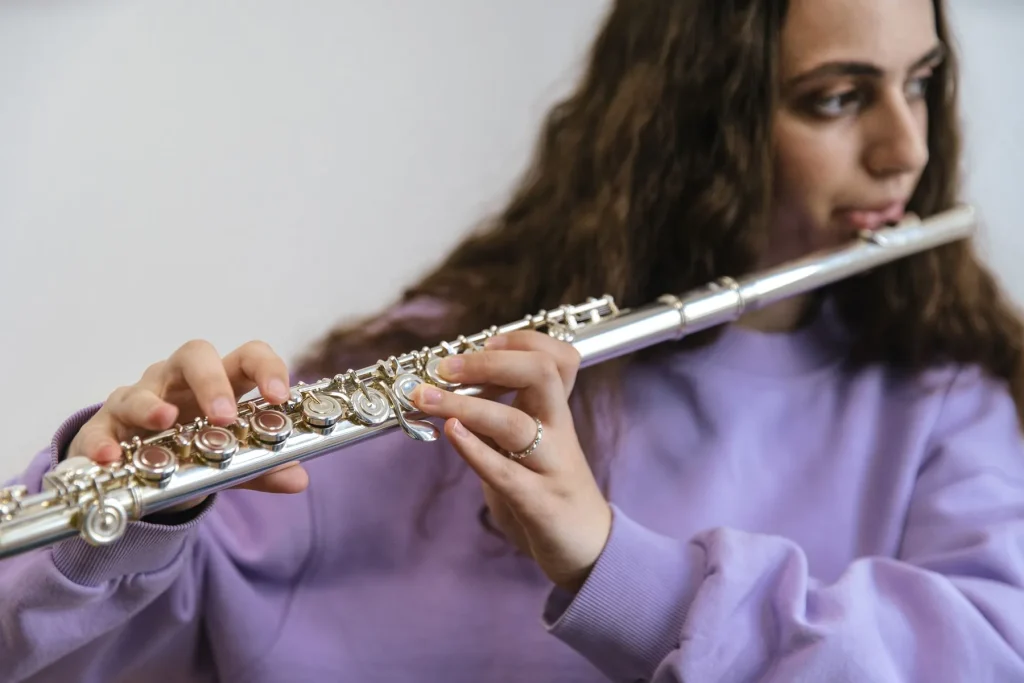
Welcome to this comparison of the essential differences between the ocarina and the flute. Whether you are an undecided beginner or a curious musician, this article is designed to help you make an informed choice before a possible purchase.
These two wind instruments share acoustic principles, but differ in many practical and musical ways. Drawing on more than 10 years of experience with both instruments, the author offers a detailed, firsthand analysis.
We will compare how they are made, the sounds they produce, their historical origins, the challenges of learning them and their prices. Each instrument has its own charm, and your choice will depend on your preferences and musical goals.
By reading this article, you will learn more about these musical instruments. Get ready to discover what makes each one distinctive.
Introducing the wind instruments: ocarina and flute
Let us explore wind instruments through two familiar examples. They are fascinating because they produce sound through vibrating air. This fundamental principle is shared by all instruments in this category.
Definitions and shared principles
The flute is a reed instrument, often used in genres such as classical music, jazz and folk. The ocarina, meanwhile, is a vessel flute, usually made of ceramic and recognizable by its oval shape.
Both instruments produce sound by making air vibrate. Their mechanisms and playing techniques, however, differ considerably.
- Wind instrument: An instrument that produces sound by making air vibrate in a tube or cavity.
- Flute: A member of the woodwind family, prized for its crystalline sound.
- Ocarina: A particular type of flute, often associated with gentle, resonant melodies.
- Music education: These instruments play a key role in learning music, and the flute is commonly taught in schools.
- Ease of learning: With an average volume of 70 dB, the ocarina is accessible to beginners thanks to its intuitive handling.
The musical appeal of these instruments
The flute can produce expressive sounds that appeal in both symphony orchestras and chamber ensembles. The ocarina, for its part, evokes fantasy worlds through its captivating melodies, often popularized by video games.
In short, their range of sounds and accessibility make both instruments appealing to music lovers. Though distinct, the ocarina and flute enrich the world of wind instruments with their unique qualities.
Historical origins of the ocarina and flute
The roots of these two instruments run deep in music history. One goes back millennia, while the other is relatively recent. Let us explore the fascinating origins of the flute and ocarina.
The flute’s ancient history
The flute is one of the oldest known wind instruments, with archaeological evidence dating back 35,000 years. These finds reveal its use in prehistoric cultures and attest to its cultural importance.
The recorder emerged in Europe in the 14th century, particularly in England. Over the centuries, it evolved and became more complex, eventually taking the form we know today.
Early transverse flutes, also ancestors of this instrument, originated in Asia. They subsequently spread through Europe from the 9th century onward, illustrating their gradual movement across the world.
The ocarina’s more recent development
By comparison, the ocarina has more recent origins. Although rudimentary vessel flutes existed in Mesoamerican civilizations, notably among the Aztecs, the instrument was rediscovered in Europe in the 16th century by Hernán Cortés.
The modern ocarina took shape only in the 19th century. The Italian Giuseppe Donati gave it its characteristic goose-head shape and set the number of holes at 10. One of the oldest archaeological finds associated with this instrument is the Runik ocarina, dating back 6,000 years.
The ocarina was also used during the world wars to transmit military messages, adding an unexpected historical dimension to the instrument.
These different origins illustrate the distinct paths of the flute and ocarina through history. The flute’s millennia-long history and the ocarina’s more recent development deepen our understanding of musical instruments and their place in cultures around the world.

Construction and materials: fundamental differences
The design and construction of these instruments reveal striking contrasts. Each results from choices of materials and manufacturing methods that affect its sound and durability.
Traditional and modern materials
Flutes are made from a variety of materials. Professional flutes generally use:
- Metal: Silver is prized for its exceptional sound quality.
- Wood: Quality recorders are often wooden, giving them a distinctive warmth of tone.
- Synthetic materials: Plastic and resin are commonly used for student models.
Ocarinas, by contrast, are mainly made from:
- Ceramic: This material gives them a warm, resonant sound.
- Plastic: Modern ABS plastic models are more durable and affordable.
- Wood and metal: Though rarer, these materials are used to achieve particular sounds.
As one expert puts it:
“The choice of materials determines not only sound quality but also the playing experience.”
Handcrafted and industrial methods
Flutes are often made using standardized industrial processes, allowing mass production and consistent quality. Ocarinas, meanwhile, are often handmade. Shaping their rounded bodies requires particular skill.
Most ocarinas consist of a single piece, making each one distinctive. The flute, by contrast, has numerous moving parts that can be replaced. This design difference also affects tuning options. Some flute models allow their tuning to be adjusted, while most ocarinas do not.
In conclusion, materials and manufacturing methods directly affect each instrument’s sound, durability and price. For a closer look, read this article about the differences between the ocarina and flute.
Instrument shapes and designs
The shape and design of wind instruments play a crucial role in their sound and ease of handling. The ocarina and flute have distinct features that affect both their appearance and musical performance.
The ocarina’s rounded shape
The ocarina has a characteristic rounded shape reminiscent of a goose’s head. This makes it a vessel flute, a category distinct from traditional tubular flutes. Its rounded chamber acts as a Helmholtz resonator, producing a gentle, enveloping sound as air vibrates in the enclosed cavity.
With its built-in mouthpiece and holes arranged across a curved surface, the ocarina calls for a vertical hand position. This gives it a distinctive feel but generally limits the number of holes and, consequently, its range. An ocarina may therefore offer fewer notes than other instruments.
Straight tubes and flute varieties
The flute, meanwhile, consists of one or more straight tubes. Its elongated shape allows powerful projection and precise control of nuances. A transverse flute, for example, has a cylindrical body held horizontally, while a recorder is held vertically and played by blowing directly into its mouthpiece.
A transverse flute weighs about 300 grams on average, while an ocarina weighs no more than 150 grams. This difference affects how each instrument handles. The flute’s straight body also allows keys to be added to extend its range, unlike the ocarina.
Flute varieties add further diversity to the wind family. The pan flute consists of several tubes of different lengths, while recorders come in several sizes: soprano, alto, tenor and bass.
| Feature | Ocarina | Flute |
|---|---|---|
| Shape | Rounded | Straight tubes |
| Average weight | 150 grams | 300 grams |
| Playing position | Vertical | Horizontal |
| Number of holes | Limited | Extended with keys |
| Type of sound | Gentle and enveloping | Powerful and precise |
In conclusion, each instrument’s shape is more than a matter of appearance. It affects playing technique, sound and the musician’s comfort. To learn more about their nuances, read this article about the differences between the ocarina and flute.
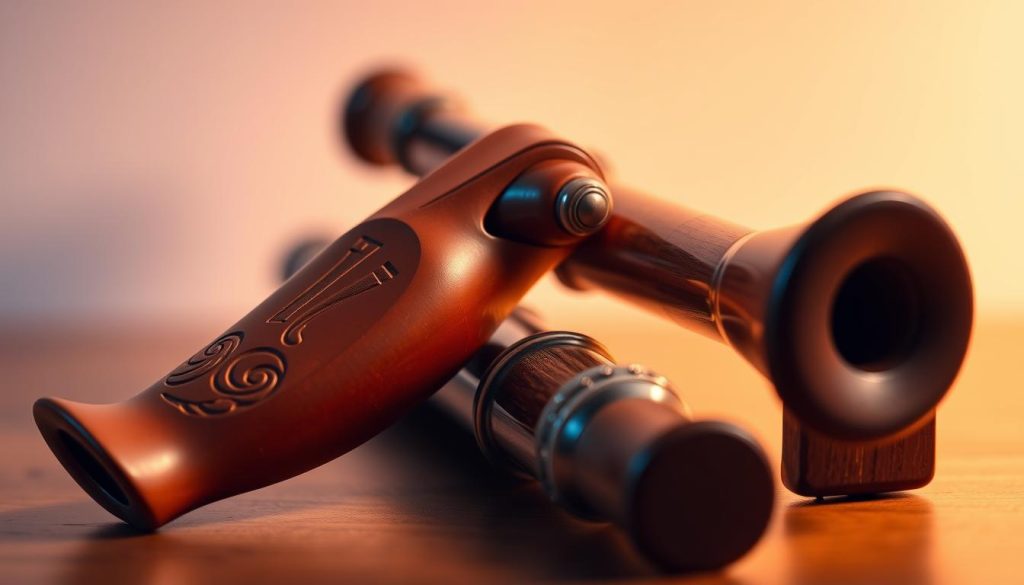
Playing techniques: mastering breath and fingering
In this section, we will explore the playing techniques specific to each instrument. Every wind instrument makes demands on the player’s breathing and fingering. Both are essential to producing a good sound.
Embouchure and breath direction
To play the transverse flute, the musician blows at a 90° angle to the tube. The embouchure is on the side, with the mouthpiece positioned against the lower lip. This technique creates the precise vibration needed for clear notes.
The ocarina, by contrast, uses a direct mouthpiece. The musician blows into its built-in mouthpiece, directing air toward the edge. This approach is more intuitive but still requires careful control of breath direction. To play in tune, the player must adjust breath pressure.
Breath control is a fundamental difference. On the flute, breath remains constant regardless of the note being played. On the ocarina, pressure must vary. High notes require a stronger breath than low notes, which can surprise beginners.
Moreover, the ocarina uses about 30% more breath than the flute. That calls for stamina and efficient air management, especially during long playing sessions.
Fingering and musical expression
Flute fingering uses a system of 16 to 18 keys. It requires precise coordination with the hands held horizontally. Musicians must master their finger movements to play quickly.
On the ocarina, fingering involves covering 4 to 12 holes, with the fingers held vertically. Although this may seem simpler, quick note changes demand precision.
Vibrato is also more challenging to master on the flute. On the ocarina, it is easier to produce because the player directly controls the breath entering the mouthpiece.
In conclusion, mastering either instrument requires regular practice. Musicians may prefer one or the other depending on the feel and techniques they enjoy. Blowing into an ocarina is very different from playing a flute and demands greater technique and control.

Ocarina or flute: what are the differences between these instruments?
Comparing these instruments reveals interesting differences in both sound and playing experience. Each has qualities that affect a musician’s choice according to personal preference.
Differences in sound and timbre
The ocarina stands out for its gentle, resonant sound. A whistle makes air vibrate inside its hollow chamber according to the principle of a Helmholtz resonator. The flute, by contrast, produces a clearer, breathier sound, with frequencies between 500 and 4,000 Hz.
The ocarina’s timbre is often described as melancholic and nostalgic, creating a warm atmosphere. Its frequencies range from 200 to 2,000 Hz, while the flute projects powerfully enough for large concert halls.
- Ocarina: Gentle, resonant sound; frequencies from 200 to 2,000 Hz.
- Flute: Clear, breathy sound; frequencies from 500 to 4,000 Hz.
Scale and range
In terms of range, the transverse flute spans three octaves, allowing a wide variety of notes. A standard 12-hole ocarina, by contrast, offers a more limited number of notes. Some multi-chamber models, such as the Japanese triple ocarina, can span three octaves, though this is unusual for the instrument.
The flute also makes it easy to change key and play in several keys, unlike the ocarina, which is generally limited to one or two depending on the model. This gives flutists greater musical flexibility.
The musician’s playing experience
Playing the two instruments also feels quite different. The flute provides a sense of precise control through its key system, which allows subtle shaping of notes. The ocarina offers more direct, organic contact with the instrument, which some musicians find especially satisfying.
Acoustically, neither instrument is superior. Musicians may prefer the flute or ocarina according to the sound they like. For example, the ocarina has a unique capacity for polyphony, allowing several notes to be played at once, which is not possible on a standard flute.
In conclusion, the choice between these instruments depends largely on musical goals and sound preferences. The flute is often better suited to orchestras, while the ocarina is ideal for intimate melodies.
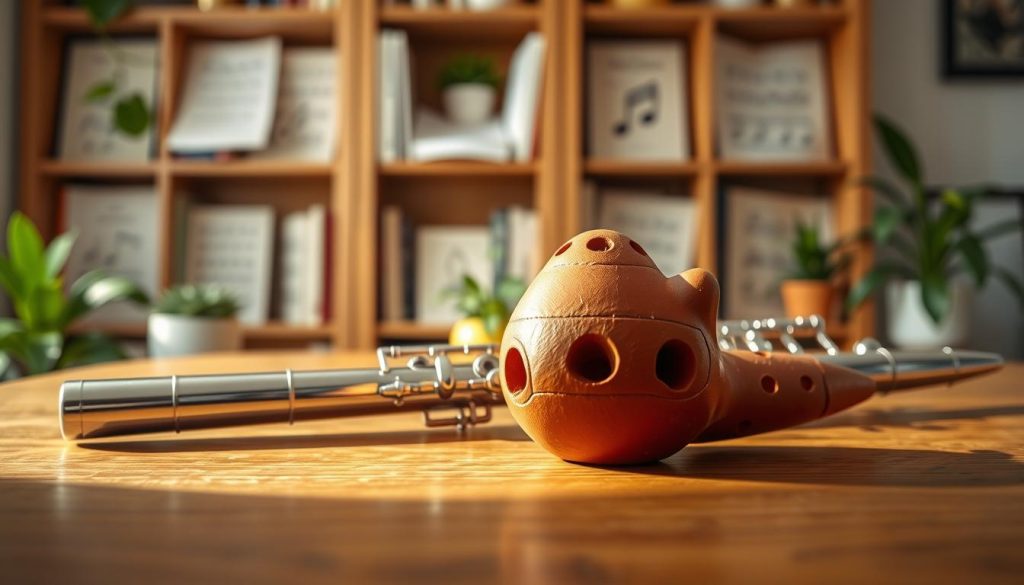
Learning: ease, resources and challenges
Learning a new instrument can be both exciting and daunting. Beginners need to understand the differences between instruments to make an informed choice. Let us compare the learning curves of the flute and ocarina, along with their challenges and available resources.
The flute’s learning curve
It takes about six months to develop a solid foundation on the flute. This is partly because of its much wider range of notes and the ability to play in several keys, which make it more complex to learn overall.
As for fingering, the two instruments present roughly the same level of difficulty. Each demands its own coordination and precision. On the flute, breath pressure remains relatively even from note to note, simplifying that part of the technique.
It is worth noting that 78% of conservatories teach flute, making qualified teachers and learning materials easier to find. Beginners can therefore benefit from many online tutorials and suitable pieces of sheet music.
Learning the ocarina and its challenges
By contrast, the basics of the ocarina take an average of two months to learn, making it more accessible to beginners. Ocarinas do, however, demand more practice to play in tune. The player must blow harder or softer depending on the desired note, with high notes requiring a stronger breath.
Resources for learning the ocarina are more limited. Finding suitable sheet music and specialist teachers may take additional research. Still, methods such as the Ocarina Method Book are available to help beginners.
In conclusion, if your aim is to reach a high standard and join an orchestra, the flute seems the natural choice. If you would rather relax and play for pleasure, the ocarina will suit you well.
Musical uses and settings
Let us look at the flute’s and ocarina’s places in different musical styles. Both appear in varied genres, from classical music to video game soundtracks.
Styles and genres for the flute
The flute has a central role in symphony orchestras. It also appears in jazz, with renowned artists such as Herbie Mann. Here are some styles in which it stands out:
- Classical music: A key orchestral instrument that contributes crystalline tones.
- Jazz: Valued for its improvisational possibilities and ability to adapt to varied rhythms.
- World music: It fits easily into folk and other contemporary genres.
Uses and popularity of the ocarina
The ocarina, for its part, is often associated with traditional and folk melodies. In South America it is used in religious ceremonies, adding a spiritual dimension to its gentle tunes.
The instrument enjoyed renewed popularity thanks to video games, especially The Legend of Zelda, leading to a 400% rise in sales between 1998 and 2000. Some notable points include:
- Presence on YouTube: Ocarina covers have amassed more than 120 million views.
- Festivals: Tokyo’s Ocarina Festival celebrates this distinctive instrument and brings together enthusiasts from around the world.
- Soundtracks: The ocarina features in films such as Nausicaä, where it creates captivating atmospheres.
In conclusion, each instrument has a place in particular musical settings. The flute excels in orchestral ensembles and jazz, while the ocarina is well suited to intimate melodies and fantasy worlds.
Price comparison and affordability
In this section, we will examine the cost of buying an ocarina or flute. Price is often one of the most important factors for musicians, especially beginners.
Average prices and price ranges
A plastic or resin student flute costs around €50. A quality recorder or transverse flute, however, can cost several hundred or even several thousand euros. Professional models made of silver or wood often exceed €3,000.
An entry-level plastic ocarina costs around €20. A mid-range ceramic ocarina costs less than €100, a decisive advantage for this wind instrument. Double and triple ocarinas cost between €150 and €400, while professional models can reach €500.
What affects the cost?
Several factors affect an instrument’s price. Material is important: metal or wooden flutes are generally more expensive than plastic ones. For ocarinas, ceramic costs more than plastic.
Manufacturing complexity, the maker’s reputation and the number of chambers in an ocarina also matter. Handmade ceramic models, for example, can reach €800, reflecting the skill required to make them.
Additional costs should also be considered. Maintaining a flute, including oiling the keys and replacing pads, adds to the budget. An ocarina requires little maintenance, making it more affordable still.
Finally, secondhand marketplaces such as PriceMinister and Cdiscount offer affordable options for both instruments. They can reduce the initial cost and put quality models within reach.
Fragility and care: practical points to consider
When choosing an instrument, its fragility and care requirements are essential considerations. They can affect its lifespan and the playing experience.
In terms of material strength, the ocarina is often considered more fragile than the flute. A fall can destroy it, especially if it is made of ceramic or terracotta. Flutes are not indestructible either, but materials such as wood and metal generally make them more resistant to impacts.
There are, however, plastic ocarinas, including ABS plastic models, that offer greater durability. They withstand knocks better, making them ideal for beginners or travel. If you plan to carry an ocarina, protect it in a rigid case. This will prevent a heavy object from crushing it and reduce the risk of damage.
Care and repairability
A flute needs regular cleaning, key oiling and occasional pad replacement. These tasks mean extra cost and effort for the musician. Ocarina care is simpler and generally involves cleaning the mouthpiece and holes. Its fragility still calls for careful handling at all times.
Repairability is another important consideration. Flutes have modular parts, allowing some components to be replaced if damaged. An ocarina, usually made in one piece, cannot be repaired if it cracks. An accident may therefore mean buying a new instrument.
In conclusion, material choice directly affects an instrument’s resilience. Handle an ocarina carefully, especially where it might be knocked. For more on instrument care, read this article about the differences between the ocarina and flute.
Conclusion
Let us finish by revisiting the main differences between these two wind instruments. Ocarinas and flutes are distinct, but each has its own charm. If you hope to join an orchestra, the flute is probably the better choice because of its wider range and richness of sound.
If instead you want to relax and play for pleasure, the ocarina is ideal. Its ease of learning and affordable price make it an excellent choice for beginners.
Whatever you decide, music is a rewarding adventure. Explore these fascinating instruments further. Try them in a store to get a feel for their handling and sound. The Instruments du Monde store offers more than 50 ocarina models, including models inspired by video games.
Share your experiences and choices in the comments, and join a community passionate about these beautiful musical instruments.