
Aim: this article offers practical ideas inspired by the Canon to help couples in France plan a harmonious, personal ceremony.
Music shapes every moment of a wedding. It sets the mood, accompanies the entrance, signing and exit, and heightens the emotion shared with guests.
We suggest options suited to the venue, the length of the aisle and the couple’s tastes. We bring tradition and modernity together through well-known works and contemporary arrangements for an elegant touch.
The Canon remains the thread running through these ideas: we explore its tempo, atmosphere and instrumentation. Original alternatives — gypsy jazz, Holst, Mussorgsky and Márquez — open up further possibilities.
What you’ll find: practical advice connects music with logistics (timing, transitions and coordination), while historical context helps you make informed choices.
Together, these ideas aim to inspire a moving and successful ceremony. This guide is clear, practical and focused on concrete decisions.
Why music shapes your wedding ceremony
A cohesive selection of music shapes the ceremony’s emotional progression. Music accompanies every stage: the prelude, the couple’s entrance, the signing and the exit. It creates an atmosphere and guides guests’ attention.
Prelude: it calms the gathering and establishes a peaceful mood. Bright pieces by Bach provide a soothing backdrop before the bride arrives.
Entrance: the entrance music should be clearly audible and suited to the couple’s walking pace and the length of the aisle. The Wedding March remains a familiar choice.
Signing: choose gentle, continuous pieces (Air, Wachet auf) to accompany this moment without interruption. Prepare two or three backup pieces for each stage.
Exit: choose something energetic: an anthem or triumphant piece marks the couple’s departure amid applause. Connect pieces through their keys and dynamics to avoid abrupt changes.
- Plan the timing and any cuts in advance.
- Check audibility and reverberation at the venue.
- Prepare a brief cue sheet for each moment (title, composer, duration, tempo).
For practical guidance and examples of music to prepare, see this resource.
Pachelbel’s Canon for weddings: music ideas
Choosing the right moment for this piece affects the ceremony’s emotional progression. It works especially well for the couple’s entrance, thanks to its gradual build, or for the exit, which it can close on a bright harmony.
As for tempo, choose a faster version if you want joy and movement. A slower tempo creates a solemn, reflective atmosphere.
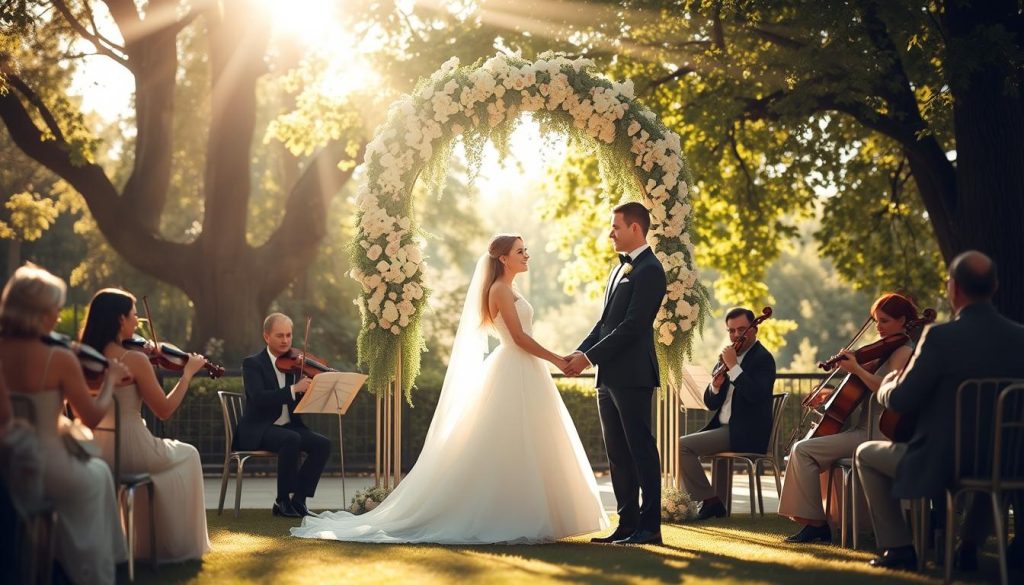
For arrangements, a string quartet offers an appealing purity. An organ gives the piece greater scale in a church. Piano or harp makes the melody more intimate.
For a smooth playlist, begin with a gentle prelude, follow it with a march or announcement, then let the central piece reach its climax.
- Plan the ending of the piece: agree on a discreet signal to stop it.
- Balance the instruments: do not let the bass cover the main melody.
- Prepare a backup: have a quality recording ready if a musician is unavailable.
Finally, consider blending classical and contemporary sounds: subtle modern textures (sustained sound layers or prepared piano) can enrich the piece without obscuring its original counterpoint.
Timeless classics for every moment
Great works from the repertoire offer clear choices for the atmosphere you want: solemn, reflective or triumphant.
Mendelssohn’s Wedding March: a solemn entrance everyone recognizes
The Wedding March (A Midsummer Night’s Dream, 1842–1843, No. 7) remains a universally recognized choice for the entrance. Its steady rhythm helps the couple keep pace and puts guests at ease.
Wagner, Lohengrin and its prelude: grandeur and emotion
The “Here Comes the Bride” march retains its traditional character. The more ethereal prelude to Lohengrin needs a long aisle to allow the tension to build.
Bach, Wachet auf and Air: for a bright, calming prelude
Wachet auf (BWV 140) brings choral clarity; the Air (Suite in D) creates a gentle texture, ideal for a prelude. These pieces work well before the main entrance.
Handel, Zadok the Priest and Water Music: anthems and majesty
Zadok the Priest has a powerful choral impact. Suite No. 3 (Water Music) brings splendour and flow, making it well suited to interludes or the exit.
Ave Maria (Schubert) and other spiritual pieces: intensity and reflection
Ave Maria suits a signing or a moment of reflection. Keep the volume moderate in a church and adapt the ensemble (organ, voice or quartet).
- Suggested sequence: Air (Bach) → Wedding March → Ave Maria → triumphant exit (Handel/Wagner).
- Possible ensembles: solo organ, violin and piano duo, string quartet, or choir for Zadok.
- Rehearse at the venue to adjust the opening, duration and reverberation.
For more selections suited to the ceremony’s sequence, see our dedicated selection.
Original alternatives and personal touches
Trying contrasts between symphonic music, jazz and Latin rhythms adds a personal touch while preserving the ceremony’s harmony.
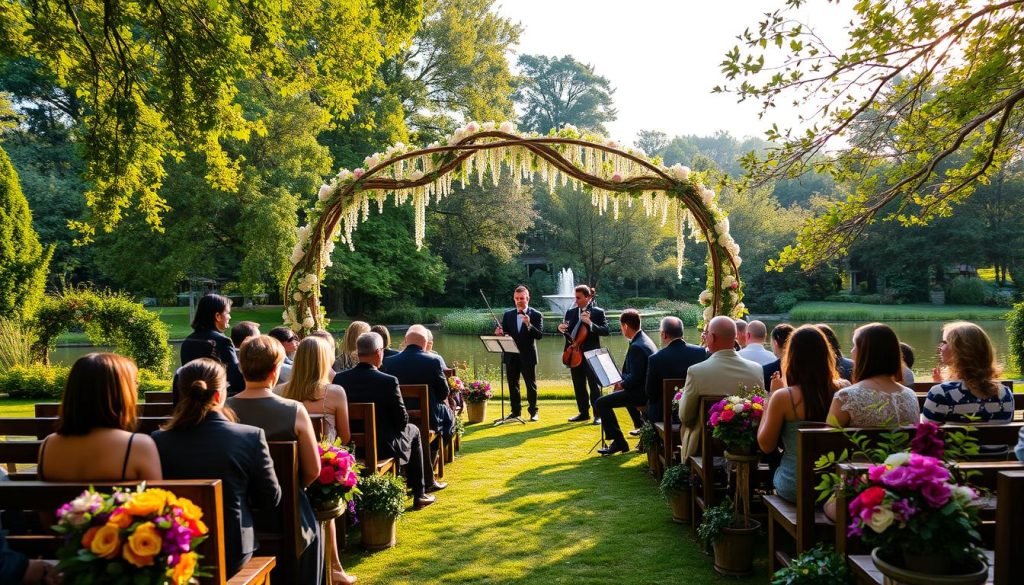
Holst (The Planets) offers epic passages. They suit an entrance or a dramatic transition. Choose a short excerpt so the ceremony does not feel weighed down.
Holst and Mussorgsky: epic and regal moods
Mussorgsky’s Promenade conveys a sense of grandeur in just a few bars. It is ideal when time is limited.
Gypsy jazz: effortless elegance
Minor Swing by Django Reinhardt and Stéphane Grappelli brings lightness and warmth. It creates a chic atmosphere, perfect for welcoming guests or the drinks reception.
Márquez’s Danzón No. 2: building toward the celebration
Danzón No. 2 begins calmly, then gathers energy. It is an excellent choice for the exit or the transition to the drinks reception.
- Consider string arrangements for the more adventurous pieces.
- Adapt the dynamics to the venue (church or secular ceremony).
- Talk with the musicians about tone colours and nuances (muting, pizzicato).
Practical tips for a smooth, moving ceremony
Adapting each piece to the venue and the couple’s walking pace makes the moment memorable.
Coordinate music and logistics: consider the length of the aisle and adjust the tempo so the entrance and exit follow the couple’s pace without interruption. Agree on clear transitions: a fade, a cadence or a measured stop, depending on the venue’s reverberation.
Churches and religious settings
In a church, have the parish approve your music choices well in advance. Prepare another sacred piece (Ave Maria or Bach’s Air) in case a modern song is declined.
Live musicians or a recording
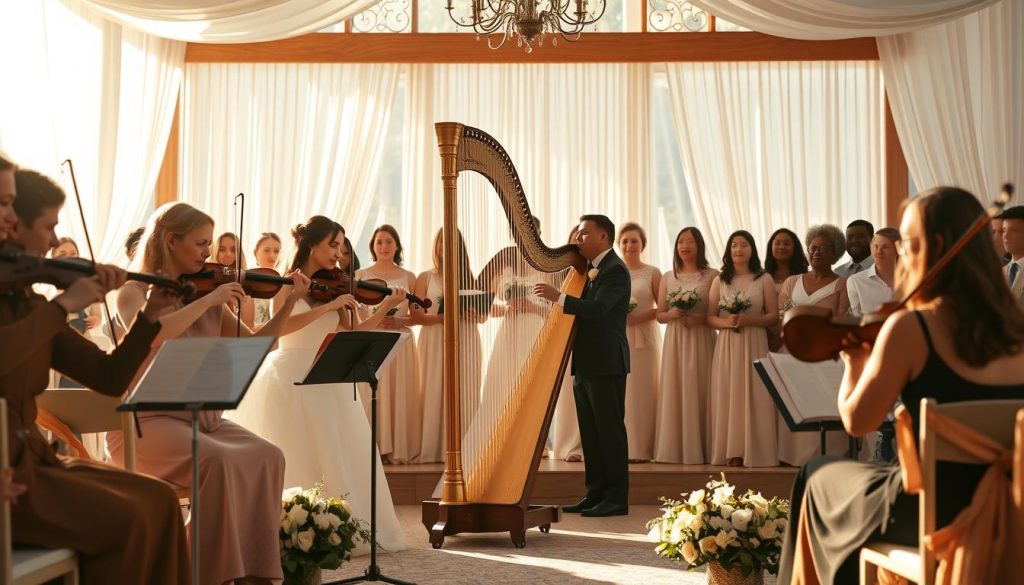
Hiring musicians makes the most of the venue’s acoustics. A technical rehearsal is essential: agree on entrances, cues and sound balance. If a performer is unavailable, a quality recording should be ready.
“A clear plan prevents hesitation and protects the emotion of the moment.”
| Option | Benefit | What to prepare |
|---|---|---|
| Live musicians (quartet/organist) | Rich acoustics, unique atmosphere | Rehearsal, space, electrical power |
| Recording | Reliability, manageable cost | File quality, amplification, synchronization |
| Combination (live musicians and recordings) | Full coverage, built-in backup | Technical coordination, sound balance |
Finally, create a clear playlist and a cue sheet specifying the order and duration of the pieces, along with cues for the bride, the exit and the guests. Keep it simple, run through it at a rehearsal and confirm it with the officiant.
To learn more about planning and musicians, see our dedicated page.
Conclusion
Thinking of music as a narrative thread helps guide guests’ emotions throughout the ceremony.
A simple method: identify each moment, decide on the mood you want, then refine your choice of pieces. Build a playlist that grows in intensity and provides clear cues.
The featured piece, whose tempo and instrumentation can vary, remains an inspiring centrepiece. Combining tradition and modernity reveals the couple’s personality.
Technical and personal coordination: rehearse at the venue, check sound levels and timings, and prepare a recording as a backup. This helps the celebration flow smoothly.
Ultimately, music becomes the wedding ceremony’s emotional signature and resonates long after the day itself.