Purpose of this guide: to offer a critical, systematic reading of Wikipedia pages about Johann Pachelbel and identify the sections to consult when checking facts.
Who was he? Born in 1653 and active until 1706, this composer and organist holds a central place in German Baroque music. He is known for his extensive catalogue: toccatas, fugues, chaconnes, 94 Magnificat fugues, and chamber music, including Musicalische Ergötzung.
His best-known piece, the Canon in D major for three violins and basso continuo, creates a halo effect that sometimes draws attention away from his other works.
Practical approach: cross-check authority records (BnF, GND, VIAF, ISNI), freely available scores (IMSLP), and discographies to verify attributions, dates, and editions. This guide then examines common biases, key biographical details, and useful databases.
Why Wikipedia Shapes Our View of Johann Pachelbel and Why Sources Matter
Pachelbel’s Canon is often the public’s introduction to his music. Algorithms highlight this piece, its form, and its variations at the expense of other works. This bias affects how we remember his career and the church posts he held.
The organization of the pages—biography, works, notes—guides the reader. We first encounter his posts (Vienna, Eisenach, Erfurt, Stuttgart, Gotha, Nuremberg), then his signature piece and its features: violins, violins and basso continuo, a bass line, and a 12/8 meter.
- Consult the references and external links to cross-check the date: around 1680 is the year commonly given for the Canon and Gigue.
- Open the scores on IMSLP to check the violins’ entries, their staggered timing, and the bass part.
- Compare language versions to spot inconsistencies or additional information about instruments, voices, and references to musicians.
“Readers often remember one piece or audio excerpt, but rarely the breadth of a catalogue.”
Practical tip: comparing the years of his career with sacred and secular repertories helps clarify what the works were written for and avoid historical shortcuts or modern interpretations that stray too far from their Baroque context.
Essential Biographical Facts About the Baroque Composer and Organist
Born and baptized in Nuremberg in 1653, Johann Pachelbel began his musical training with Heinrich Schwemmer. He continued his studies with Johann Kaspar Kerll, who introduced him to Italian influences.
Youth, Training, and Italian Influences in Vienna
In 1673, he became organist at St. Stephen’s Cathedral in Vienna. This period marked his absorption of a South German style blended with Italian features. These influences appear in his works for organ and ensemble.
A Career Between Church and Court
The following years took him to Eisenach (1677), then Erfurt (Predigerkirche, 1678). He later worked in Stuttgart (1690) and Gotha (1692), before returning to Nuremberg in 1695 to take a post at St. Sebaldus. These posts combined church duties with obligations at court.
Later Life, Teaching, and Family Legacy
As Johann Christoph’s teacher, he helped pass on the musician’s craft. He published Musicalische Sterbens-Gedancken (1683), Musicalische Ergötzung (1691), and Hexachordum Apollinis (1699).
“His career reveals a versatile musician, best known today for a chamber piece but trained first and foremost as an organist.”
His sons Wilhelm Hieronymus and Carl Theodorus became musicians. He died in Nuremberg in 1706, leaving a lasting mark on Baroque music.
Canon and Gigue in D Major: A Landmark Work for Three Violins and Basso Continuo
Dated to around 1680, Pachelbel’s Canon (PWC 37, T.337, PC 358) is a chamber work in two movements. The first is a strict canon for three violins supported by basso continuo.
The ostinato bass spans two measures and repeats 28 times. Canonic entries are layered over this foundation: each violin voice enters two measures after the previous one. The result develops twelve contrapuntal and rhythmic variations.
Harmonically, the progression I‑V | VI‑III | IV‑I | IV‑V provides the foundation. The simple melody combines quarter-note, eighth-note, and sixteenth-note figures to create a clear, memorable texture.
The second movement is a lively, dance-like gigue in 12/8. This contrasting form helps explain the work’s modern ceremonial use, especially at weddings.
“The clarity of the bass and the simplicity of the melody underpin the work’s enduring appeal.”
- Instrumentation: three violins and basso continuo (harpsichord, cello, or viol).
- Structure: a three-voice canon over a repeated bass, followed by a concluding gigue.
- Reception: increased popularity after Paillard’s recording (1969), with an influence on modern pop and rock.
Pachelbel’s Works Beyond the Canon: Organ, Chamber, and Vocal Music
The organist’s output extends far beyond the celebrated Canon. It includes a substantial body of organ music: toccatas, chorale preludes, fugues, and chaconnes. The bass line often plays a structural role, while the form remains clear and balanced.
The 94 Magnificat fugues are a contrapuntal landmark. They show his command of voices and fugal techniques in a liturgical setting.
Chamber Music and Harpsichord
Musicalische Ergötzung (1691) brings together pieces for two violins and bass. Hexachordum Apollinis (1699) is written for keyboard—organ or harpsichord—and illustrates how canonic principles can be applied to other forms.
Vocal Works and a Selective Discography
His vocal output includes about 20 cantatas and 30 motets. Melodic clarity and counterpoint remain central.
- Recommended recordings: Antoine Bouchard’s complete organ works and toccatas performed by Erik Feller.
- Keyboard: Simone Stella’s complete recording.
- Ensemble: London Baroque/Harmonia Mundi for Musicalische Ergötzung and the Canon.
“The three-voice texture and controlled variation span genres and instruments.”
Wikipedia and Johann Pachelbel: Sources Worth Knowing
A systematic approach makes information easier to verify. Begin with the biography and the list of works for an overview.
Then read the discography and notes. These sections often point to BnF, VIAF, ISNI, and GND authority records, as well as IMSLP or AllMusic. Those links help verify an organ piece or a chamber composition.
What Should You Look for in the “List of Works”?
Identify the catalogues and their different numbering systems (P, T, PC), along with the organization of each series. These references make it easier to locate a specific part and an estimated date.
- Check that the form and performing forces are described consistently (for example, a canon and gigue in two parts).
- Compare language versions and export their references for cross-checking in a library.
- Keep a critical eye on the dominant place of Pachelbel’s Canon and on questionable attributions.
“An online page is a starting point: always compare it with a recognized musicological resource.”
Identifying Work Catalogues: P, T, PC, and POP for Organ Music
Identifying a work begins with choosing the right index: P, T, and PC organize the list of works and their opening passages in different ways.
Perreault and Welter: PC Numbering, Work Lists, and Opening Passages
Perreault (P, 2001) and Welter (PC, 1998) assign numbers that vary with editions and discoveries.
Welter sometimes groups several pieces under one number when an opening passage is missing. Take care: this helps explain differences in references between editions.
Tsukamoto: The Online T Catalogue and Series by Key
The T catalogue (Tsukamoto, 2002) is useful because it can be consulted online and often organizes works into series by key.
This structure makes it easier to find a fugue or prelude in G major or G minor, or to search by Magnificat tone.
The POP Catalogue of Organ Works: Chorale Preludes and Other Pieces
The POP catalogue, adopted by Antoine Bouchard, covers organ music specifically: chorale preludes, Magnificat fugues, and other organ pieces.
It helps match a discography entry with a score reference, which is useful for listening and editorial work.
- Symbols: * = questionable attribution, ! = lost work. Include them in your citations.
- Practical examples: series of Magnificat fugues (primi to septimi toni) in F, G, C, A, and D, often in G minor or G major depending on the opening passage.
- Recommended method: start with the list of works in an entry, note its P, T, and PC numbers, then look for the corresponding POP reference for any organ piece.
“Catalogues evolve: cross-checking P, T, PC, and POP reduces attribution errors.”

Secondary Sources and Databases to Cross-Check with Wikipedia
A reliable approach begins by comparing information across sources. An online entry becomes more credible when encyclopedias and specialist catalogues confirm it. This helps prevent confusion about a piece’s date, form, or attribution.
Encyclopedias and Authority Records
Britannica and Universalis provide sourced overviews that help place a composer and his career in context. Authority databases (BnF, VIAF, ISNI, GND) help verify identity, name variants, and links between people and works.
Scores, Discography, and Metadata
IMSLP provides access to original scores and helps readers check the key, performing forces, and realization on harpsichord or continuo.
AllMusic and MusicBrainz document recordings, dates, and labels. Compare their entries with label discographies such as Harmonia Mundi’s to confirm editions and performances.
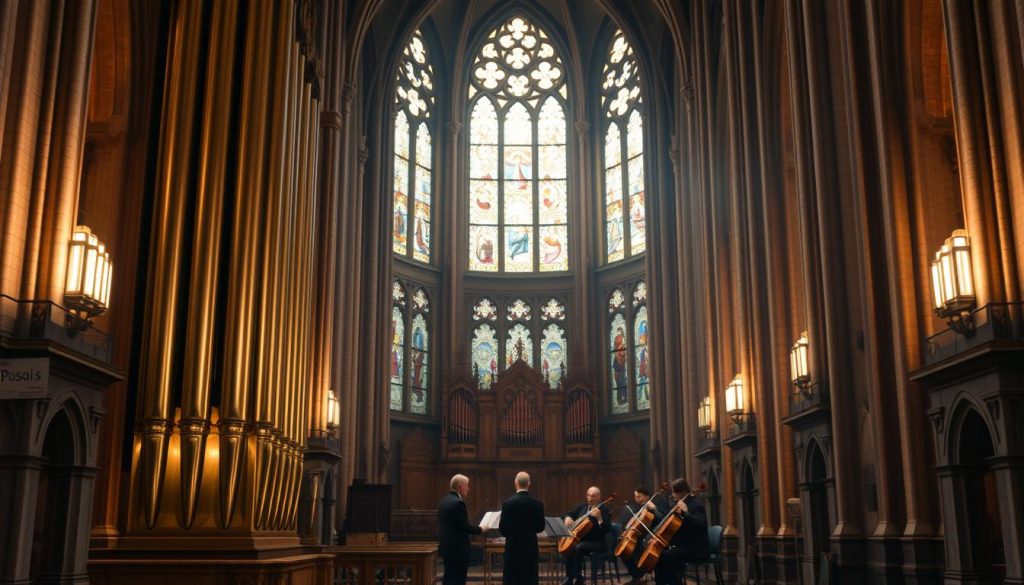
“Start with a page, export its references, then check every claim against at least one scholarly entry and one music database.”
| Type | Example | Use |
|---|---|---|
| Encyclopedia | Universalis, Britannica | Concise context and a verified bibliography |
| Authority record | BnF, VIAF, ISNI, GND | Identifying people and name variants |
| Score | IMSLP | Comparing opening passages, performing forces, and the structure of the list of works |
| Discography | AllMusic, MusicBrainz, Harmonia Mundi | Checking metadata, performers, and editions |
- Find P, T, PC, and POP numbers in these databases to match scores with recordings.
- Listen to several performances (chamber ensembles, organists, harpsichord) to gauge how they differ from modern arrangements.
- Recommended procedure: export the references, then verify each claim against at least one scholarly entry and one music database.
Reading a Page About Pachelbel’s Canon Critically
When reading an entry about Pachelbel’s Canon, first confirm the work’s actual form. It has two parts: a canon followed by a gigue. The gigue is in 12/8, and the canon rests on a two-measure ostinato bass repeated 28 times.
Checking the Form, Key, and Bass Line
Confirm that the original key is D major, and note any mention of G major or G minor: those keys often indicate arrangements or transpositions.
Cross-Checking the Performing Forces, Voices, and Variations
Check the performing forces: three violins and basso continuo. The canon is written for three voices that enter two measures apart. Count 12 variations and verify the harmonic progression I‑V | VI‑III | IV‑I | IV‑V.
Compare the page with a score (IMSLP) and recordings (AllMusic, Paillard’s 1969 discography). Look for descriptions of modern arrangements (viola pizzicato, Alberti-style arpeggios): these do not always appear in the source.
“Checking the text, score, and recording reduces confusion between the original work and its adaptations.”
- Confirm the structure (canon and gigue, 12/8, ostinato bass).
- Compare the stated keys with the score in D major.
- Check for three violins and basso continuo, as well as a three-voice canon.
- Check descriptions of the rhythms and contrapuntal techniques.
- Consult IMSLP, AllMusic, or the BnF if references are missing.
Conclusion
To conclude, remember that the Canon alone does not represent the Nuremberg composer’s entire output.
Reading an online page is a starting point: verify the date, performing forces, and bass line in recognized catalogues. Use P, T, PC, and POP to cite a work correctly.
Appreciate him as a seventeenth-century organist and musician by exploring his organ works, vocal works, and chamber music. Compare scores (IMSLP) with recordings (AllMusic, MusicBrainz).
To place a piece in its cultural context, consult the list of works. A critical method does justice to his artistic circle, his pupils, and his entire output.