Johann Pachelbel (1653–1706) was a Baroque organist and composer from Nuremberg. His place in South German music connects local traditions with Italian influences.
This guide offers a clear, accessible path through his work. In a few steps, it introduces the pieces worth discovering first.
The starting point is the famous Pachelbel’s Canon and its gigue in D major. This work reveals how a repeated ostinato can support a wealth of variations.
Readers will find a step-by-step introduction to the organ, harpsichord, chamber music, and suites. Simple listening tips will help them recognize formal and historical features.
Who was Johann Pachelbel? A quick introduction to the Baroque composer
Baptized in Nuremberg in 1653 and deceased there in 1706, Johann Pachelbel was a leading seventeenth-century organist in the German-speaking south. Having studied with Johann Kaspar Kerll, he absorbed Italian features that enriched his compositions for organ and harpsichord.
His career took him from Vienna (1673) to Eisenach (1677), then to Erfurt (1678), and finally, from 1695, to St. Sebald’s Church in Nuremberg. In Eisenach, he formed a lasting friendship with the Bach family, taught Johann Christoph, Johann Sebastian’s brother, and became a godfather in Johann Ambrosius Bach’s family.
In Erfurt, his contract required him to compose chorale preludes regularly and one substantial work each year, illustrating his standing as a sought-after musician. Letters offering and renewing appointments attest to his growing reputation.
His sons continued the tradition: Wilhelm Hieronymus and Carl Theodorus also became musicians, and the latter emigrated to America. To place this artistic movement in context, see the page on composers and musical periods, which situates his role in the South German organ school.
Major works by Johann Pachelbel: a quick guide
The Canon appeals through its clear harmonic language and graceful melody. Its repeating framework carries the listener along with seemingly effortless simplicity.
Instrumentation: three violins and basso continuo. This combination highlights the interweaving of contrapuntal lines over a steady foundation.
Structure and form
The Canon is written for three voices. Each enters two measures after the previous one, creating a gradual layering and an increasingly animated texture.
The ground bass drives the piece: its two-measure pattern is repeated 28 times. This repetition creates a sense of continuous flow and supports the entire composition.
Theme and variations
The four-measure theme unfolds through twelve variations. The figures move from quarter notes to sixteenth notes, with Baroque diminutions and ornamentation.
The harmonic progression I–V, vi–iii, IV–I, IV–V offers a listening key to the work’s distinctive sound.
The gigue, modern uses, and listening tips
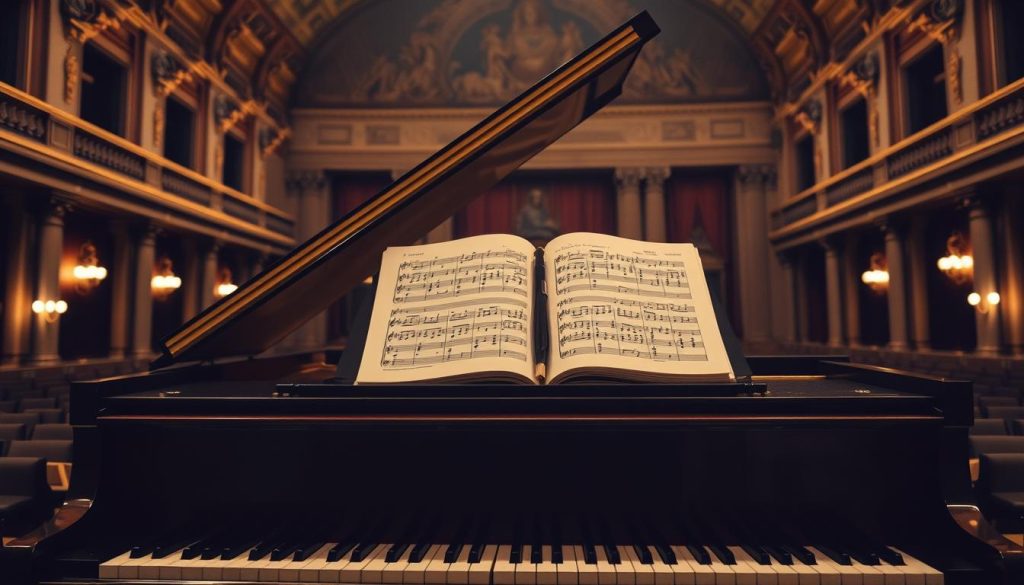
The livelier gigue in 12/8 completes the pairing of the Canon and Gigue in D major. It is heard less often, but gives the end of the work a different character.
Modern uses include chamber music, popular recordings (Paillard, 1969), and wedding processions. Listen to several performances at contrasting tempos to hear how tempo changes the drama.
| Element | Characteristic | Listening effect |
|---|---|---|
| Instrumentation | Three violins and basso continuo | Interwoven counterpoint and rhythmic foundation |
| Ostinato | Two-measure bass repeated 28 times | Continuous flow and formal framework |
| Form | Three-voice canon, twelve variations | Increasing intensity and ornamentation |
| Gigue | 12/8, dance-like character | Rhythmic contrast and a livelier ending |
To learn more, read about Pachelbel’s Canon.
Beyond the Canon: essential works for organ and harpsichord
For organ and harpsichord, Pachelbel created musical worlds that combine devotion and ingenuity.
Chorales: from ornamented preludes to chorale variations. “Christ lag in Todesbanden” juxtaposes an austere fugato, a pedal chorale, and a lively countermelody. The Musikalische Sterbensgedanken (1683) offer an intimate meditation shaped by personal hardship.
Fugues and ricercars: his output includes 94 Magnificat fugues and several free fugues. These miniatures show a surprising freedom and imagination, often with a playful touch.
Toccatas, preludes, and fantasias: short pieces of restrained virtuosity in a moderated stylus phantasticus. The Fantasia in G minor illustrates modulation, suspensions, and evocative chromaticism.
Chaconnes and variation arias: the Chaconne in F minor is a pinnacle of the keyboard repertoire. Hexachordum Apollinis (1699) and its Aria sexta, known as the Sebaldina, remain favorites on the harpsichord, combining decorative art with church tradition.
| Category | Examples | Why listen |
|---|---|---|
| Chorales | Christ lag in Todesbanden, Musikalische Sterbensgedanken | Liturgical structure and expressive depth |
| Fugues | 94 Magnificat fugues, free fugues | Contrapuntal invention and freedom of movement |
| Toccatas and fantasias | Fantasia in G minor, preludes | Dreamlike poetry and measured virtuosity |
| Chaconne and arias | Chaconne in F minor, Hexachordum Apollinis | Exploration of variations and decorative harpsichord writing |
Chamber music and suites: Pachelbel in the salon and the church
Between intimacy and liturgy, his music for small ensembles reveals a lighter, more inventive side. It connects music-making at home with sacred music while retaining contrapuntal clarity.
Musicalische Ergötzung and the art of the duet
Musicalische Ergötzung (1691) brings together six suites for two violins and basso continuo. Its use of scordatura, in the manner of Biber, adds distinctive colors.
The bass interacts with the two upper voices to create clear textures. Their melodic exchanges are easy to follow, making these pieces an ideal first encounter with Pachelbel beyond his organ music.
Harpsichord suites (1683): dance and a range of keys
The harpsichord suites published in 1683 cover about 17 keys. They often follow the sequence of allemande, courante, sarabande, and gigue, sometimes with an added aria or gavotte.
The closing gigue balances each cycle. Exploring this small catalogue of miniatures helps listeners become familiar with Baroque dance rhythms.
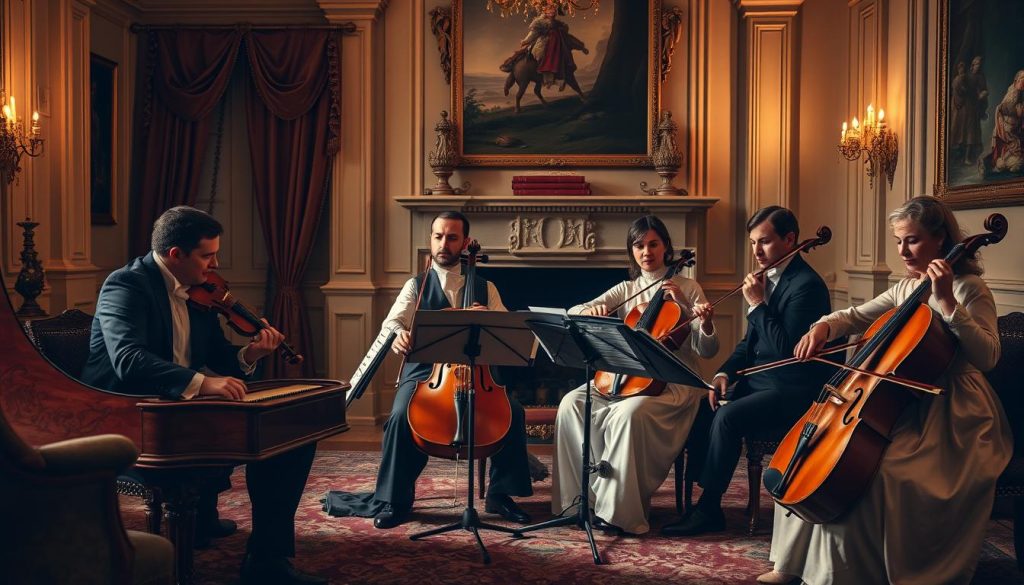
Listening tip: pair a harpsichord suite with a movement from the Ergötzung to appreciate the variety of instruments, lines, and variations within short works.
Influence, adaptations, and legacy: from Johann Sebastian Bach to popular culture
A simple bass line helped this music travel from churches to the popular music charts.
Influences: Pachelbel followed in the tradition of Kerll and the South German organ school. His style nourished a tradition that continued with Johann Sebastian Bach, strengthening the contrapuntal keyboard idiom.
Echoes in classical music
In classical music, there are related examples: Handel (HWV 310) uses a ground bass akin to the Canon’s. Haydn and Mozart use similar sequences, with harmonic differences in the final measures.
Adaptations and popular culture
The Jean-François Paillard orchestra’s 1969 recording brought the work to a modern audience. Since then, many groups have adapted its pattern: from the Beatles to Maroon 5, as well as Oasis, Green Day, and the celebrated “Canon Rock.” These adaptations show how flexible the Canon can be.
“The Canon’s strength lies in its economy: a clear bass line allows a thousand transformations.”
| Aspect | Example | Impact |
|---|---|---|
| Chain of influence | Kerll → South German school → Bach | Transmission of counterpoint |
| Classical music | Handel, Haydn, Mozart | Reuse of the ground bass |
| Pop and film | Maroon 5, Beatles, films (13 Going on 30) | Melodic and harmonic adaptations |
For comparison, listen to a Baroque performance followed by a pop adaptation: you will hear what remains of the Canon and what changes. To explore classical music further, see this selection of classical repertoire.
Conclusion
Johann Pachelbel emerges as an organist closely associated with St. Sebald’s. His career and letters attest to many years devoted to the church and keyboard music.
This guide began with the Canon and Gigue in D major, while recalling that his catalogue also includes toccatas, fugues, chorales, chaconnes, suites, and chamber music. These works reveal an aesthetic of clarity, grace, and contrapuntal discipline.
To continue exploring, listen to the Canon and Gigue, a chaconne in F minor, a few Magnificat fugues, and a harpsichord suite. His family and sons carried on this musical tradition; their lives help place each work in its historical context.