
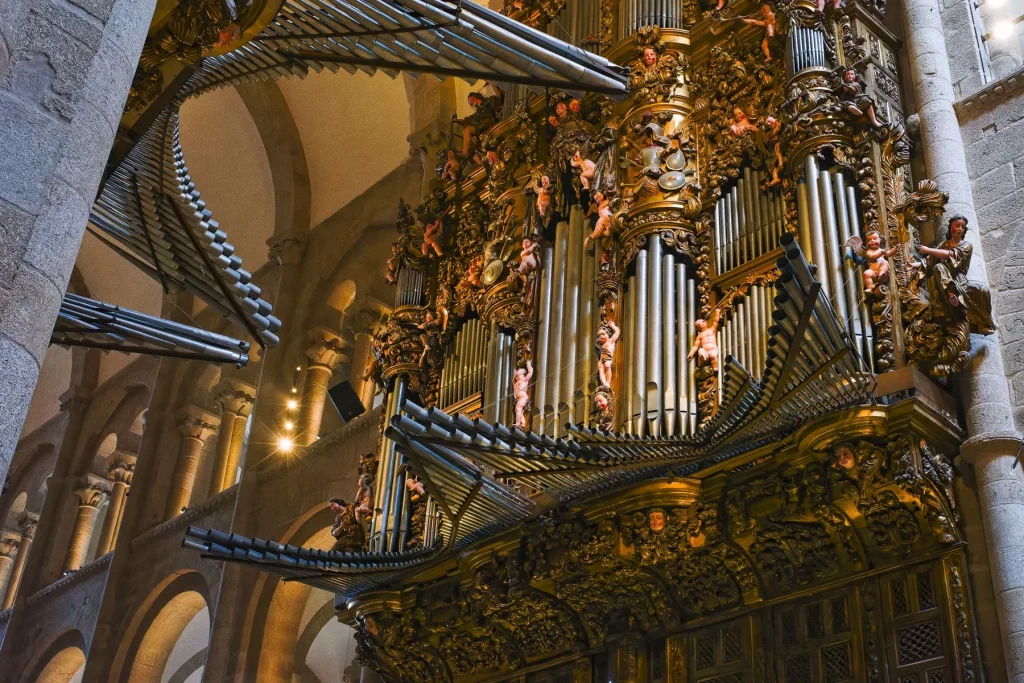
Johann Pachelbel wrote the Canon & Gigue in D major around 1680 for three violins and basso continuo.
This piece has become a symbol of Baroque music, often played at weddings and in films. On the organ, its polyphonic framework and repeating bass line gain clarity.
This article offers effective stop combinations, practical approaches to tempo, articulation and ornamentation, and recording recommendations to help you develop a polished interpretation.
Why it works on the organ: steady tone colours support the bass, distinct voices bring out Pachelbel’s canon, and a suitable acoustic makes the imitative entries easier to hear.
We place the composer in the South German tradition, whose organ building was well suited to this repertoire and influenced generations of musicians, including Bach.
Who this is for: organists and music lovers. Whether you play a French Romantic instrument or a German Baroque organ, you can adapt the stops and articulation.
By the end, you will have a practical roadmap and a step-by-step plan for choosing stops. We also point out common pitfalls: excessive mixtures, uneven tempos, indistinct voices and a pedal part that is too prominent.
Why this Canon captivates on the organ: a path to a successful interpretation
The organ version turns the layered voices into a clear soundscape. The basso continuo in D major creates a recurring pulse. This stable framework helps build a musical arc that any listener can follow.
The rigorous form of Pachelbel’s canon, with its staggered entries, becomes easier to follow when each voice has a distinct tone colour. The organ can separate the musical layers and reveal the polyphony without muddiness.
Part of the appeal also lies in the melody: simple and songlike, it becomes hypnotic through repetition. The harmonic progression stays fresh even after many repetitions. A flowing tempo and flexible phrasing preserve the underlying dance character, which resembles a chaconne.
| Aspect | Effect on the organ | Practical advice |
|---|---|---|
| Basso continuo | Stable foundation and recurring pulse | Choose a gentle pedal stop |
| Imitative entries | Clear layers and contrast | Give each voice its own tone colour and build gradually |
| Melody | Sustained notes and greater expressiveness | Favour singing stops with a stringlike character |
| Climax | Gradual rise | Add stops in stages until the sound reaches full brilliance |
Historical context and form: from Nuremberg to modern organs
Born in Nuremberg in 1653, Johann Pachelbel holds a central place in the musical history of the seventeenth century. A German organist and composer, he wrote the celebrated piece for three violins and basso continuo in D major around 1680.

The form is a three-voice canon in which each entry repeats the same melody after a delay. The repeating bass in D major provides the harmonic framework.
Transcribed for other instruments early on, the piece gained wider recognition in the twentieth century. Max Reger contributed a piano arrangement that has inspired many recordings.
Why the organ is a natural fit
- Continuity of sound: the instrument can sustain the basso continuo without interruption.
- Contrapuntal clarity: dividing the voices between two manuals makes their interplay audible.
- Harmonic planning: the recurring chord progression in D major guides the choice of stops.
Stylistically, Johann Pachelbel connects the Italian and German traditions of his century. Today, many recordings and transcriptions demonstrate the piece’s versatility within the history of classical music.
Organ stops: effective combinations for the Canon
For the organist, stop selection determines the clarity of the contrapuntal texture. A gradual approach respects the three-voice form and the recurring basso continuo while retaining something of the strings’ character.
Restrained German principal chorus
Begin on the main manual with Principal 8’/4’ and Octave. Save the Mixture for the climax. This combination keeps Pachelbel’s canon clear without overpowering the voices.
Contrasting colours
Assign Oboe 8’ or Quintadena to one imitative voice, Flute 8’/4’ to another, and gentle foundation stops to the third.
Separate the musical layers across two manuals to make the harmony and entries easier to follow.
Foundations and alternation
Give the basso continuo to the pedals: Bourdon 16’ and 8’, or Principal 16’ and 8’, depending on the instrument. Pay attention to legato and the start of each note.
Plan manual changes to highlight the answering phrases, without overusing couplers.
Atmosphere and development
On historical organs with meantone temperament, favour stops that bring out the character of D major.
In large modern spaces, hold back the reed stops at first. Build by adding 2’ stops, fifths and then the Mixture near the end for a balanced climax.
Interpretive choices: tempo, phrasing and ornamentation
A tempo that allows the music to breathe reveals the chaconne-like dance underlying the piece. Aim for a moderate forward motion, neither rushed nor heavy, so the music remains clear.
A flowing tempo without rushing
Keep a steady pulse. Allow very slight flexibility at harmonic transitions to add shape without interrupting the flow.
Articulate in short groups
Divide the form into groups that follow the bass line. Leave a brief breath at each new voice entry to bring out Pachelbel’s canon.
Restrained German-style ornaments
Ornament sparingly, using appoggiaturas and expressive slides at cadences. Let the imitated melody sing while keeping the bass regular.
| Element | Approach | Aim |
|---|---|---|
| Tempo | Moderate forward motion and a steady pulse | Reveal the dance and melody |
| Phrasing | Breaths at entries and articulation in short groups | Clarify the form |
| Ornamentation | Subtle appoggiaturas | Add grace without excess |
| Balance | A sustained, legato bass | Maintain the piece’s framework |
Working on these details produces interpretations that combine discipline and grace while remaining true to Johann Pachelbel’s style.
Pachelbel’s Canon on the organ: stops and interpretation
Bringing out the three-voice texture calls for clear choices. The piece is built on three successive entries. Each voice imitates the preceding one over a repeating bass in D major.

Layering the sound
Give each voice a distinct tone colour: for example, Oboe 8’ for the first, Flute 8’ for the second and gentle foundation stops for the third. Avoid excessive doubling so the form stays clear.
- Balance: adjust the attack so each entering voice comes slightly to the fore without covering the bass.
- Rhythmic stability: keep the pedal part steady; it holds the piece together.
- Economy of movement: choose two or three clear stages instead of constant changes.
Building tension
Plan a gradual change of stops. Introduce 2’ stops and a fifth before considering light mixtures near the end.
| Stage | Action | Aim |
|---|---|---|
| Opening | Foundation stops and two distinct tone colours | Contrapuntal clarity |
| Middle | Add fifths and 2’ stops | Bring the melody into focus |
| Ending | Light mixtures or stronger octaves | A climax without overload |
Serve the music of Johann Pachelbel by keeping its flow regular. The melody can then remain songlike and the harmony intelligible.
Beyond the organ solo: inspiring arrangements and ensembles
Mixed instrumentations bring fresh energy to Johann Pachelbel’s contrapuntal writing. They show how the same line can breathe differently with each combination of instruments.

Magnificat fugues and chaconnes: organ, cello consort and theorbo (Space Time Continuo)
Space Time Continuo (Analekta, 2022) presents Magnificat fugues and a chaconne in F minor shared among organ, theorbo and cello consort.
On this album, the instruments sometimes share the texture within a single fugue. Reviewers praise the beauty of the music and the care taken in its performance.
- These arrangements highlight the bass line and the flexibility of the voices. They offer a useful listening perspective when working on Pachelbel’s canon.
- The strings and violins offer models for legato and keyboard articulation.
- The theorbo suggests gentler attacks and elegant releases.
| Recording | Performers | Value for the organist |
|---|---|---|
| Space Time Continuo (Analekta, 2022) | Organ, theorbo and cello consort | Reveals the repeating bass and enriches the range of tone colours |
| London Baroque | Chamber ensemble, violins and continuo | Provides models of articulation and musical rhetoric |
| Solo and ensemble comparison | Solo organ and mixed ensemble | Helps with choices of tempo, dynamics and tone colour |
Listening tip: listen to an organ solo and then this album to refine your choices. Arrangements broaden your ideas while complementing solo practice.
Recommended recordings for organists and music lovers
To refine your interpretation, choose recordings that bring out clarity, balance and style. Complete collections offer a useful overview; solo albums reveal choices of stops and tempo.

Performances and complete collections
Olivier Vernet: organ anthologies with restrained stop choices and exemplary phrasing.
Joseph Kelemen (Oehms), Owens (Delphian) and the CPO project: complete collections worth comparing for their stylistic consistency.
Historical approaches and alternatives
Wolfgang Rübsam (Naxos) reveals the stylus fantasticus; his Hexachordum Apollinis on the lautenwerk sheds light on the composer’s musical rhetoric.
Gustav Leonhardt and Kei Koito favour historical organs and period tone colours.
| Artist / Album | Label | Value for the organist |
|---|---|---|
| Olivier Vernet (anthologies) | Various | Clear stop combinations and models of phrasing |
| Joseph Kelemen | Oehms | Complete collection and historical consistency |
| Wolfgang Rübsam | Naxos / website | Stylus fantasticus and lautenwerk |
| Jozef Sluys (Erfurt) | Ars Musici | The 1702 Stertzing organ and its ideal range of tone colours |
Round out your listening with John Butt, Albert Bolliger, Joseph Payne and ensembles such as London Baroque. These performances can enrich your technique and musical sensitivity.
Practical workshop: your performance roadmap
Practical preparation always begins with a close assessment of the instrument and the space. This lays the groundwork for studying the form, the repeated bass in D major and the distribution of the voices.
Choosing the organ and temperament: favour a clear acoustic
Assess the 8’ and 4’ foundation stops, the availability of a Quintadena or Oboe 8’, and the response of the 16’ and 8’ pedal stops. Test the building’s reverberation to check that the melody remains intelligible at a distance.
If the temperament is unequal or meantone, check that D major sounds pleasing. Avoid combinations that create distracting beats in the harmony.
A section-by-section stop plan: from foundation stops to mixtures
Choose a flowing but flexible tempo; adjust it in the nave so the imitative entries remain clear.
| Phase | Stops | Aim |
|---|---|---|
| Sections 1–2 | 8’/4’ foundation stops (Positive/Great) | Contrapuntal clarity |
| Sections 3–4 | Add a 2’ stop or a light fifth | Bring the melody into focus |
| Sections 5–6 | Contrasting colours (Oboe/Flute/Quintadena) | Contrast between musical layers |
| Ending | A light Mixture if the acoustic allows | A climax without overload |
Practical distribution: voice 1 on the Positive (Flute 8’/4’), voice 2 on the Great (Principal 8’/4’), and voice 3 as a discreet addition. Pedals: Bourdon or Principal 16’/8’ to support the bass.
Practise in short groups. Keep the pedal part even and connect the phrases carefully to preserve the harmony. Plan no more than two or three stop changes, timed to the cadences.
Record a trial performance in the church and listen from a distance to check the balance between voices. Adapt the plan to the instrument: favour gentle foundation stops on a Romantic organ, and principals and flutes on a historical one.
Complete a clear roadmap with a target tempo, stops for each section, breathing points and occasional ornaments. It will be a repeatable guide for performances and lessons.
Conclusion
The music becomes more transparent when each layer of sound receives careful attention. A successful organ performance depends on clear voices, a flowing tempo, a gradual build in the stops and preservation of the piece’s underlying dance.
Johann Pachelbel, a seventeenth-century composer, wrote music of striking clarity that has endured. Playing this classical music calls for grace without heaviness and a balance between the harmonic foundation and the singing voices.
Listen to several albums and performers to inform your choices. Make a plan, try it on your instrument, then share the result in a concert or church service so these pieces continue to live in everyday performance.