
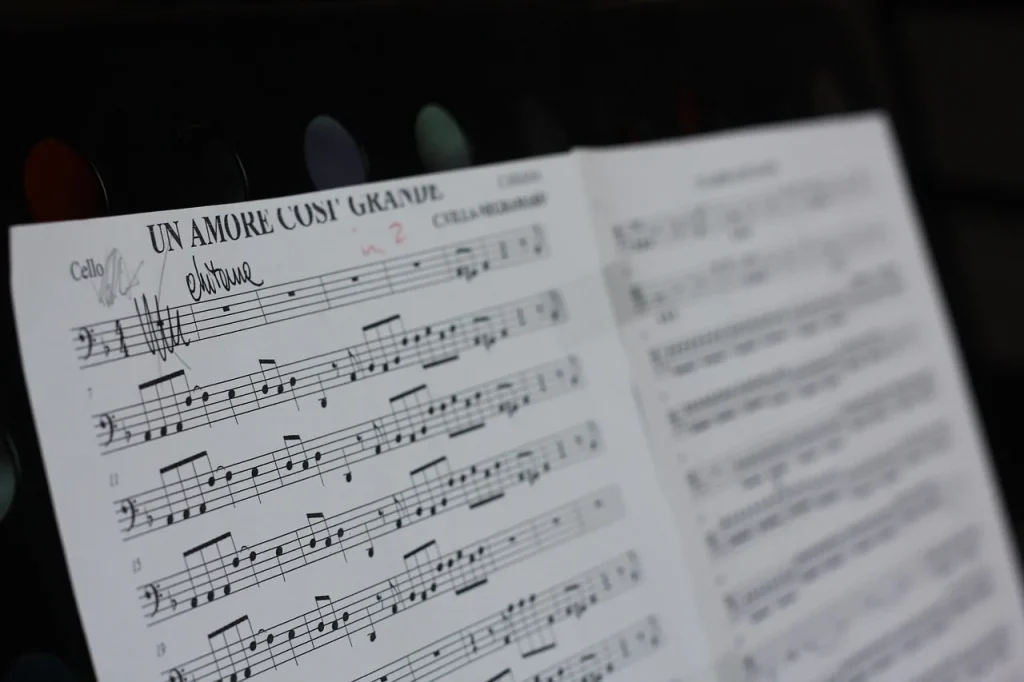
Canon in D major dates from around 1680. Originally, it was a three-part canon followed by a gigue, written for three violins and a continuo bass in four-beat time.
From a Baroque piece to a cultural favorite, this work has found a lasting place in classical music and beyond. Its repeating pattern over a ground bass creates a simple, enduring emotional effect.
The wider public rediscovered it in the late 1960s, notably through a 1969 recording by Jean-François Paillard’s orchestra. That recording sparked a wave of arrangements that brought Pachelbel’s Canon to audiences around the world.
Here, we trace its journey: Baroque origins, the composer’s life, musical structure, rediscovery, influences and cultural uses.
Our aim: to understand how a piece written for a specific ensemble won a broad audience and continues to inspire transcriptions, from piano arrangements to pop versions.
Why Pachelbel’s Canon still fascinates classical music lovers
The work’s power lies in a musical structure that feels familiar to the ear and stirs emotion. A simple harmonic progression and a ground bass create a repeating framework in which the melody can unfold.
Listeners often describe the effect as calming.
The steady bass and subtle melodic changes encourage reflective listening. Some studies and accounts report reduced stress during guided listening, although these findings should be treated with caution.
Its appeal is also evident in its uses: weddings, soundtracks, television series and online content. Since its twentieth-century rediscovery, Pachelbel’s Canon has become very popular on YouTube, Spotify and other platforms around the world.
- Bright, repeating harmony that appeals to both the ear and the emotions.
- A progression that has had a broad influence on arrangers and composers.
- Jazz, pop and classical reinterpretations that offer fresh ways to listen while retaining the spirit of the original.
“Depending on the performance, the piece creates a solemn or tender atmosphere.”
In short, Pachelbel’s Canon crosses stylistic boundaries and remains a reference point for more contemporary classical music, thanks to the clarity of its musical material.
History of Pachelbel’s Canon: Origins and Success
Composed around 1680, the piece belongs to a Baroque musical language built around basso continuo and counterpoint. It reflects seventeenth-century practices, when contrapuntal forms and stylized dances were prominent.
Johann Pachelbel (1653–1706) was a composer and organist who studied in Nuremberg and was also active in Vienna from 1673. His output includes organ works, chorales and occasional pieces.
Written for three violins and basso continuo, the work was originally a ceremonial piece: a canon followed by a gigue. It could be performed in liturgical settings or noble households.
After centuries of relative obscurity, the piece found a second life in the twentieth century. Within a few decades, Pachelbel’s Canon moved from churches and drawing rooms to weddings and modern media.
| Element | Original function | Modern use |
|---|---|---|
| Basso continuo | Harmonic foundation | A point of reference for listeners |
| Three violins | Contrapuntal dialogue | Arrangements and transcriptions |
| Canon & gigue | Ceremonial piece | Ceremonies and popular culture |
“A piece written centuries ago is now part of our shared musical memory.”
How is the Canon built? Structure, key and musical principles
The work has two parts: a three-part canon followed by a lively gigue in D major. The first movement favors reflective counterpoint; the gigue closes with a clear, rhythmic dance.
Canon and gigue in D major: two complementary movements
The canon creates a measured atmosphere. The gigue adds movement and contrast. Together, they balance contemplation and energy.

Three violins and basso continuo: the original instrumentation
The ensemble consists of three violins above a continuo bass. The bass line is played by cello or violone, with a chordal instrument such as a harpsichord or organ.
The ground bass and harmonic progression that carry the work
A recurring bass line repeats in four-beat time. This simple progression provides the rhythmic foundation and sense of tension that guide the listener.
The three-part canon: imitation, counterpoint and variation
The entries are staggered: each violin takes up the same theme at regular intervals. The contrapuntal texture grows from these overlapping lines and small melodic variations.
| Element | Role | Musical effect |
|---|---|---|
| Three violins | Successive imitations | Clear counterpoint |
| Basso continuo | Harmonic foundation | Rhythmic stability |
| Gigue | Dance-like conclusion | Rhythmic momentum |
Johann Pachelbel: the composer, his era and his other works
A portrait of a musician who shaped the organ tradition between Nuremberg and Vienna.
Johann Pachelbel was born in Nuremberg in 1653 and moved to Vienna in 1673. He became a respected organist and worked for the Church. He composed liturgical and teaching pieces throughout his career.
His work as an organist and composer led him to explore different forms and harmonies. He wrote chaconnes, toccatas, fugues and suites. His catalog includes Hexachordum Apollinis and many preludes.
In late seventeenth-century Germany, contrapuntal music flourished. Nuremberg and Vienna exchanged styles and practices. These exchanges fed Pachelbel’s inventiveness.
Beyond his most famous piece, his output includes Magnificat settings, organ works and chaconnes such as the Chaconne in F minor.
| Role | Type of work | Use |
|---|---|---|
| Church organist | Preludes, chorales | Liturgy and teaching |
| Composer | Chaconnes, toccatas | Concerts and keyboard repertoire |
| Teacher | Hexachordum Apollinis | Study and dissemination |
“His output shows great command of the keyboard and counterpoint.”
The roots of his influence: Pachelbel, the Bachs and his teaching legacy
A personal connection between Pachelbel and the Bach family helped musical practices spread through Germany. Their close ties supported the exchange of ideas and methods.

In 1677, Pachelbel became friends with Johann Ambrosius Bach in Eisenach. Among his pupils was Johann Christoph Bach, the older brother of the young Johann Sebastian Bach.
This teaching relationship exposed the future master to models of counterpoint and organ playing. Pachelbel’s teaching enriched local practice and trained pupils in essential forms: the chorale, fugue and variation.
- Circulation of manuscripts and copies.
- Learning keyboard forms and techniques.
- Oral transmission and family ties.
Ultimately, this stylistic lineage places the work within an influential tradition. Understanding those connections helps explain the importance of this legacy in music history and its modern reception.
From the seventeenth century to the 1960s: the rediscovery that changed everything
A recording from the late 1960s turned a composition nearly three centuries old into a popular phenomenon.
1969: Jean-François Paillard’s chamber orchestra released a carefully crafted version. Its clear melodic lines and appealing orchestral sound reached a broad audience.

1969: Jean-François Paillard’s recording and the surge in popularity
The 1969 release was a turning point. Nearly 300 years after its composition, the piece finally reached listeners beyond specialist circles.
Record production, radio programming and television broadcasts extended its reach. Listeners discovered a simple, moving structure that could be adapted to many repertoires.
From the 1970s to today: covers, transcriptions and worldwide reach
The 1970s brought a wave of arrangements and transcriptions. Versions for piano and guitar appeared alongside jazz and pop interpretations.
Pachelbel’s Canon found its way into films, programs and ceremonies. Its reach spread around the world, making the piece a very popular standard.
| Period | Key event | Result |
|---|---|---|
| 1969 | Paillard’s recording | Renewed media attention |
| 1970s | Covers and transcriptions | A growing range of styles |
| Since 1980 | Use in media | A widely recognized standard |
“A rediscovery that turned an old piece into a modern reference point.”
This rediscovery also shows the role of the cultural industries. Records and radio introduced a previously little-known work to new audiences.
Performances and arrangements: from piano and organ to guitar and jazz
This melody has lent itself to transformations ranging from intimate piano performances to full orchestral arrangements.

Ensembles such as Tafelmusik offer historically informed performances on period instruments. These versions highlight the clear counterpoint and Baroque timbres.
From harpsichord and piano to large ensembles
Max Reger produced a piano arrangement that helped popularize the piece in the early twentieth century.
Beginner methods use arrangements of the piece to teach ostinato and variation.
Guitar, jazz and popular reinventions
Jean-Claude Rapin recorded a notable guitar version in the 1960s.
Jacques Loussier and others transformed the musical material into jazz. Since the 1970s, pop, rock, dance and hip-hop arrangements have multiplied.
On screen: film and anime
In visual media, the piece often lends solemnity or emotion. It can be heard, for example, in Neon Genesis Evangelion, where it underscores intense moments.
| Type | Performer or use | Effect |
|---|---|---|
| Historical (Baroque) | Tafelmusik | Precision and authenticity |
| Piano | Max Reger / teaching | Accessibility and warmth |
| Guitar | Jean-Claude Rapin | Intimacy and clarity |
| Jazz / pop | Jacques Loussier / modern covers | Rhythmic renewal |
“The clear harmonic progression invites arrangers to explore while preserving the signature of Pachelbel’s Canon.”
Uses, symbolism and cultural reach
At many ceremonies, this melody brings a gentle, shared sense of solemnity.
Its place in wedding processions and ceremonies
The piece is often chosen as a wedding processional. Its steady tempo and stable harmony create a dignified, welcoming atmosphere.
Congregations and guests often experience a calming, lyrical effect. These qualities make the work suitable for moments of reflection and rites of passage.
Its use has grown since the 1970s. It has become very popular in places of worship and at civil ceremonies.
The practice crosses borders: the piece is heard around the world, reflecting its nearly universal appeal.
| Function | Musical strength | Programming suggestion |
|---|---|---|
| Processional entrance | Steady tempo, controlled tension | Allow 1 to 2 minutes for the entrance |
| Moment of reflection | Calming harmony | Pair it with a violin or piano solo |
| Finale or exit | Melodic clarity | Pair it with a livelier Baroque piece |
“The simple progression creates a lasting emotional memory.”
Listening and choosing a version: ways to get the most from the piece
How you listen shapes your experience of the work: choose a performance that suits the occasion.
Where can you hear it today? YouTube makes it easy to discover many versions. Spotify, Deezer and Apple Music offer extensive catalogs and themed playlists for weddings, relaxation or meditation.
Historically informed performances and modern reinventions
Compare historically informed performances (Tafelmusik, period ensembles, measured tempos) with contemporary reinventions (Brooklyn Duo, ensemble arrangements). Listen to versions for piano, organ and guitar to hear how each timbre changes the ostinato line.
Practical criteria for choosing
Consider recording quality, the balance between instruments, the consistency of the tempo and the violins’ phrasing. Alternate Baroque performances with modern reinterpretations to hear the differences.
| Platform | Strength | When to use it |
|---|---|---|
| YouTube | Quick discovery, videos | Explore several versions |
| Spotify / Deezer | Playlists, audio quality | Extended listening and comparison |
| Apple Music | Curated catalogs | Editorial selections and compilations |
Tip: search for “Pachelbel Canon” on these platforms to find selections and classical music compilations.
Conclusion
Conclusion
Written for three violins and a ground bass, this piece retains its immediate impact centuries later. Composed in the late seventeenth century, Pachelbel’s Canon owes its longevity to a clear structure and an emotionally compelling ostinato.
Johann Pachelbel, a composer and organist, created a work that is both simple and memorable. The instruments—violins, harpsichord or organ—produce the balanced sound that makes it so clear.
Since the 1960s, recordings and arrangements for piano and modern ensembles have carried the melody around the world. Roughly 300 years old, the piece remains a bridge between tradition and reinvention.
Listen to and compare different versions, then let the progression speak for itself: this article is an invitation to explore more works by the German composer.