Why this guide?
This selection helps English-speaking readers choose an interpretation for a particular occasion: discovery, relaxation, a ceremony or pop inspiration.
Quick background. The German composer Johann Pachelbel wrote the Canon and Gigue in D major around 1680.
The piece has become ubiquitous. You hear it at weddings, at home and even in stadiums.
What you’ll find here: a balanced selection of Baroque performances, neo-Baroque interpretations, ambient variations and pop-rock references.
The selection also explains how to recognize a well-recorded performance. It emphasizes the variety of arrangements and tempos.
For historical background and recording recommendations, see this Gramophone guide.
Why the Canon and Gigue in D major still fascinate us today
You recognize the melody immediately: its structure follows a logic that is both strict and irresistible.
The repeating bass line establishes a rhythmic and harmonic framework that supports the entire piece. This unchanging bass gives the basso continuo its weight and audible momentum.
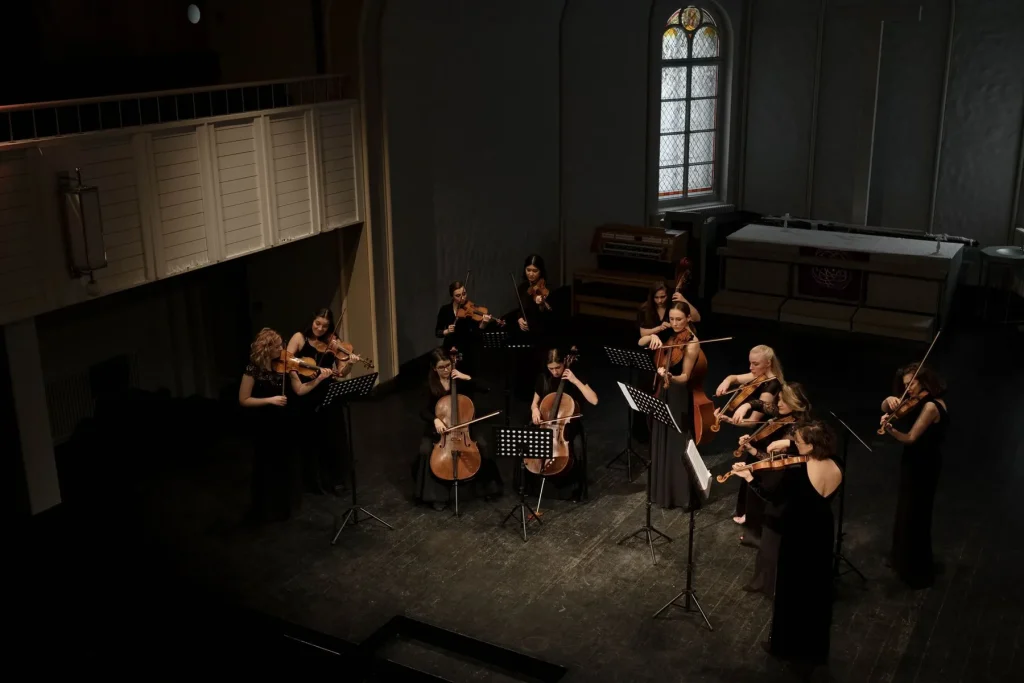
Over this framework, three violins enter in imitation, each taking up the theme two bars after the previous one. The technique creates an ever-growing flow and produces rich chords as the parts overlap.
In Baroque music, the basso continuo, played on harpsichord, organ or theorbo, guides the harmony. The composer Johann Pachelbel combines contrapuntal clarity with expressive melody.
The contrast between the solemnity of the Canon in D major and the liveliness of the Gigue in D major helps explain the piece’s lasting appeal.
“Canon” means “rule”: a discipline that gives expression room to flourish.
For more historical background, see this historical introduction.
The best versions of Pachelbel’s Canon
To guide your listening, here are five approaches that reveal different sides of this masterpiece’s sound.

An authentic Baroque performance
What to listen for: period instruments or their equivalents, restrained vibrato and a lively tempo.
A good recording reveals the singing quality of the violins and the piece’s contrapuntal clarity.
A version for a ceremony
For a wedding, choose a moderate tempo and silky strings.
The bass should carry the emotion without weighing down the texture.
A neo-Baroque approach on harpsichord
Clear articulation and precise dynamics: a modern version that recalls the spirit of an earlier age.
The harpsichord brings out the harmonic contours and the dance rhythms of the Canon and Gigue.
An ambient variation
Brian Eno stretches the tempos and layers washes of sound to turn the piece into a meditative landscape.
A pop reference and orchestral color
Procol Harum draws on the recurring pattern of the Canon and Gigue in Sunday Morning, amplifying the harmonic progression.
Pop arrangements use expansive strings, the repeating bass line and generous reverberation.
Listening points: intonation, balance between sections and the phrasing of cadences.
Each musician seeks the dance, the singing line or the gravity of the harmony in this Canon and Gigue in D major.
When pop takes up the Canon: its legacy, covers and songs it inspired
Beneath their modern sheen, several popular hits contain the structure of a Baroque melody. This connection shows that the piece retains its emotional power, whether we dance to it or cry to it.
Rain and Tears (Aphrodite’s Child)
Composed by Vangelis in 1968, this song follows the progression of Pachelbel’s Canon almost exactly. A neo-Baroque harpsichord quotes the theme in the introduction and establishes the mood from the first few seconds.
Go West (Village People → Pet Shop Boys)
The same harmonic framework becomes a disco beat. The choirs and brass turn the song into a unifying anthem, embraced by football crowds such as PSG’s supporters.
Memories (Maroon 5)
Over a spare vocal arrangement, the progression carries a contemporary elegy dedicated to a friend. Nostalgia becomes a universal refrain.
Listening tips: identify the chord sequence beneath the orchestral texture, then notice each musician’s choice of tempo and timbre.
“The harmonic DNA of an old canon can build a memorable song, whether intimate or communal.”
Conclusion
The strength of this composition lies in a simplicity that invites countless reinterpretations. Pachelbel’s Canon combines a dance-like Gigue in D major with a singing lyricism that still appeals today.
Its distinctive sound rests on three violins in imitation, supported by a basso continuo. This understated bass provides a common foundation for Baroque, ambient and pop interpretations.
Whether it is a radio song or a ceremonial version, the same progression creates contrasting emotions. Listen closely: identify the bass, follow the violins as they enter and enjoy the final cadence.
Tip: compare recordings and tempos to choose the interpretation that moves you most. Returning to the Baroque original before exploring modern arrangements reveals the work’s longevity.