
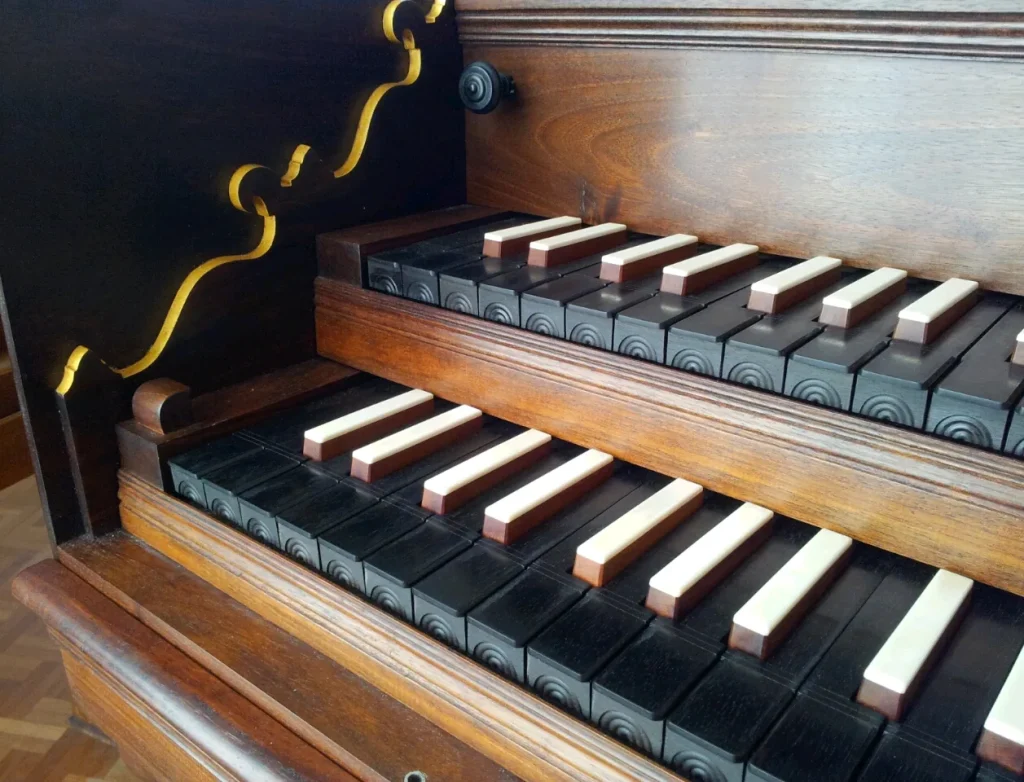
Introduction — This keyboard collection holds a major place in the South German Baroque tradition. Composed by Johann Pachelbel, it displays a restrained and learned style in which counterpoint illuminates the melodic line.
Published in Nuremberg in 1699 by Cornelis Nicolas Schurtz, the collection brings together six arias with variations. Key scheme: D minor (6), E minor (5), F major (6), G minor (6), A minor (6), F minor (8).
Instrumentation: organ or harpsichord, for domestic and devotional use. The dedications to Ferdinand Tobias Richter and Dietrich Buxtehude highlight an active network of teachers.
Practical references — Catalogue numbers P.193-198 and T.211-216. Seven freely available scores, authority identifiers (VIAF, GND, BNF) and a fragmentary autograph noted by RISM help with research.
To consult the list of works and access resources, see the dedicated page. This article covers the background and structure of the collection, offers a closer look at Aria sexta, and provides listening pointers and a discography.
Background, history and origins of Hexachordum Apollinis
Published in the late 1690s, this keyboard collection marks a culmination of the South German tradition. Johann Pachelbel combines contrapuntal skill with a sense of artistic restraint.
Place in history: the work bears Buxtehude’s influence while asserting a voice of its own. The dedication to Dietrich Buxtehude and Tobias Richter attests to a network of masters and a wish to pass on knowledge, particularly to the composer’s son Wilhelm Hieronymus.
Published in Nuremberg in 1699 by Cornelis Nicolas Schurtz, the collection was intended for two settings: church performance and music making at home. This versatility called for writing adaptable to either organ or harpsichord and encouraged its use in teaching.
- Edition: Nuremberg, 1699 — a useful reference for research.
- Character: restrained artistry, understated grace and variations designed for edification.
- Aim: to pass on contrapuntal craft within a network of masters.
For a detailed introduction and bibliographic references, consult the critical account.
Hexachordum Apollinis: Pachelbel’s Keyboard Collection
This cycle comprises six arias, each conceived as a self-contained piece useful for study. They follow a precise key scheme and form a coherent whole.
- P.193 — Aria and 6 variations in D minor.
- P.194 — Aria and 5 variations in E minor.
- P.195 — Aria and 6 variations in F major.
- P.196 — Aria and 6 variations in G minor.
- P.197 — Aria and 6 variations in A minor.
- P.198 — Aria sexta (Sebaldina) and 8 variations in F minor.
Key scheme and teaching approach
The first five pieces progress from D to A in a hexachordal pattern. The last turns to F minor, creating a rhetorical conclusion. This design serves both teaching and expression.

| Catalogue | Number of variations | Key |
|---|---|---|
| P.193 / T.211 | 6 | D minor |
| P.194 / T.212 | 5 | E minor |
| P.195 / T.213 | 6 | F major |
| P.196 / T.214 | 6 | G minor |
| P.197 / T.215 | 6 | A minor |
| P.198 / T.216 | 8 | F minor (Sebaldina) |
Aria sexta, known as Sebaldina, is the cycle’s expressive high point. Its theme carries a gentle melancholy; the eight variations deepen its nuances without resorting to virtuosity for its own sake.
For performers, clear phrasing, flexible articulation and a measured tempo bring out the counterpoint and ornamentation. The dedication to Tobias Richter helped the collection circulate beyond Nuremberg; to hear interpretations of it, consult a selection of recommended recordings.
Scores, recordings and listening pointers
Access to publicly available scores makes analysis easier and guides listeners toward illuminating recordings.
Scores and access
About seven score editions are available on IMSLP. Use the IMSLP page to download sources legally and compare editions.
Also consult the authority records: VIAF 179865326, GND 300460716 and BNF 13947306j. The RISM record notes a fragmentary autograph useful for critical readings.
Selected discography and instrumental colours
There is no separate publicly available part; the work is presented as a keyboard volume.
Organ, harpsichord, clavichord: the organ brings broad resonance; the harpsichord offers clarity and crisp articulation; the clavichord provides intimacy and subtle dynamics for the minor-key pieces and variations.
| Instrument | Sound contribution | Recent reference |
|---|---|---|
| Organ | Resonance, harmonic weight | Historical performances (selection) |
| Harpsichord | Contrapuntal clarity | Recordings on copies of historical instruments |
| Clavichord | Intimacy, nuance | Joris Potvlieghe (2017-2018), Blumlein recording |
A reference recording
The clavichord recording (2017-2018) favours the “less is more” philosophy. Recording chain: Neumann TLM170R microphones in a Blumlein configuration, a Presonus ADL600 valve preamplifier and Studer A80R analogue tape.
Listening tips: start with Aria sexta in F minor, then return to the aria in D minor to follow the hexachordal scheme.
Conclusion
This cycle brings together the educational and spiritual artistry of the South German Baroque in a compact journey through the keys.
Its design combines teaching, devotion and refinement. The progression from D to A, followed by the culmination in F minor, gives the music a meditative quality.
Aria sexta, known as Sebaldina, serves as a poetic epilogue and stylistic signature. It combines nuance with contrapuntal mastery.
To continue your study, consult the scores page and the VIAF, GND and BNF authority records, as well as the RISM entry.
Performers and music lovers will benefit from comparing the organ, harpsichord and clavichord to appreciate the work’s different colours and the transmission encouraged by its tribute to Buxtehude and Tobias Richter.