
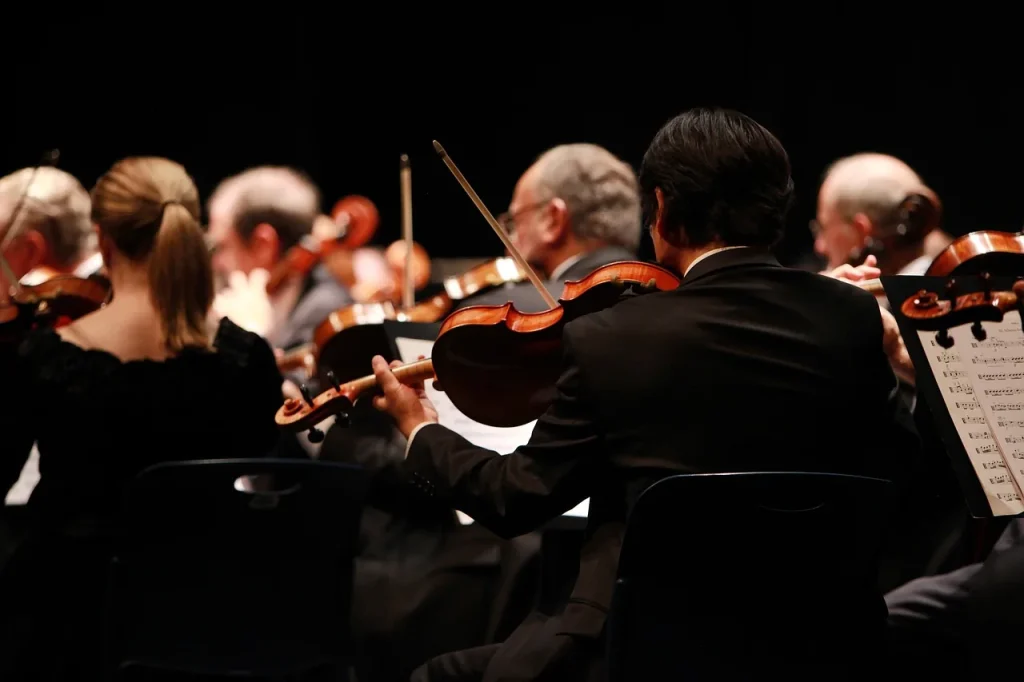
An iconic Baroque work, this canon was originally written for three violins and basso continuo.
Johann Pachelbel, a major composer and organist, wrote polyphonic chamber music in the seventeenth century. Its musical material rests on an ostinato that structures the counterpoint.
In 1968, a slower version by Jean‑François Paillard renewed public interest. This interpretation changed how the piece was perceived and broadened its use, from concerts to weddings.
Here we compare brisker, historically informed performances with the slower version that shaped perceptions in the late twentieth century. We examine the melodic lines, phrasing, articulation, and brief gigue that concludes the work.
For a musical overview and examples of adaptations, see the dedicated article on this page.
Origins, instrumentation, and the place of Pachelbel’s Canon in the Baroque repertoire
Clear counterpoint characterizes this piece and reflects its historical context.
Johann Pachelbel (1653‑1706) was an organist and composer who studied in Vienna. He taught and influenced German musicians. His work belongs to the Lutheran tradition and the disciplined German school of organ playing.
Original instrumentation and composition
The composition bears the inscription “Kanon & Gigue für 3 Violinen & B. C.” It combines three violins above a basso continuo. In practice, it requires at least five musicians: three violinists, a bowed bass player, and a player of a chordal instrument.
Structure and musical language
Its technique is a canon at the unison: each part enters at regular intervals, repeating the same line. The progression unfolds in two-bar units over an ostinato bass and is followed by a brief gigue, often omitted from popular versions.
| Element | Description | Effect |
|---|---|---|
| Instrumentation | Three violins + basso continuo (at least five musicians) | Balanced timbres and transparent polyphony |
| Technique | Canon at the unison, harmonic ostinato | An echo effect and imitative melody |
| Context | Late seventeenth century, when ostinatos were popular (for example, in Purcell’s music) | A notable place in the chamber repertoire |
For a detailed account and sources, see the dedicated article on this page.
Tempo and dynamics of Pachelbel’s Canon
The same chord sequence can feel like a dance or a meditation, depending on how it is played.

From a brisk Baroque tempo to slower readings: expressive choices
Historically informed ensembles favor a brisk pace that restores the gigue’s energy and the piece’s dancing momentum.
By contrast, the slower 1968 interpretation offered a more meditative reading and made the work familiar to a wider audience.
Dynamics, articulation, and counterpoint
A successful performance depends on clear entries, even sixteenth and thirty-second notes, and a well-defined imitative melody.
The ostinato bass should remain audible without making the texture heavy, while dissonances need careful handling.
Period instruments and examples of performance
On Baroque strings, crisp attacks and a clear tone bring the counterpoint into focus.
Voices of Music offers a natural balance: three Baroque violins supported by continuo, followed by a clearly phrased final gigue.
- What to listen for: transparent lines, an intelligible bass, and consistent dynamics.
- Acoustics: a reverberant hall encourages a slower pace; a dry room supports a livelier one.
Performances, adaptations, and modern echoes
This piece has found new life on the piano and in many string arrangements.
Transcriptions and instrumental challenges
At the piano, the three violin lines must be distributed between two hands. The pianist keeps the ostinato bass present without making the texture heavy.
Fingering requires precision in fast passages and care to preserve contrapuntal clarity. Teaching arrangements simplify some parts for learners.
From a chord sequence to pop culture
Since 1968, the harmonic sequence has provided a model for well-known songs. Rain and Tears (Aphrodite’s Child), Oh Lord, Why Lord (Pop Tops), and La maladie d’amour are telling examples.
Other songs, such as Go West and Basket Case, show how adaptable this progression is. The piece also became a fixture at weddings and in 1970s cinema.
| Version | Strengths | Challenges |
|---|---|---|
| Solo piano | Accessibility, wide circulation, teaching arrangements | Redistributing the parts and managing the bass |
| String quartet/ensemble | Lyrical richness, balance among parts, tonal color | Maintaining the ostinato and balancing the inner parts |
| String orchestra with continuo | Broad scope and dramatic power | Risk of heaviness; consistent dynamics required |
Listening tip: choose a version that brings out the clarity of the parts and uses flexible dynamics, according to your preferences. For study, choose a progressive teaching transcription.
Conclusion
Conclusion
The D-major composition sums up the art of Johann Pachelbel: clear counterpoint, a memorable melody, and an effective ostinato.
The original instrumentation — three violins with basso continuo — shapes the movement and balance of the lines. The slower twentieth-century readings and historically informed performances offer two complementary views of the work.
The final gigue and the harmonic sequence deserve renewed attention. The repertoire remains alive, from period-instrument concerts to piano transcriptions.
To refine your preferences, listen to established ensembles and compare their performances: each interpretation changes how the same sequence is heard. You can also find a piano selection at the most beautiful piano pieces.