
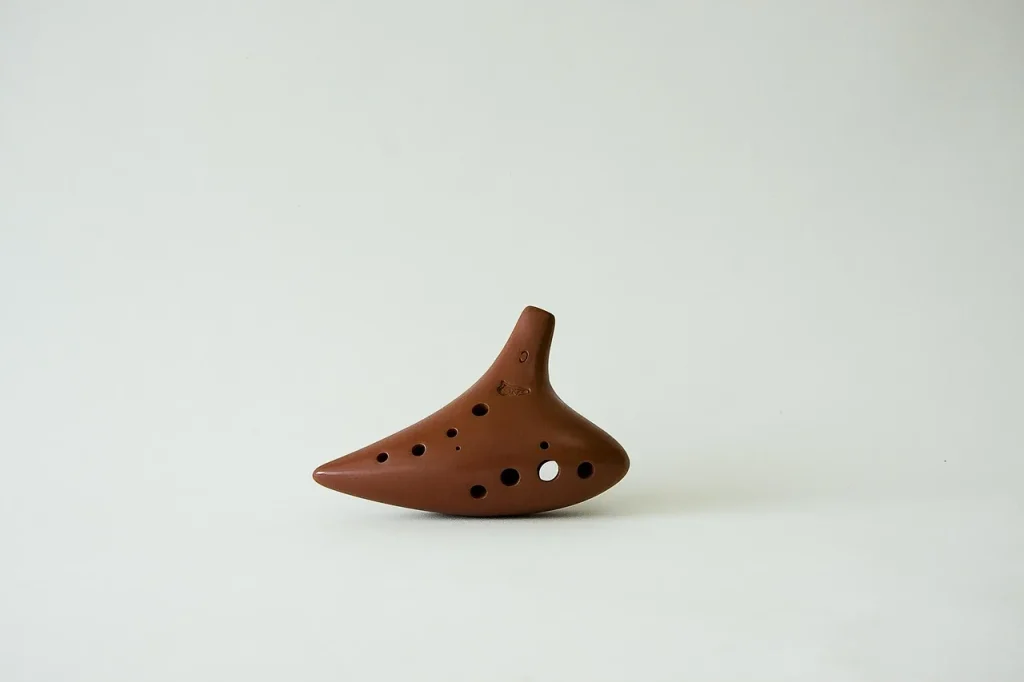
The 8-hole ocarina is a fascinating wind instrument that musicians of all levels can enjoy. Whether you are a beginner or an experienced player, it offers a unique experience in the world of music. Often overlooked, it has plenty of melodic possibilities.
In this article, we will explore how it works, learn to master the notes it produces and discover how to read suitable sheet music. We will also look at its place in contemporary and traditional music.
Discover how the ocarina can become your ideal musical companion. With an approach that combines simplified theory and practical exercises, you can quickly become familiar with the instrument. Get ready to play hundreds of melodies!
Introduction to the 8-hole ocarina: an accessible wind instrument
The 8-hole model is a wind instrument that is attracting more and more music enthusiasts. Its simplicity and accessibility make it a good choice for musicians of all levels. Let us explore its fascinating history, distinctive features and reasons it might become your new favourite instrument.
Origins and popularity of the ocarina
This instrument has roots in several ancient cultures. Giuseppe Donati popularised the ocarina in Italy in the 19th century. Since then, its reputation has spread across the world. Today, it often appears in video games and films, adding to its popularity.
Distinctive features of the 8-hole model
The 8-hole model has a distinctive design. It has 6 holes on top and 2 underneath, which are covered with the thumbs. This arrangement makes it possible to play up to 18 different notes. Although compact, the instrument requires players to memorise fingerings, making it more difficult to master than some other models, such as those with 10 or 12 holes.
Here are a few reasons the 8-hole model might be right for you:
- Compact size: Easy to carry, it can be worn as a pendant.
- Accessibility: Quality instruments are available from around €50.
- Versatility: Once you know the fingerings, you can play a variety of melodies.
- Learning: It is a good way to introduce beginners to basic musical concepts.
In short, this instrument combines tradition and modern appeal while offering a rewarding musical experience. If it interests you, read this article to learn more.
How the 8-hole ocarina works
Understanding how this instrument works helps you get the most out of it. The arrangement of its holes plays a key role in producing sound. Each hole has a specific function that affects the instrument’s pitch and range.
Arrangement and function of the holes
Eight-hole ocarinas have 6 holes on top and 2 underneath. The index, middle and ring fingers cover the upper holes, while the thumbs cover the lower ones. Covering or uncovering each hole changes the pitch. This makes it possible to play up to 18 different notes, including 11 natural notes and 7 chromatic notes.
Breath and mouthpiece technique
Breath is essential to producing sound. Air is blown through the mouthpiece, creating vibrations within the instrument’s body. To get a clear sound, place your lips properly around the mouthpiece. Good breath control helps you produce a steady tone from your first attempts.
Range and key
Range refers to the notes an instrument can produce, whether it is a bass, alto or soprano model. Key also matters: a model in C will produce different pitches from one in F or G, even with the same fingering. Understanding these concepts is useful before you begin learning melodies.
Understanding how the ocarina works can help you avoid common mistakes, especially with breath control. To learn more about reading sheet music, see this article.

Notes and scales you can play on an 8-hole ocarina
This fascinating instrument lets musicians explore a wide variety of notes. Eight-hole models can produce up to 11 natural notes and 7 chromatic notes, or 18 pitches altogether. That gives musicians of all levels plenty of melodic possibilities.
The natural scale and chromatic notes
The natural scale begins at low C and extends to high C. The notes in between are available as well. Chromatic notes, such as sharps and flats, add more depth to your playing. To produce them, you need specific fingering combinations.
Fingering system and finger positions
This instrument has a distinctive fingering system. Unlike transverse models, on which you lift your fingers one at a time, the 8-hole ocarina requires you to memorise fingering combinations. The system draws on the work of John Taylor, who developed a method for 6-hole ocarinas in the 1960s.
Practical examples of fingerings for common notes
Here are some examples of fingerings for common notes:
- C: Cover the first upper hole.
- D: Cover the first and second upper holes.
- E: Cover the first, second and third upper holes.
- F: Cover the first, second, third and fourth upper holes.
- G: Cover the first, second, third, fourth and fifth upper holes.
- A: Cover the first, second, third, fourth, fifth and sixth upper holes.
- B: Cover all the upper holes.
Practising these fingerings helps develop muscle memory, so you can play notes smoothly and accurately.
Understanding and reading sheet music and tablature for the 8-hole ocarina
Learning to read music for this instrument is an essential step for any player. Ocarina music comes in several formats, each with its own features. Here is an overview of the main types available.
The different types of sheet music
There are three main types of music documents for this instrument:
- Simple tablature: These visual diagrams clearly show which holes to cover.
- Standard sheet music: This notation requires knowledge of notes and their durations.
- Detailed tablature: This combines notes and fingerings to make learning easier.
Reading simple tablature: symbols and fingerings
Read tablature from top to bottom and left to right. Here are some key points to remember:
- Black holes should be covered, while white holes remain open.
- A horizontal dash indicates that the previous note should be held for two beats.
- Parentheses with a multiplier indicate how many times to repeat a note.
- Braces indicate a phrase mark: several notes are played in one breath.
Standard sheet music for the ocarina: key music theory concepts
To read standard sheet music, it is important to understand these elements:
- The staff and treble clef are fundamental to identifying notes.
- Note values have different durations: whole note (4 beats), half note (2 beats), quarter note (1 beat) and eighth note (1/2 beat).
- Rest values matter just as much: whole rest (4 beats), half rest (2 beats) and quarter rest (1 beat).
| Note value | Duration (in beats) |
|---|---|
| Whole note | 4 beats |
| Half note | 2 beats |
| Quarter note | 1 beat |
| Eighth note | 1/2 beat |
| Sixteenth note | 1/4 beat |
Detailed tablature: combining notes and fingerings
Detailed tablature is especially helpful for beginners. It shows how notes correspond to fingerings, making them easier to learn. It is an excellent way to connect music theory with playing the instrument.
Finally, the ocarina’s key must match the key for which the music was written. Tablature designed for a model in C cannot be played on a model in G without adjustments.
To learn more about reading sheet music, see this article.
How the 8-hole model compares with other ocarinas
Every ocarina model has its own characteristics. In musical range, the 8-hole model sits between 6-hole and 12-hole models. Let us compare them to understand its particular features.
Comparing 4-, 6-, 10- and 12-hole ocarinas
Ocarinas come in several models, each with its own advantages. Here is an overview of the number of notes each model can play:
| Model | Number of notes |
|---|---|
| 4 holes | 8 notes |
| 6 holes | 17 notes |
| 8 holes | 18 notes |
| 10 holes | 18 notes |
| 12 holes | 22 notes |
Four-hole models can play one octave, while 12-hole models have a wider range of about an octave and a half. The 6-hole ocarina developed by John Taylor offers a good compromise, but the 8-hole model is particularly versatile.
Advantages and limitations of the 8-hole model for playing and learning
The 8-hole model has several advantages. Its compact size makes it easy to carry, even as a pendant. Musicians also often appreciate its oval shape. With 18 notes available, it offers plenty of melodic variety.
It has limitations too. Beginners may find memorising its fingering combinations harder than learning to play other models. On a 12-hole ocarina, for example, fingers can be lifted in sequence, which simplifies learning.
Recommendations for different players
The right instrument depends on the player. If portability and a compact shape are your priorities, the 8-hole model is a good choice. If you are a beginner looking for a more intuitive approach, a 12-hole ocarina may suit you better. Its simpler fingering system makes learning easier.
Instrument quality matters too. Peruvian ocarinas can be attractive, but some are poorly made or out of tune. Choose a model known for reliable tuning.
Tips for getting started and improving on the 8-hole ocarina
To play this instrument well, you need to master a few basics. In particular, learn to play scales both ascending and descending. This will help you memorise fingerings and improve your playing.
Tips for mastering breath and mouthpiece technique
Breath control is essential for a steady sound. Here are some practical tips:
- Control your airflow: Blow steadily to produce an in-tune sound on each note.
- Breathing exercises: Practise exercises that develop your breath capacity, which helps when playing complete melodies.
Scales and finger coordination exercises
To improve your coordination, practise the C major scale regularly:
- Play the scale ascending and descending to memorise the fingerings.
- Start slowly to establish each position in your muscle memory.
These exercises form the basis of many pieces. Repeating them will improve your speed and accuracy.
A gradual approach to reading sheet music
Starting with simple tablature is effective. You can then move on to detailed tablature and, finally, standard sheet music. This progression will support your learning:
- Simple tablature clearly shows which holes to cover.
- Detailed tablature combines notes and fingerings to make learning easier.
To learn more about reading sheet music, see this article.
Regular practice matters too. Fifteen minutes a day is better than one long session a week. It will help you make steady progress and stay motivated. Be patient: this instrument’s fingering system can take longer to memorise than that of a 12-hole model.
Choosing and caring for your 8-hole ocarina
Several factors matter when choosing a wind instrument. Whether you are new to music or an experienced player, your choice can affect your playing experience. It helps to know which models and materials are available.
Material quality and available models
Ocarinas are generally made from two main materials: ceramic and plastic. Ceramic is often favoured for its rich, natural sound. Plastic is a less expensive and more durable option.
Here is an overview of each material’s advantages and disadvantages:
- Ceramic: Produces a richer sound but is fragile. Its estimated lifespan is about 15 years.
- Plastic: Stronger and lighter, but it may look like a toy. Its estimated lifespan is about 8 years, and it is easy to clean with soapy water.
Choose a model that fits your needs and budget. Expect to spend around €50 on a good beginner instrument.
What beginners should look for in an ocarina
To get off to a good start, choose a well-made instrument that plays in tune. Consider these factors:
- Accurate notes: make sure the instrument is properly tuned.
- Build quality: favour reputable makers.
- Reasonable price: a budget of around €50 is suitable for a good model.
General marketplaces such as Amazon.fr may carry unreliable models. Consider a specialist retailer such as Instruments du Monde instead.
Care tips to extend your instrument’s life
Good care helps your instrument last longer. Here are some practical tips:
- Daily cleaning: Wipe the mouthpiece with a soft cloth after each use.
- Avoid sudden temperature changes: Do not leave your instrument in places with extreme temperatures.
- Storage: Keep it in a dry place, away from moisture.
- Additional tip: Occasionally apply sweet almond oil to leather seals to help them last longer.
Finally, take care when choosing Peruvian models, which are sometimes poorly tuned, and favour instruments with reliable tuning. Also consider the instrument’s key (C, F or G) when buying, as it will affect which pieces you can play.

| Material | Lifespan | Advantages | Disadvantages |
|---|---|---|---|
| Ceramic | 15 years | Rich sound | Fragile |
| Plastic | 8 years | Durable, lightweight | May look like a toy |
| Wood | 10 years | Warm sound | Requires more care |
Conclusion
Although less well known, this wind instrument offers many musical possibilities. We have explored how it works, the scales it can play and ways to read its sheet music. Choose a model suited to your needs and experience, taking its number of holes and key into account.
Do not be discouraged if memorising the fingerings is difficult at first. With practice, you will be able to play a variety of melodies and enjoy performing familiar pieces. This compact, expressive instrument opens up a broad musical repertoire.
Explore the instrument’s history, its different models and more advanced playing techniques. Begin your musical journey and share your enthusiasm with other musicians around the world.