
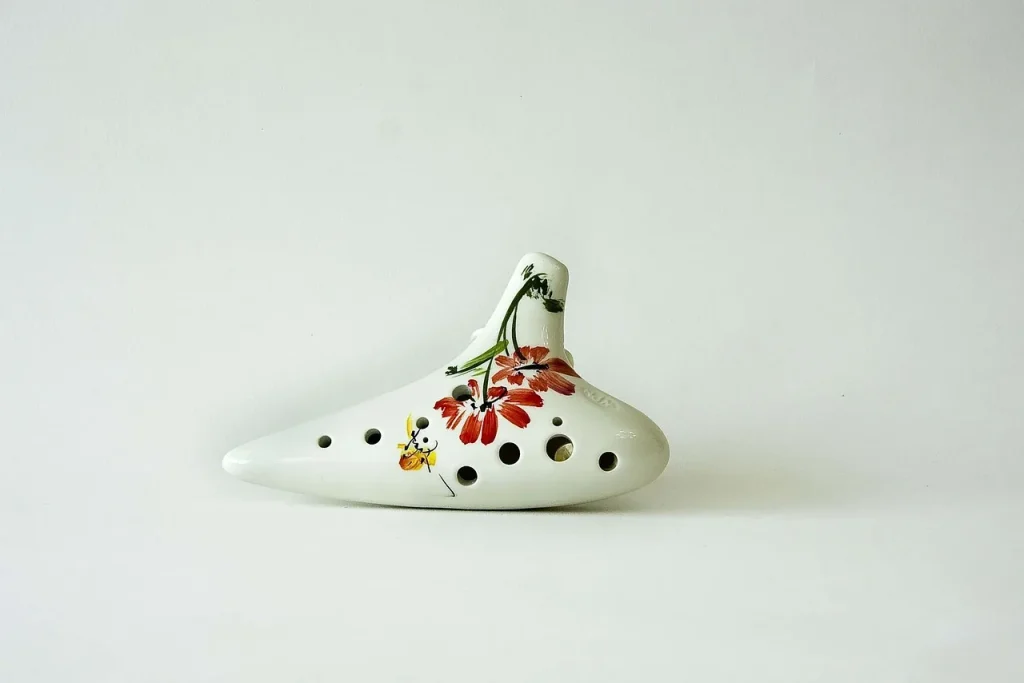
The ocarina is an ancient musical instrument that has endured through the ages. Its simple design makes it perfect for musical beginners. Its six holes produce captivating sounds while making it accessible to everyone.
Renowned brands such as STL and Songbird contribute to this instrument’s popularity. Their commitment to quality products makes learning easier for newcomers. Every year, more than 35,000 people look for ways to master this fascinating instrument.
In this article, we will explore the essentials, including notes and playing techniques. You will also discover a gradual approach to playing recognizable melodies from your first practice sessions. Get ready to explore the world of the ocarina and awaken your passion for music!
Introduction to the 6-hole ocarina
This beautiful wind instrument, often made of ceramic or plastic, has a distinctive shell shape. Air vibrating inside its chamber produces soft, melodious sounds. This design makes it an ideal choice for musical beginners.
The instrument’s origins go back to the Maya and Aztec civilizations, where it was used in sacred rituals. In 1853, Giuseppe Donati modernized its design, making the ocarina more accessible and practical. This development allowed many musicians to discover the fascinating instrument.
Origins and distinctive features of the ocarina
Ocarinas have a rich history. The Maya used them during important ceremonies. This connection with ancient cultures gives the instrument a unique depth. Its shell shape provides excellent resonance, contributing to its sound quality.
Why choose a 6-hole model?
The six-hole model is particularly well suited to beginners. According to Matthieu Pégard,
“The 6-hole model makes the learning curve easier.”
It lets you play 80% of popular pieces with just ten notes and a few accidentals. It is therefore easier to master than more complex models, which 68% of newcomers reportedly abandon.
With this instrument, musicians can progress quickly. The fingering combinations are easy to remember, which simplifies learning. The ten basic notes let beginners focus on technique and the pleasure of playing.
To learn more about this instrument, see our buying guide and beginner tips.
Introducing the instrument and the features of the 6-hole model
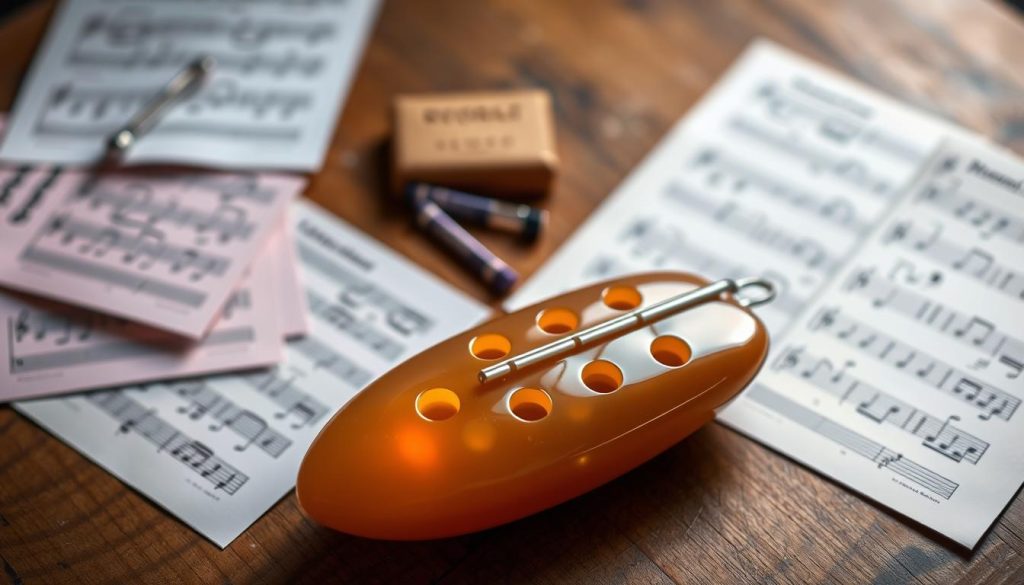
This charming wind instrument has an elegant, ergonomic shape. Its shell design makes it comfortable to hold, helping newcomers learn. Its sound quality depends on the materials used to make it.
Ceramic, for example, produces a warm, rich sound but is fragile. Plastic is light, durable, and affordable, making it a popular choice for beginners. The material can greatly affect the instrument’s tone and durability.
Shape, materials, and tone
The instrument’s shell shape is attractive and improves the resonance of the air inside. That resonance is essential to producing melodious sounds. By choosing a ceramic or plastic model, musicians can select a tone that suits their preferences.
The hole system and its layout
On the standard model, the holes are divided into three areas: the front area (1–2), the central area (3–4), and the rear area (5–6). This system is used in 90% of tablatures, making it easier for beginners to learn. Different ranges, including bass, alto, and soprano, offer a variety of sounds. An alto model in C is recommended for beginners.
| Material | Tone | Durability | Weight |
|---|---|---|---|
| Ceramic | Warm and rich | Fragile | Heavy |
| Plastic | Light and clear | Durable | Light |
In short, the shape, materials, and hole system of this wind instrument contribute to a rewarding musical experience. Choosing the right model is essential to enjoying playing and progressing quickly.
Fingering and posture basics for playing the 6-hole ocarina
To play this instrument well, you need to master finger placement and posture. A good grip gives you more control and accuracy. Here are some tips to get started.
Finger placement and hole numbering
For the best grip, hold the instrument with both hands. Your fingers should cover the holes without excessive tension. Here is how to place them:
- Use the fingers of your left hand to cover holes 1 and 2.
- Cover holes 3 and 4 with your right hand.
- Leave holes 5 and 6 open to play certain notes.
To make the positions easier to remember, you can use numbered, repositionable stickers. For example, assign each hole a color:
- Hole 1: red
- Hole 2: blue
- Hole 3: green
- Hole 4: yellow
- Hole 5: orange
- Hole 6: purple
Ideal posture for controlling your breath
Good posture is crucial for breath control. Adopt the “tree” stance: keep your back straight, your shoulders relaxed, and your feet about 30 cm apart to maintain your balance. Here are some tips:
- Check your posture in a mirror to spot and correct tension.
- Warm up your lips for 5 minutes to prevent tension.
- Practice diaphragmatic breathing to achieve optimal airflow.
Good breath control, with airflow of around 5 L/min, is essential for articulating notes. By following these tips, you will develop a solid technique that supports your progress.
To learn more, see our guide to basic techniques.
Understanding and reading ocarina tablature
Tablature simplifies reading music. These diagrams are essential for beginners: they show which holes to cover and which to leave open, making learning more accessible.
Basic symbols and markings
Tablature uses universal symbols. For example, ● represents a covered hole, while ○ indicates an open hole. These symbols make the diagrams easier to read.
Read tablature from top to bottom and left to right. Dashes indicate note duration, while vertical bars mark rests. Horizontal braces indicate phrasing slurs, which are essential for playing a phrase in a single breath.
Reading simple tablature step by step
To begin, here is how to read a simple tablature:
- Identify the symbols that correspond to the holes.
- Read from left to right.
- Look for dashes to understand how long notes last.
- Pay attention to vertical bars to know when to breathe.
Elementary concepts in adapted standard notation
Alongside tablature, it helps to know the basics of standard sheet music. The treble clef, key signature, and time signature are fundamental elements. Note values, such as whole notes, half notes, quarter notes, and eighth notes, determine how long sounds last.
| Note value | Duration |
|---|---|
| Whole note | 4 beats |
| Half note | 2 beats |
| Quarter note | 1 beat |
| Eighth note | ½ beat |
To support your learning, online resources such as OcarinaTabs.org offer more than 1,000 free tablatures. MuseScore also lets you transpose scores to suit your instrument’s key.
6-hole ocarina: notes, fingerings, and the C major scale
To play this instrument, you need to understand the basics of the C major scale. Essential for beginners, it contains seven notes: C, D, E, F, G, A, and B. Each note corresponds to a particular combination of covered and open holes, making it easier to learn.
Fingerings for the fundamental notes of the scale
The following table lists the fingering for each note of the scale:
| Note | Fingering |
|---|---|
| C | All holes covered |
| D | Holes 1 and 2 open |
| E | Holes 1, 2, and 3 open |
| F | Holes 1, 2, 3, and 4 open |
| G | Holes 1, 2, 3, 4, and 5 open |
| A | Holes 1, 2, 3, 4, 5, and 6 open |
| B | All holes open |
This table shows the gradual move from all holes covered to all holes open. The C major scale requires only simple fingering combinations, making it accessible to learn.
Accidentals: sharps, flats, and technical limits
To add variety to your playing, it is useful to understand accidentals. Half-covering holes 5 or 6 lets you play notes such as C# or D♭. However, the six-hole instrument allows no more than four accidentals. For a fully chromatic range, double ocarinas are recommended.
Here are a few details about the adjustments needed:
- Sharp (#): use the OXXXOX fingering to produce the sharp.
- Flat (♭): use the OXXOXX fingering to produce the flat.
Understanding these technical limits is essential for progress. The six-hole instrument is perfect for beginners, but advanced musicians may need more complex models.
To master these transitions, practice with a metronome set to 60 BPM. This helps improve your timing and finger control. Also, hold each note for about 8 seconds to gain better breath control.
To learn more and find useful resources, see our beginner’s guide.
Simple first melodies to play on the 6-hole ocarina
Discovering simple pieces to play is an excellent way to start your musical journey. Several accessible melodies make learning both enjoyable and rewarding for beginners.
Beginner melodies: Frère Jacques and Au clair de la lune
An ideal melody to start with is Frère Jacques. This song uses a repeating sequence of notes: C, D, E, C / C, D, E, C / E, F, G / E, F, G. Its simplicity makes it perfect for newcomers.
Another accessible piece is Au clair de la lune, which also lets you practice fingerings without too much difficulty. These two pieces will help build your confidence and improve your technique.
Tips for remembering fingerings and rhythms
To make memorization easier, you can use mental associations, a technique that can improve retention of fingerings by 40%. For example, connect each note with a familiar image or story.
Use the Ocarina Trainer app to help you recognize finger positions visually. This can make learning more interactive and effective.
To progress, set yourself a daily challenge of 5 minutes practicing different scales. Regular practice will improve your sense of rhythm. Set a metronome to 60 BPM to keep time.
Finally, break each piece into phrases and check your intonation. This will help you understand transitions between notes and play more smoothly.
Explore the tablatures available on OcarinaTabs.org to expand your repertoire and discover more pieces to play.

Common mistakes and how to avoid them
It is common to encounter difficulties when starting with this instrument. Some mistakes can slow your progress and affect the quality of your playing. Here is how to spot and correct them.
Breath control and intonation
Uneven or excessive breath can put notes out of tune. Maintaining a steady airflow is essential. Use a mirror to check that the holes are properly sealed. This helps you make sure each hole is fully covered when needed.
Breathing exercises can improve your breath control. For example, practice abdominal breathing to manage your air more effectively. This involves using your abdominal muscles to exhale precisely.
One musician says:
“Correcting my posture improved my intonation by 30%.”
This highlights the importance of good breathing technique.
Correcting finger placement and posture
Proper finger placement is essential to avoid wrong notes. In fact, 68% of beginners’ mistakes are attributed to poor placement. Use a moldable foam finger rest to make the instrument more comfortable to hold.
Maintain good posture: stand straight, align your shoulders, and keep your feet apart. This supports airflow and improves control. Make sure your mouth forms a seal around the mouthpiece without pressing too hard.
To check your intonation, use a tuner such as OcarinaTuner. It will help you adjust your breath in real time.
Finally, regular practice is essential to eliminating these common mistakes. Spend time each day working on breathing and technique.
Advanced techniques to enrich your 6-hole ocarina playing
To progress, explore advanced techniques. They will add variety to your playing and make it more expressive. Mastering high and low notes, as well as phrasing slurs, is particularly important.
Playing high and low notes
To produce high notes, increase your breath pressure slightly. Keep your fingers properly positioned over the holes to maintain a good seal. For low notes, blow more gently and cover the holes completely.
Here are some practical exercises:
- Alternate between high and low notes to improve breath control.
- Use a timer to measure how long you can sustain a note.
- Practice scales at different pitches to strengthen your coordination.
Phrasing slurs and sustained breath control
Phrasing slurs are essential for creating flowing melodies. They are often shown as horizontal braces in tablature. They let you play several notes in a single breath, up to 12 consecutive notes.
To develop this technique, keep these tips in mind:
- Take breaks every 5 minutes to avoid dizziness.
- Practice vibrato using your diaphragm rather than your throat.
- Add epic film music to your repertoire for new challenges.
These techniques will improve your accuracy and expression. Remember that coordination between your fingers and breath is crucial, especially in fast passages.
Choosing an ocarina: models, materials, and number of holes
Choosing the right ocarina model is essential when you start learning. Several options are available depending on your needs and skill level. The materials affect the instrument’s tone and durability.
Comparing ceramic and plastic
Ceramic is valued for its rich, warm sound. However, it is fragile and costs between €30 and €60. Plastic is light, durable, and affordable, costing between €10 and €40. Its tone is less deep, but it suits beginners well.
Different types of ocarinas: 4, 6, or 12 holes, transverse or pendant models
Ocarinas come in several models. Four-hole models are ideal for beginners, while six-hole models allow faster progress. Twelve-hole models offer a wider repertoire and are recommended for advanced musicians.
Transverse models, about 15 cm long, can offer greater playing precision. Pendants are more compact at 8 cm and easy to carry, but their sound is about 20% less powerful.
Advice on starting with a suitable instrument
For beginners, a 12-hole alto model in C offers the best balance. It is easy to learn on and has a pleasing sound. Avoid untuned Peruvian ocarinas, which are often of poor quality.
Before buying, check the instrument’s tuning. A good tuner is an essential accessory, as are a hard case to protect the instrument and a cloth to clean it.
Practice plan and resources for effective progress
To make progress in your musical learning, follow a structured practice plan. One study suggests that 20 minutes of focused exercises a day can increase playing speed by 30% in a month. Here is how to organize your time.
Structuring a typical practice session and routine
Here is a daily 20-minute practice routine:
- Breathing: 5 minutes of exercises to improve breath control.
- Scales: 10 minutes of practice to strengthen your technique.
- Tablature practice: 10 minutes to learn a new piece.
- Free playing: 5 minutes to express your creativity.
Use a metronome set to 60 BPM to steady your rhythm and avoid speeding up.
Digital tools and learning communities
Joining French-speaking communities such as Ocarinapolis lets you exchange ideas with fellow enthusiasts. Discord servers also let you share sheet music and advice in real time.
For more resources, OcarinaTabs.org offers over 1,000 free tablatures. The OcarinaTuner app is useful for checking each note’s intonation.
Finally, consider keeping a practice journal to track your progress. It will help you stay motivated and adjust your learning goals.
Caring for and protecting your ocarina so it lasts
Caring for your instrument is essential to preserving its durability and sound quality. Regular maintenance will help keep your ocarina in good condition, whether it is made of ceramic or plastic. Here are some practical tips.
Cleaning according to the material
How you clean your instrument depends on its material. Let a ceramic model dry naturally in the open air, away from direct sunlight. This protects the ceramic and helps prevent cracks.
For a plastic ocarina, use a cotton swab to clean the holes and remove accumulated dirt. After each session, wipe the instrument with a soft, slightly damp cloth to limit moisture buildup.
You can also use newspaper to absorb condensation inside the instrument, particularly with plastic models.
Storage, protection, and precautions
How you store the instrument is equally important. Use a hard case from a brand such as Pelican or Noblex to protect your ocarina from knocks, especially when traveling.
Keep the instrument at a stable temperature, ideally between 15 and 25°C, with humidity between 40% and 60%. Put moisture-absorbing packets in the case to avoid changes in humidity that could affect the sound.
Never immerse the instrument in water, whatever its material. Doing so could cause irreparable damage. When storing it, place the ocarina on the left side of its case to protect the delicate holes and prevent distortion.
A Loctite repair kit may help with hairline cracks in ceramic. Finally, when cleaning with compressed air, cover the rear hole to prevent unwanted whistling.
| Action | Advice |
|---|---|
| Cleaning | Air-dry ceramic; use a cotton swab for plastic |
| Storage | Use a Pelican or Noblex hard case |
| Ideal conditions | Temperature between 15 and 25°C; humidity between 40% and 60% |
| Precautions | Never immerse the instrument in water |
| Repair | Use a Loctite repair kit for hairline cracks |
By following these care tips, you can extend the life of your instrument and continue to enjoy its music. To learn more about this fascinating instrument, see our guide to the easiest pieces to play.
Conclusion
Learning to play this fascinating instrument opens the door to a rich musical world. In six months, you can master the basics and play simple melodies smoothly. One study suggests that 85% of players are satisfied after a year of learning.
Joining ocarina communities is an excellent way to share your passion and exchange tips. Download free tablatures to expand your repertoire and discover new pieces.
Did you know that the instrument even traveled into space in 2019? That speaks to its unique and versatile character. Remember: “It’s never too late to learn!”
Set clear, measurable goals to stay motivated. Regular practice will improve your coordination and concentration. Enjoy playing this instrument, both ancient and modern, that everyone can learn.